
사이트 로그인
사이트 로그인
|
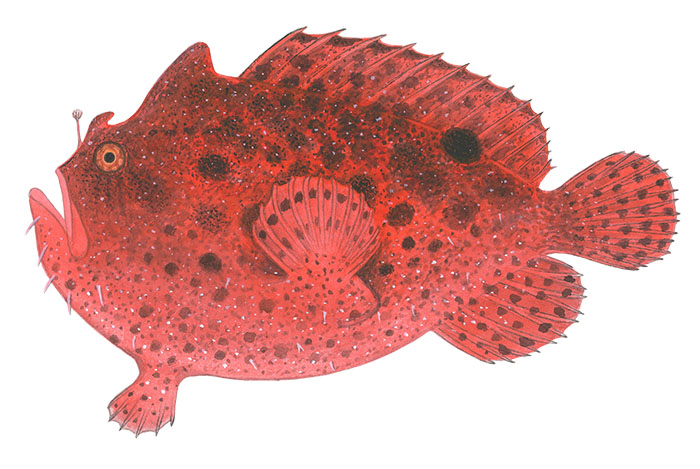
분류계통/분류계보/경골상강→조기강→아귀목→씬벵이과→스칼렛 프로그피시 Copyright by Kim In Young. 김인영 그림
|
|
| 스칼렛 프로그피시 기본 모습. Lateral view of Scarlet frogfish(Abantennarius coccineus) |
|
|
|
아귀목 씬벵이과 분포; 인도-동태평양/홍해, 동아프리카에서부터 동쪽으로 하와이를 제외하고 태평양 남쪽 가장자리인 칠레 중부의 데스벤투라다스 제도 까지 분포한다. 스칼렛 프로그피시는 다른 씬벵이류와 마찬가지로 포획 거리에 들어오는 작은 먹이는 무조건 삼키는 왕성한 육식성을 가졌다. 씬벵이류는 위협을 느끼면 여러 가지 반응 행동을 나타낸다. 공격을 당하지 않기 위해 몸의 모양과 색상을 환경 속에 위장시키고 전혀 움직이지 않는 방법을 쓰거나 베이트스 의태(擬態, Batesian mimicry)를 한다. 먹히기 쉬운 동물이 유독한(혹은 맛이 나쁜) 동물의 모습으로 꾸미어 포식자를 속이는 방법을 베이트스 의태라 한다. 스칼렛 프로그피시는 성게 모습이나 독이 강한 쏨뱅이 종류를 의태하고 바닥에 앉아 있을 수 있다. 포식자에게 공격을 당하면 흡입력이 강한 입으로 물을 빨아들여 순식간에 몸을 크게 부풀려 포식자가 삼키기 어렵게 할 수도 있다. 스칼렛 프로그피시를 포함해 씬벵이류는 그들만의 특이한 추진 방식이 있다. 입으로 빨아들인 물을 가슴지느러미 뒤에 있는 관처럼 생긴 아가미 구멍 밖으로 분사하여 추진력을 얻는 것이다. 물을 강하게 분사하여 몸을 전진시키면 먹이를 기습하는데도 도움이 된다. 낮 시간에도 사냥을 하지만 주로 야간에 활동하는 야행성이다. 외해 암초, 라군과 조수 웅덩이에서도 발견된다. 돌과 해면이 있는 바닥에서 숨어 산다. 발견되는 수심은 1-75m 이지만 대부분 10m 이내이다. 작은 물고기를 잡아먹는다. 난생이다. 알은 띠 모양이나 덩어리 모양의 한천 질 뗏목에 포장되어 부유해 다닌다. 다른 씬벵이들처럼 단독, 저서 생활을 하며 짝짓기하는 순간 외에는 서로 함께 있는 일이 없다. ※씬벵이류 이름에 색상을 붙이는 작명의 문제점(빨간씬벵이와 노랑씬벵이 이름에서 일어나는 문제점) 이런 소란은 애초에 이름을 잘못 정했기 때문에 일어난 것이다. 씬벵이들은 색상을 여러 가지로 변화시키기 때문에 특정 색상을 이름에 붙여서는 안 되는 것이었다. 씬벵이과 50 종(2023년 2월 현재)의 일반명(세계 공통 영명) 중에 색깔을 이름에 사용한 종은 스칼렛 프로그피시(Scarlet frogfish/Abantennarius coccineus) 단 1종 뿐인데 이 경우는 나름대로 이유가 있다. 한국명 “노랑씬벵이(학명; Histrio histrio)”의 일반 영명은 사르가숨피시(Sargassumfish)이며 Sargassum은 해조류 모자반 종류의 이름이다. 한국명 빨간씬벵이의 영명은 스트라이에이티드 프로그피시(Striated frogfish)이다. 글로벌 이름에서는 색샹이 포함되지 않은 것이다. 50종 중 색깔 이름을 가진 스칼렛 프로그피시(번역을 하면 빨간씬벵이)는 종의 학명이 Abantennarius coccineus인데 종소명 콕키네우스(coccineus)는 라틴어로 빨간색이란 뜻이다. 이 종의 학명에 색상이 사용된 데는 이유가 있어 보인다. 이 종도 색을 변경시킬 수 있다고 설명되어 있으나 인터넷 검색에서 사진들을 보면 다른 씬벵이들처럼 변경되는 색이 다양하지 않고 거의 대부분 적색 사진들만 나타난다. 이 지배적인 색 때문에 라틴어 학명에 coccineus 가 사용된 것으로 보인다. 따라서 근거 없이 색상 이름을 붙인 예는 한국명의 노랑씬벵이와 빨간씬벵이 2종 뿐이다. |
|
|
|
Order Lophiiformes(anglerfishes) Family Antennariidae(Frogfishes) Distribution; Indo-East-Pacific/Red Sea and East Africa to the easternmost islands of the Pacific Plate, excluding Hawaii, including the Desventuradas Islands off the coast of central Chile Having an illicium that is much smaller than the standard frogfish illicium length. Illicium about equal to the length of the 2nd dorsal spine. Esca a spherical whitish blob or it may be filamentous. Defining characteristics of Abantennarius coccineus include the last pelvic fin ray being split in two, The presence of dark patches that appear on its fins and body, and its lack of distinctive tail base, this is because the posterior dorsal and anal fins extend all the way to the beginning of the tail fin Frogfish express various behaviours when feeling threatened. To prevent attacks, they will either remain as still as possible, using their camouflage to hide or else they will use Batesian Mimicry. This is where a prey animal will mimic other dangerous species to prevent predators attacking. Abantennarius coccineus is known to do this by resting on the seafloor in the way a sea urchin would or else picking up similar behaviours to the poisonous scorpionfish. Once attacked by a predator they use their mouths powerful suction to swell their whole body with water, making it difficult for any predatorial animal to swallow it. A unique behaviour to the family Antennariidae is the unique form of locomotion they have . Many of the fish in this family, including Abantennarius coccineus, can take water in through the mouth and expel it through gill openings similar to tubes, located behind its pectoral fins. Using powerful exhalation, it can propel itself forward and often does so to help ambush its prey. Abantennarius is also mainly nocturnally active however still catches prey during the day time Collected from tide pools as well as lagoon and seaward reefs, secretive among rocks and sponges. Feeds on small fishes. Benthic. Oviparous. Eggs are bound in ribbon-like sheath or mass of gelatinous mucus called 'egg raft' or 'veil'. Found among reef crevices or among rubble in 1-75 m, but usually less than 10 m. Similar to all frogfishes, A. coccineus is a voracious carnivore which devours all small prey that enters within its reach. Like other members of the Antennariidae family, it has a solitary and benthic lifestyle, only tolerating each other for the simple act of fertilization. ※Problems of naming the frogfishes by using color names(Names of Red frogfish and Yellow frogfish in Korean species) This fuss was caused by the wrong name in the first place. Because they change colors in various ways, specific colors to their names should not be given. Of the 50 global common names of Family Antennariidae, only one species, the Scarlet frogfish(Abantennarius coccineus) is given color for its name. The first two species that were known early in Korea are Histrio histrio(Sargassumfish) and Antennarius striatus((Striated frogfish), translated into English as Yellow frogfish and Red frogfish respectively. The scientific specific name of Scarlet frogfish is coccineus, means red in Latin. There seems to be a reason for the use of color in the scientific name of this species. It has been described that this species can also change its color, but if you search photos of this species on the Internet, the colors of this species are not as diverse as other species, almost all specimens are red. Because of this dominant color, coccineus appears to be used in the Latin scientific name. Therefore, there are only two examples of using colors in the names of species without validity; the Yellow frogfish and Red frogfish in Korea. |
 스칼렛프로그피시 분포도. Distribution map of Scarlet frogfish(Abantennarius coccineus). Main reference/GBIF. Author/fishillust.com |
 스칼렛 프로그피시 묘사도. Illustration of Scarlet frogfish(Abantennarius coccineus). Author/left; Jordan, David Starr; Evermann, Barton Warren(1905). Author/right; FAO |
 스칼렛 프로그피시 죽은 개체 사진. Dead specimen of Scarlet frogfish(Abantennarius coccineus). Author/left; Jeffrey T. Williams(Smithsonian Institution). Author/right; Randall, J.E. |
 Left/스칼렛 프로그피시, 수중사진. Scarlet frogfish(Abantennarius coccineus) at depth. observed in Australia. Creator/sarah-sydneydives. Right/ 스칼렛 프로그피시, 신선한 상태의 죽은 개체. Scarlet frogfish(Abantennarius coccineus). Fresh dead specimen. Collected in South Africa, 24-27m. Creator/Richard Winterbottom. Rights holder/South African Institute for Aquatic Biodiversity. |
 Left/스칼렛 프로그피시 수중사진. 주변 환경에 묻혀있다. Scarlet frogfish(Abantennarius coccineus) blending into its surroundings. Location; Lembeh, Indonesia. Author/Rickard Zerpe. Right/스칼렛 프로그피시 수중사진. 주변 환경(돌)과 유사하게 위장하고 있다. Scarlet frogfish(Abantennarius coccineus) at depth. Blending into its surroundings. Author/Teresa Zubi. licenses/by-nc/4.0/ |
 Left/스칼렛 프로그피시. Scarlet frogfish(Abantennarius coccineus). observed in Israel. Publisher iNaturalist. Creator/Rafi Amar. licenses/by-nc/4.0/. Right/스칼렛 프로그피시. Scarlet frogfish(Abantennarius coccineus). observed in Philippines. Publisher iNaturalist. Creator/ Blogie Robillo. licenses/by-nc/4.0/ |
 Left/스칼렛 프로그피시, 신선한 상태의 죽은 개체. Scarlet frogfish(Abantennarius coccineus). Fresh dead specimen. collected in Chinese Taipei. Creator/Phillip Heemstra. Rights holder/South African Institute for Aquatic Biodiversity. Right/스칼렛 프로그피시 수족관 사진. Scarlet frogfish(Abantennarius coccineus) in aquarium. Author/Robert Wielgórski |
 스칼렛 프로그피시, 수중사진. 모래 바닥과 동일한 피부 색으로 위장한 상태. Scarlet frogfish(Abantennarius coccineus) at depth. A state camouflaged with the same skin color as the sandy bottom. Observed in United Arab Emirates. Creator/Fadi Yaghmour |
 스칼렛 프로그피시의 X-레이 사진. 위장 속에 잡아먹은 큰 물기기가 보인다. X-ray image of Abantennarius coccineus revealing a large prey in its stomach. Author/Sandra Raredon(Smithsonian Institution). |
|
|


|
| Copyright ⓒ FISHILLUST.COM All rights reserved. All contents can not be used without permission of the copyright holder. |


 검색
