Order Beloniformes Family Belonidae(Needlefishes)
Flat needlefish
Ablennes hians(Valenciennes, 1846). Max. length/140 cm TL, common length/70.0 cm SL. max. published weight: 4.8 kg
Korean name/mul-dong-gal-chi(물동갈치)
Japanese name/ハマダツ(Hamadatsu)
Chinese name/橫帶扁頜針魚
Taiwan name/扁鶴鱵
D/spines 0, soft ray 22-25. A/spines 0, soft ray 25~27. P1/13-15, P2/6. Predorsal S/340~430. Vertebrae/86 - 93. Gill rakers/0.
Distribution; Worldwide distribution in tropical and warm temperate waters. Eastern Atlantic/Cape Verde and Dakar to Moçamedes, Angola, Namibia. Western Atlantic/ Chesapeake Bay (USA), Bermuda, and northern Gulf of Mexico to Brazil. Throughout the Indian Ocean. Western Pacific: off coasts and islands from South Sea of Korea, southern Japan through the East Indies to Australia. Reported from Tuvalu. Eastern Pacific/Mexico to Peru. Entire Caribbean, Antilles and South American coast to Rio de Janeiro. A few specimens have been collected from Syria to Israel in the Mediterranean Sea, likely migrants from the Red Sea.
General; The Flat needlefish(Ablennes hians) is the only species in the genus Ablennes. Also known as the barred needlefish. The depth of body is low, body length is very long, and severely compressed laterally compared to other Needlefishes. No ridge on caudal peduncle. The eyes are large and the space between the eyes is flat. A pair of large oval nostrils in front of the eyes. Both jaws are long and pointed in shape of a crane’s beak. The length of both jaws is similar. Jaws are shorter in younger ones. A row of sharp fangs on both jaws. No teeth on the roof of the mouth(palate bone). The posterior bone of premaxillary is covered by the skeleton of anterior eye when mouth is closed, but is exposed when the mouth is open. In other words, the upper jaw has a structure that can protrude. The gill membranes are separated from the isthmus(the middle part of the chest and throat, the part between the left and right gill holes). No gill rakers.
The dorsal and anal fins start far back from the middle of body, and the long anterior rays of two fins rapidly shorten as they go backward, forming a sickle shape. The origin of dorsal fin starts above the 3rd and 4th soft rays of the anal fin, and the rear ends of the bases of the two fins end in symmetrical position. Juveniles and adults have an elevated black lobe in the posterior part of the dorsal fin. The pectoral fins are hook-shaped, located close to dorsal side of body and can’t be laid down completely to body side. Pelvic fins are located near the lower abdomen in the middle of body. The caudal fin is forked and asymmetrical, with the lower lobe slightly longer than the upper lobe. The body is covered with very small scales, and scales on the head appear only a little in front of the two eyes and a part of top of head. The lateral line is biased near the ventral outline of the body, and starts from lower gill cover and extends in a straight line to the caudal region. The lateral line does not diverge toward the pectoral fins. In females, only left gonad is developed, and in males the right gonad is small or absent.
In live state or fresh, dorsal side of body is greenish brown, and the center and belly are white. Eyes are yellow. The head, below the upper edge of the eye, is silvery white. Some descriptions say the color of the dorsal side is bluish or blue-green. The multiple color descriptions may be due to the fish's counter shading strategy. Darkening the back color to deceive predators in the sky and brightening the lower body to deceive predators below is called “Counter shading”. When looking at the ocean from above, the color of the water varies depending on the clarity of water, the environment of the bottom(sandy, reef, etc.), how deep or shallow the water is, and the fish that use counter shading match their back color to these water color.
12-14 dark transverse(vertical) bands on the body side, bands in anterior part are faint and gradually becomes distinct as it goes posterior direction. On the body, there is a pattern of 12-14 dark spots at roughly regular intervals, sometimes nearly round in shape and sometimes vertically elongated. The spots are often faint or absent in anterior body, with only a few dark black spots on posterior body. Among the 4 species distributed in Korea(Ablennes hians, Strongylura anastomella, Tylosurus melanotus, Tylosurus crocodilus), only Ablennes hians has dark bands pattern on its body. Sometimes there is a dark horizontal stripe across the center of the body, and sometimes there is no stripe at all. The illustration I've shown is the case with the dark stripe. The first half of the jaws has a pinkish tone. Dorsal fin with large, dark rear lobe. Caudal fin dark in ground color and with blackish margin. Pelvic fins white.
It swims along the coastal waters and also found in river estuaries. Found on the water surface or in the water column only. Sometimes in large groups. Young individuals around 5cm are found in summer in seagrass beds along marsh margins from the bay mouth to the river, moving out to deeper water when they mature. Carnivorous. Oviparous. Eggs may be found attached to objects in the water by filaments on the egg's surface. Migrate within oceans between spawning to find different feeding areas. It feeds on small fish and crustaceans such as shrimp. It is mainly caught by angling or with the help of artificial lights. It is also by-caught in low-level trawling. Marketed fresh and salted; smoked or frozen. Its value as a food differs from region to region. In some regions, they are reluctant to eat because the flesh is green, and in others, it is a popular food.
|

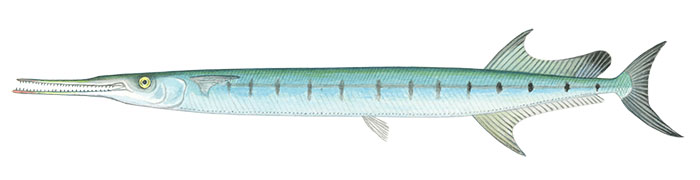
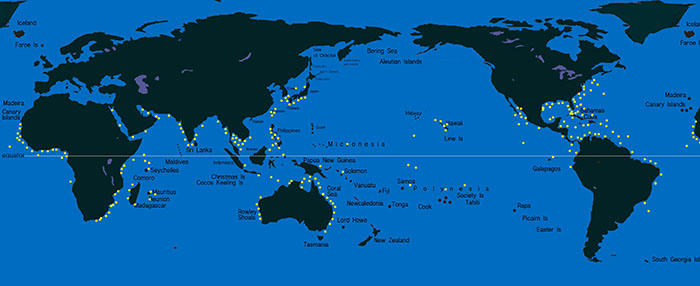 물동갈치 분포도. Distribution map of Flat needlefish(Ablennes hians). Main Ref. GBIF, as of May 2023. Edited by fishillust.com
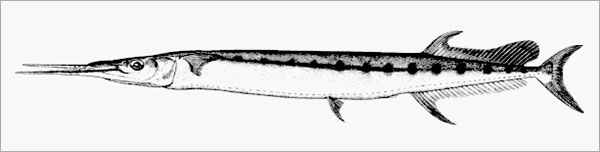 물동갈치 묘사도. Illustration of Flat needlefish(Ablennes hians). Author/FAO
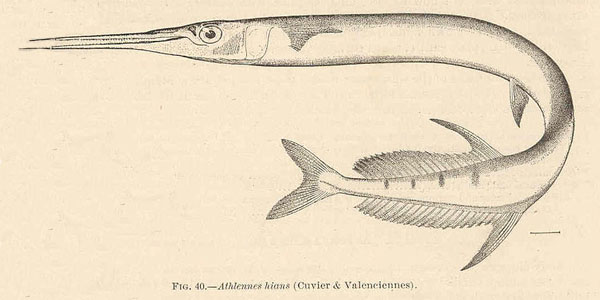 물동갈치 묘사도. Illustration of Flat needlefish(Ablennes hians). Date/1905. Author/David Starr Jordan(1851–1931) Source/Collection of University of Washington.
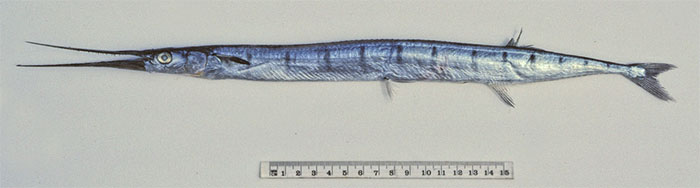
 물동갈치 죽은 개체 샘플. Preserved specimen of Flat needlefish(Ablennes hians). Author/Ross Robertson. Source/www.discoverlife.org. For educational use only.
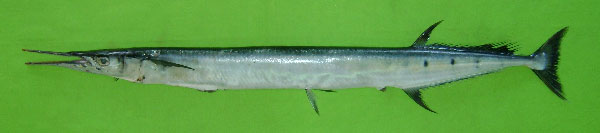 물동갈치 죽은 개체 샘플. Preserved specimen of Flat needlefish(Ablennes hians). Author/Hamid Badar Osmany. This file is licensed under the Creative Commons Attribution-Share Alike 3.0 Unported license.
 물동갈치 죽은 개체 샘플. Preserved specimen of Flat needlefish(Ablennes hians). Location/St Johns County, FL, USA. Author/ed_flagler. (CC BY-NC)
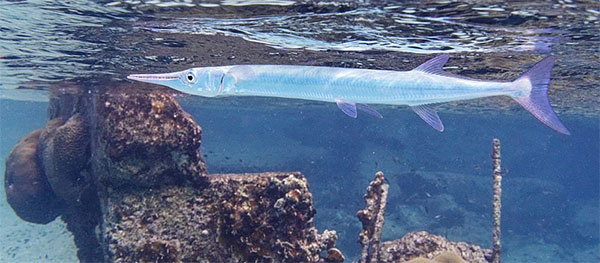
 물동갈치. 수면 위에서 촬영됨. filmed above water. Flat needlefish(Ablennes hians). Country/Maldives. Author/Susan. (CC-BY). Source/fishbase.org
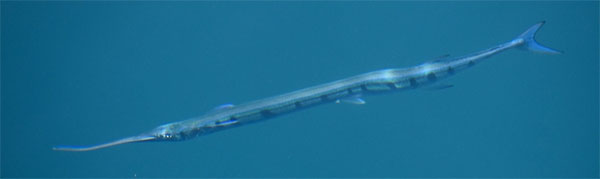
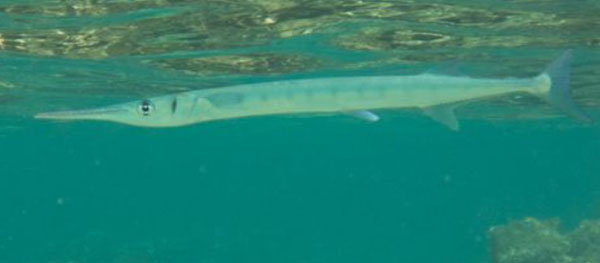 물동갈치 수중사진. Underwater photo of Flat needlefish(Ablennes hians). observed in Bonaire. Author/Youp van den Heuvel. Source/gbif.org. (licenses/by CC/4.0/)
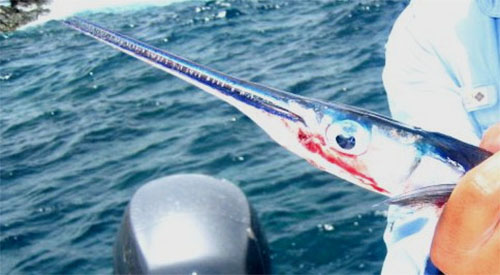 물동갈치의 이빨을 보여주는 사진. Photo showing teeth of Flat needlefish(Ablennes hians). Author/Clinton & Charles Robertson. Source/Flickr. (CC BY-NC)
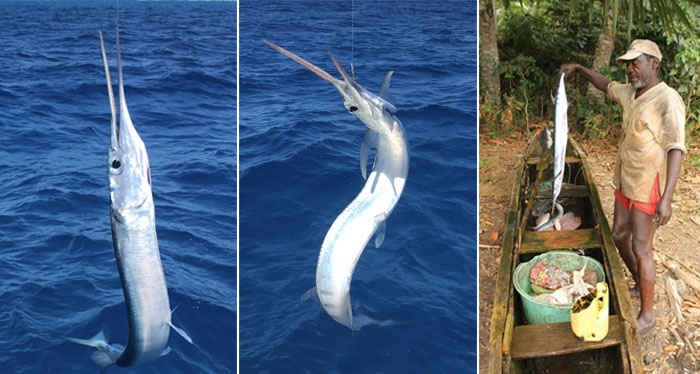 Left and center/낚시에 걸려 올라오고 있는 물동갈치. Flat needlefish(Ablennes hians) coming up after being caught by line fishing. Author. Author/Liz Childress. Location/Straits of Florida, FL, US. Source/ iNaturalist. (CC BY-NC). Right/카누로 물고기를 잡는 아프리카 어부가 물동갈치를 들어 보여주고 있다. An African canoe fisherman shows off his catch of Flat needlefish. Location/Isla de Príncipe, Equatorial Guinea(적도 기니의 쌍투메 프린시페). Author/Fundación Tierra Ibérica. Source/inaturalist.org (CC BY-NC)
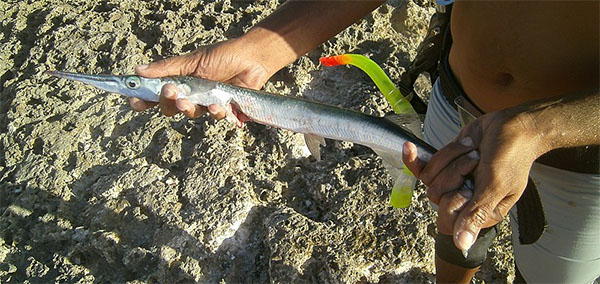 물동갈치. Flat needlefish(Ablennes hians). Location/Bay of Pigs, Cuba Author/Tisquesusa. Source/Wikimedia. (CC BY-NC).




 검색
