close_btn

철갑상어(Chinese sturgeon). Acipenser sinensis(Gray, 1835) → Family 60


분류계보/경골상강→조기강→철갑상어목→철갑상어과→철갑상어(Chinese sturgeon; Acipenser sinensis)
Superclass Osteichthyes→Class Actinopterygii→Order Acipenseriformes→Family Acipenseridae→ Chinese sturgeon; Acipenser sinensis

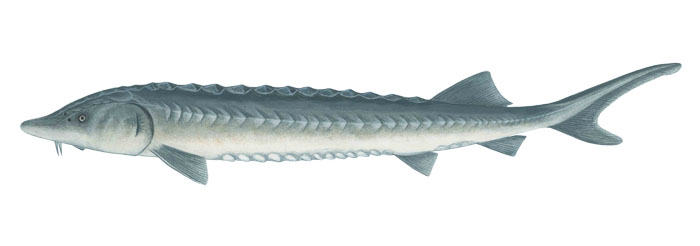
Copyright by Kim In Young. 김인영 그림
Acipenser_sinensis_mypainting_700.jpg
철갑상어의 기본 모습. Lateral view of Chinese sturgeon(Acipenser sinensis)

[Marine; freshwater; brackish]
철갑상어목 철갑상어과 Order Acipenseriformes FamilyAcipenseridae(Sturgeons)
철갑상어(Chinese sturgeon)
Acipenser sinensis(Gray, 1835). 200~500cm TL. max. published weight: 600.0 kg. max. reported age: 13 years
Dorsal spines 0, Dorsal soft rays 50-57, Anal spines 0, Anal soft rays 32-40. 골판 열 수/5,
등의 골판 수 10개 체측 골판 수 29~45개, 복부 골판 수 8~15 개.

분포; 서북태평야/중국해와 중국의 주장 강(珠江), 일본(사가미 해)에 분포하며 한국에도 서해와 남해로 흐르는 큰 강의 하구와 연안에 드물게 가끔 출현했다는 기록이 있다. 한국명은 “철갑상어”이다. 멸종 위기 종이며 국제거래 금지 종.

일반개요; 철갑상어는 중국, 일본, 한반도에 분포했었으나 서식지 파괴와 남획으로 대부분 분포 지역에서 멸종 상태에 있다. 중국에서는 판다와 같은 급으로 국보(national treasure) 동물로 보호되고 있다. 철갑상어는 물론 모든 철갑상어는 물고기의 원조격인 종으로 백악기에서부터 화석이 발견된다. 경골어류이며 연질어류(Chondrostei)로 분류된다. 뼈대가 상어류처럼 연질이지만 분류학적으로는 경골어류이다. 중국 청 왕조 시대에는 철갑상어의 살코기와 연골뼈를 함께 조리한 요리가 있었는데 고급 음식이었다. 다 자란 철갑상어는 2m에서 5m까지 크며 무게가 200에서 500 kg까지 나간다. 세계에서 가장 큰 철갑상어 종류에 들어간다. 머리는 뾰족하고 입은 머리 아래에 있다.

철갑상어들은 민물에서 알을 낳고 새끼는 바다로 나가 성장한다. 철갑상어는 생의 한 때를 바다에 살지만 대형 민물고기로 분류된다. 연어는 알을 낳고 죽지만 철갑상어는 전 생애를 통해 여러 번 알을 낳는다. 철갑상어는 중국 동부 해안에 살다가 성적으로 성숙하면 번식을 위해 강 상류로 올라간다. 세계 철갑상어류 중에서 철갑상어가 산란하러 이주하는 거리는 가장 길며 3,200 km까지 양자강 상류로 올라간 기록이 있다. 철갑상어들의 번식 율은 매우 낮다. 일생에 3번 내지 4번 밖에 산란하지 못한다. 한 회기에 백 만개의 알을 낳아 체외 수정을 한다. 그러나 부화율은 1% 가 채 안 된다.

철갑상어는 양자강 본류와 그 지류(첸탕강, 민장강, 주장강)에 매우 넓게 퍼져있었던 물고기이다. 다 자란 성어는 삼킬 수 있는 먹이이면 어떤 동물이든 먹는 포식자이다. 유어들은 수생 곤충과 애벌레, 규조류, 부식물질을 먹는다.

1970년에는 매년 2000 마리의 철갑상어가 양자강에서 산란을 하였다. 지금은 오염과 인간 활동에 의해 서식지가 줄어서 몇 백마리 정도가 나타나 산란을 한다. 철갑상어의 주요 산란지 중 하나였던 양자강 상류지류 진사 강(金沙江)은 1980년대 초에 댐(Gezhouba Dam)이 생기는 바람에 철갑상어의 이동 길이 막혀버렸다. 철갑상어는 강의 교통량이 증가하여 일어나는 소음에 매우 민감하며 선박의 프로펠러에 충돌하여 사망하는 일도 빈번하다.

보호와 연구
철갑상어의 원시성 특징들은 계통분류학과 생물학의 아주 중요한 연구자료가 된다. 이러한 가치 때문에 중국은 1970년대부터 철갑상어를 “중국 1급 보호동물군”으로 지정하여 양육과 보존에 대해 연구해오고 있다. 1982년에 설립된 철갑상어연구소(Chinese Sturgeon Institution of China)의 부설 기관인 철갑상어 박물관(Chinese Sturgeon Museum)은 이 멸종 위기 종을 보호하기 위해 인공 사육 기술을 연구해오고 있다. 이 박물관은 황백강(Huangbo River 黄柏河)에 있는 작은 섬 “Xiaoxita”에 있다. 양자강어업연구소(Yangtze River Fisheries Research Institute)도 철갑상어를 인공 부양하여 증식시키는 임무를 띤 기관이다. 이들 기관들은 인공 배양에 성공해서 새끼들을 하천에 방류하는 데 일부 성과를 보았다고 발표한 적이 있다. 프로젝트 기간에 중국이 방류한 철갑상어 치어는 5백만 마리에 이른다. 그러나 2007년에 양자강 하구에 나타난 어린 개체는 단 14마리에 불과했다. 그 전 해에는 600 마리가 발견되었다. 수상 교통량이 많아지고 오염이 심해지는 양자강의 철갑상어 보존 노력은 희망을 잃어가는 것 같다.

Acipenser-sinensis_CAFS_600.jpg 철갑상어. Chinese sturgeon(Acipenser sinensis) in water tank. Author/CAFS(Chinese Academy of Fishery Sciences/중국수산과학연구소)

Chinese-Sturgeon-Museum_mokpo-Museum.jpg Left/중국 남통(南通) 박물관의 철갑상어 표본. Specimen of Chinese Sturgeon in Nantong Museum. Author/猫猫的日记本. Right/한국 목포자연사발물관의 철갑상어 표본. Chinese sturgeon at Mokpo Natural History Museum of Korea. Author/S Shamima Nasrin.


[Marine; freshwater; brackish]
Order Acipenseriformes FamilyAcipenseridae(Sturgeons)
Chinese sturgeon
Acipenser sinensis(Gray, 1835). 200~500cm TL. max. published weight: 600.0 kg. max. reported age: 13 years
Dorsal spines 0, Dorsal soft rays 50-57, Anal spines 0, Anal soft rays 32-40. Body shield rows/5, Dorsal shield/10, side shield/29~45, ventral shield/8~15


Distribution; Northwest Pacific: China and Japan(Sagami Sea). Reported from Korea. Pearl River and Chinese sea. Endangered. International trade restricted (CITES II, since 1.4.98; CMS Appendix II).
General; The Chinese sturgeon(Acipenser sinensis; Chinese: 中華鱘; pinyin: zhōnghuá xún) is a critically endangered member of the family Acipenseridae in the order Acipenseriformes. Historically, this anadromous fish was found in China, Japan, and the Korean Peninsula, but it has been extirpated from most regions due to habitat loss and overfishing. It is strictly protected by the Chinese government, named a "national treasure" much like its mammalian counterpart, the giant panda. China has several conservation programmes, including reserves specifically aimed at this species and restocking through release of juveniles in the Yangtze River.

Physical appearance
Sturgeon are comparatively basal species of fish, whose earliest fossils date back to the Cretaceous period. They are best known members of the bony fish taxon Chondrostei, a group of bony fishes that have cartilaginous skeletons superficially similar to the skeletons seen in the unrelated chondrichthyan fishes. Adult Chinese sturgeon can range between 2 and 5m in total length, and weigh between 200 to 500 kg ranking them among the largest sturgeon in the world. Its head is acuminate, with the mouth under its jaw. In Qing Dynasty Chinese cuisine, its meat and cartilaginous skeleton was often cooked and served together, and considered a delicacy.

Lifecycle
Most sturgeon spawn in fresh water and migrate to salt water to mature. The Chinese sturgeon can be considered a large freshwater fish, although it spends part of its lifecycle in seawater, like the salmon, except Chinese sturgeon spawn multiple times throughout their lives. The Chinese sturgeon has a habit of upstream migration; it dwells along the coasts of China's eastern areas and migrates back up rivers for propagation upon reaching sexual maturity. It has the longest migration of any sturgeon in the world, and once migrated more than 3,200 km (2,000 mi) up the Yangtze. The sturgeon's reproductive capacity is poor; it may breed three or four times during its life, and a female sturgeon can carry in excess of a million eggs in one cycle, which are released for external fertilisation when mature. The survival rate to hatching is estimated to be less than 1%.

Habitat
The Chinese sturgeon is a critically endangered species native to China. It is largely dispersed over the main streams of the Yangtze River and coastal regions of Qiantang River, Minjiang River, and Pearl River. The adults are predators that consume any aquatic animal that can be swallowed, while the young feed on aquatic insects, larvae, diatoms, and humic substances. In the 1970s, an estimated 2,000 Chinese sturgeon spawned in the Yangtze River every year. Now, that number is down to several hundred due to the threats to its habitat, such as pollution and other human action. The channel for adult fish migrating to traditional spawning sites such as the Jinsha River in the upstream of Yangtze River was blocked after the construction of the Gezhouba Dam hydroelectric power project in the early 1980s. The sturgeon is also highly sensitive to increased noise on the river caused by growing river traffic, as well as being vulnerable to death or injury by boat propellers.

Protection and research
The primitiveness of the Chinese sturgeon makes it a great academic interest in taxonomy and biology. For this reason, China has been studying ways to breed and preserve the endangered species, classified as "China's Class One Protected Animals" since the 1970s. Built in 1982, the Chinese Sturgeon Museum is part of the Chinese Sturgeon Institution of China which is using artificial breeding techniques to try to preserve this endangered species. The museum is located on a small island called Xiaoxita in the Huangbo River, within Yiling District of Yichang.

The Yangtze River Fisheries Research Institute of the Chinese Academy of Fisheries Sciences in Jingzhou is one agency charged with breeding sturgeon in captivity for restoring the river population before the species disappears. Some success has been claimed by the authorities from artificial inducement for spawning and stream discharge for incubation. During the course of the project, 5 million fish bred in captivity have been released into the wild. However, in 2007, 14 young sturgeon were surveyed near the mouth of Yangtze compared with 600 the year before, causing concern that effort was a losing battle in the crowded and polluted Yangtze river.

Beijing-aquarium_crop700.jpg 중국 베이징 아쿠아리움의 중국철갑상어. Water tank of Chinese sturgeon in Beijing aquarium. Author/Shizhao


Copyright ⓒ FISHILLUST.COM  All rights reserved. All contents can not be used without permission of the copyright holder.