
사이트 로그인
사이트 로그인
|
분류계통/경골상강→조기강→쏨뱅이목→은대구과→은대구 Copyright by Kim In Young. 김인영 그림
|
| image on preparing |
| 은대구 기본 모습. Lateral view of Sablefish(Anoplopoma fimbria) |
쏨뱅이목 은대구과 분포; 북태평양/일본 시즈오카현의 하쓰시마섬(Hatsushima, 初島; 초도)에서부터 북으로 북해도의 훈카만(Funka Bay, 噴火湾/분화만), 러시아 베링해의 캄차카와 알래스카 연안을 거쳐 남쪽으로 동태평양 멕시코의 바하 캘리포니아 중부 세드로스 섬과 까지. 은대구는 대구와 닮아서 대구 종류의 하나로 또는 메로(Patagonian toothfish) 종류로 오인하는 일이 많으나 은대구는 대구나 메로(비막치어; Dissostichus eleginoides/농어목 비막치어과) 종류가 아니며 인척 관계로 보면 쏨벵이목의 쥐노래미과(Greenling; Family Hexagrammidae)에 가깝다. 몸은 가늘고 길며 등지느러미는 2개이며 서로 멀리 떨어져 있다. 뒷지느러미와 등지느러미는 서로 크기가 비슷하고 서로 마주보는 대칭적인 위치에 있다. 몸의 등과 옆면은 거의 검은 색이거나 암회색으로 약간 녹색 빛을 띠고 있으며 검고 약간 구불구불한 수평 방향 줄 무늬 여러 개가 병행하고 있다. 어떤 때는 많은 개수의 반점이나 얼룩 무늬일 수 있다. 배쪽은 몸 위쪽의 색이 밝아진 허연 색이다. 은대구 성어는 주로 물고기를 잡아먹으며 오징어. 난바다곤쟁이류, 해파리도 곁들여 먹는다. 먹이가 되는 물고기는 명태, 빙어류(Thaleichthys pacificus와 Mallotus villosus), 청어, 까나리, 태평양대구 등이다. 은대구는 늦겨울과 초봄에 대륙붕 경사면에서 산란한다. 알은 바닥 가까운 깊은 수심에서 발육하여 약 2주일후에 부화되어 표층으로 떠오른다. 부화된 새끼는 부유생활을 하며 연안 근처 해역의 표층에서 발견되다. 일반적으로 국지적으로 이동하지만 일부 새끼는 6~7년 성장하는 동안 3,200km 이상 이동하는 것으로 밝혀졌다. 암컷은 6,5년 성장 후 약 61cm 크기에 알을 낳을 수 있고 수컷은 5년, 약 58cm 크기에서 재생산할 수 있다. 은대구는 장수하는 물고기로 최대 수명이 94년이다. 그러나 여러 해역에서 실제로 어획되는 것들 것 20년 이하의 나이들이다. 성장하는 크기는 지역에 따라 다른데 알래스카 산이 가장 크며 최대120 cm TL에 25 kg 기록을 가지고 있다. 그러나 보통은 70 cm이하 4 kg 이하이다. 은대구는 일반적으로 저인망, 연승 및 통발 어업에서 잡힌다. 알래스카에서는 어획시 주낙에 소리를 발생시키는 장치를 부착하여 은대구 떼를 유인하는데, 이 부근에 서식하는 고래가 유인 소리에 유인되어 낚시에 걸린 은대구를 빼먹는 경우가 종종 발생한다. 어획된 은대구는 대부분 일본에서 소비된다. 은대구의 흰 살은 식감이 부드러럽고 은은한 풍미가 난다. 많은 나라에서 별미로 여겨진다. 조리하면 파타고니아 이빨고기(메로; 칠레 농어)와 비슷한 식감을 느낄 수 있다. 지방 함량이 높아 구이, 훈제, 튀김 등 다양한 방법으로 조리하며 초밥으로도 즐길 수 있다. 살에는 오메가-3 지방산, EPA 및 DHA가 자연산 연어만큼이나 많이 함유되어 있다. 간유에는 비타민 A와 D가 풍부하다. 일본 요리에서는 은대구를 달콤한 흰 된장이나 술지게미(카스즈케)에 며칠간 재운 후 사이쿄 야키(saikyo yaki) 스타일로 조리하여 먹기도 한다. 연구에 따르면 은대구의 수은 농도는 평균치이며 FDA는 임신부와 산모를 위한 가이드에서 은대구를 "Good Choices" 카테고리에 포함시키고 있다. 한국에서는 대구탕등 담백하고 깊은 맛을 자랑하는 일반 대구 요리가 인기가 많은 편이고 은대구는 탕으로 해먹으면 노래미탕과 비슷하다며 대구보다는 그리 인기는 높지 않으나 겨울 시즌이 되어 진한 맛의 생선탕을 원하는 이들은 은대구를 찾는다. 은대구는 원래 미국과 영국 사람들이 많이 먹었던 값싼 생선이었는데 일본을 비롯해 세계적으로 은대구를 먹는 유행이 번지면서 점점 귀해져 값이 턱없이 올라가 버렸다. 여러 연구 기관이나 사업체가 은대구 양식에 도전에 왔으나 성공한 곳은 아직 희귀하다. 2024년 2월에 발표된 한 기사에서 보면(source/https://thefishsite.com/) 미국의 연어양식회사(Troutlodge, Inc)의 자회사인 머린아쿠아(Marine Aqua)가 2022년에 캐나다에서 은대구 양식에 최초로 성공하였으며 일본 등 몇 나라에 수출하고 있다 한다. 2016년에 나온 뉴스에 의하면 국립수산과학원이 미국 해양대기처(NOAA)와 은대구 양식산업을 공동 연구하기로 하였다고 한다. 현재(2024년), 한국의 도전이 성공했는지 여부에 관한 기사는 찾아지지 않는다. |
Order Scorpaeniformes Family Anoplopomatidae(Sablefishes). Distribution; North Pacific/From Hatsushima Island(初島) in Shizuoka Prefecture, and Funka Bay(噴火湾) in the Hokkaido Islands, Japan, north to Kamchatka in the Bering Sea, Russia, the coast of Alaska, and southwards to Cedros Island in central Baja California, Mexico, in the Eastern Pacific Ocean. Sablefish look much like cod. Sablefish is often mistaken for a type of cod or a type of mero(Patagonian toothfish), but black cod is not a type of cod or a mero(Dissostichus eleginoides) and is rather closely related to the greenlings(Family Hexagrammidae). Body elongated and long. Has 2 dorsal fins that well separated, 2nd dorsal fin sub equal to anal fin in size and form, and opposite in position. The dorsal and body side are blackish or dark gray with a slight greenish tint. Several blackish, slightly squiggly lateral stripes run in parallel. Sometimes the pattern may be a large number of mottles or blotches. The ventral side is pale color of the upper body color. Adult sablefish are opportunistic piscivores, preying on Alaskan pollock, eulachon, capelin, herring, sandlance, and Pacific cod, as well as squid, euphausiids, and jellyfish. It spawns in late winter and early spring in waters of the continental slope. Eggs develop in deep water near the bottom for about 2 weeks until they hatch, then rise to the surface. Young-of-the-year juveniles are pelagic and found on the surface and near-shore waters. Generally localized, but some juveniles have been found to migrate over 3,200km(2,000 miles) in 6 or 7 years. Females are able to reproduce at 6 ½ years old and more than 2 feet in length. Males are able to reproduce at age 5 and 1.9 feet in length. Sablefish are long-lived, with a maximum recorded age of 94 years although the majority of the commercial catch in many areas is less than 20 years old. Sablefish growth varies regionally, with larger maximum sizes in Alaska, where total lengths up to 114 cm weights up to 25 kg have been recorded. However, average lengths are typically below 70 cm and 4 kg. Sablefish are typically caught in bottom trawl, longline and pot fisheries. Longline fisheries in Alaska frequently experience predation of sablefish by killer whales and sperm whales which remove the fish from the hooks during the process of retrieving the gear. In Alaska, schools of sablefish are attracted by sound-producing devices attached to the longlines, and whales that live in the area are often attracted by the sound and snatch up the fish. Most of the catch is marketed in Japan. The white flesh of the sablefish is soft-textured and mildly flavored. It is considered a delicacy in many countries. When cooked, its flaky texture is similar to Patagonian toothfish(Chilean sea bass). The meat has a high fat content and can be prepared in many ways, including grilling, smoking, or frying, or served as sushi. Sablefish flesh is high in long-chain omega-3 fatty acids, EPA, and DHA. It contains about as much as wild salmon. The liver oil is rich in vitamin A and D. In Japanese cuisine, the black cod (gindara) is often cooked saikyo yaki style, marinated for several days in sweet white miso or sake lees(kasuzuke) then broiled. Studies of accumulated mercury levels find average mercury concentrations. The US Food and Drug Administration puts sablefish in the "Good Choices" category in their guide for pregnant women and parents. In Korea, regular cod dishes such as Daegu-Tang(spicy fish soup) are popular for their light and deep flavours, and Sablefish is said to be similar to greenling(Hexagrammos agrammus) when cooked in spicy soup, so Sablefish is not as popular as cod, but during the winter season, people who want a rich fish soup seek out Sablefish soup. Originally, sablefish was a cheap fish that was eaten by people in the United States and the United Kingdom, but as the trend of eating sablefish spread around the world, mainly in Japan, it became increasingly rare and expensive. Several research organisations and businesses have been attempting to farm sablefish, but success is still rare. According to an article published in February 2024(source/https://thefishsite.com/), Marine Aqua, a subsidiary of Troutlodge, Inc, an American salmon farming company, was the first to successfully farm sablefish in Canada in 2022 and is exporting to several countries, including Japan. In 2016, news reported that the National Academy of Fisheries Sciences of Korea had agreed to collaborate with the National Oceanic and Atmospheric Administration(NOAA) on sablefish aquaculture. As of 2024, there are no articles on whether the South Korean challenge was successful. |
 은대구 분포도. Distribution map of Sablefish(Anoplopoma fimbria). Main ref. fishbase and GBIF. Edited by fishillust.com. as of July, 2024. |
 은대구. Sablefish(Anoplopoma fimbria). Location/Los Angeles Pacific Coast, USA. Author/Zach Fratello. (CC BY-NC) |
 심해저의 은대구. Sablefish(Anoplopoma fimbria). 수심 800미터 깊은 해저 계곡 고운 모래 바닥에 앉아있는 은대구. 사진 위쪽에 있는 붉은 점들은 레이저 광선으로 10 cm 간격으로 있으며 해당 범위 안에 있는 생물들의 크기를 측정하는 시스템이다. A sablefish resting on the soft sediments blanketing the deep canyon floor at about 800 m. The red spots(top) are lasers, spaced 10 cm apart, that are used to estimate the size of organisms that inhabit the area. Image courtesy of Lewis and Clark 2001, NOAA/OER. |
 은대구. 수심 302m 수중촬영. A Sablefish(Anoplopoma fimbria) on soft bottom habitat at 302 meters(991 ft) in Cordell Bank National Marine Sanctuary. Author/Rick Starr, NOAA/CBNMS (CC BY-NC) |
 은대구. 헤엄치는 상태. Sablefish(Anoplopoma fimbria) swimming just above the sea floor. Author/NOAA's Northwest Fisheries Science Center (CC BY-NC) |
 작은 크기의 은대구들. Small sablefish(Anoplopoma fimbria) caught in a bottom trawl survey off the coast of California. Author/Ian G. Taylor. (CC BY-NC) |
 최대 성장한 은대구. A woman holding a large Sablefish(Anoplopoma fimbria). Author/Alaska Department of Fish and Game. This image may be copyrighted. |
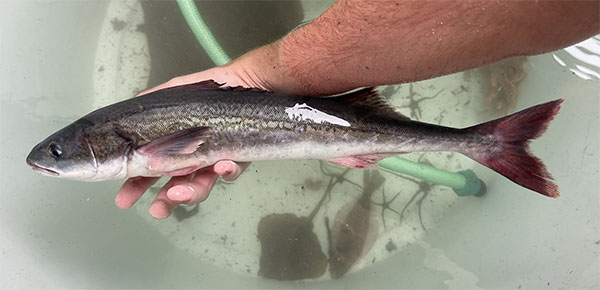 은대구 새끼. Juvenile Sablefish(Anoplopoma fimbria). Location/Pacific Coast, San Francisco, California, USA.. Author/Alex Bairstow. (CC BY-NC) |
 은대구. Sablefish(Anoplopoma fimbria). Location/Pacific Coast, San Francisco, California, USA.. Author/prickly_sculpin. (CC BY-NC) |
 어린 은대구. Young Sablefish(Anoplopoma fimbria). Location/Sitka County, Alaska, USA. Author/rolandwirth. (CC BY-NC) |
 왼쪽/훈제 과정에 들어가기 위해 대형 운반 바구니에서 내려지는 대형 은대구들. 오른쪽/훈제 과정에 들어가기 위해 은대구를 세척하는 과정. Left/Large sables unloaded from tote at Taku Smokeries, Juneau, Alaska. Author/Gillfoto Right/Large sables being washed at Taku Smokeries, Juneau, Alaska. Author/Gillfoto. (CC BY-NC) |
 왼쪽/은대구 조림. Stew of Sablefish(Anoplopoma fimbria). 오른쪽/뇨끼(gnocchi)를 곁들인 은대구 구이. Left/Part of the Korean Table D'hote at YongSuSan restaurant in L.A. USA. Author/Eugene Kim.(CC BY-NC). Right/ Roasted Sablefish with Seaweed Gnocchi. Author/Calgary Reviews from Calgary, Canada. (CC BY-NC) |
 왼쪽/일본 식당의 은대구 구이. 오른쪽/사케 간장에 절인 은대구. Left/Grilled Gindara(Sablefish). Yamaya, an Izakaya in Nagaoka, Niigata Prefecture, Japan. Author/congiro. Right/ Sake-Soy Marinated Sablefish. Author/Mack Male from Edmonton, AB, Canada. (CC BY-NC) |
 왼쪽/퍼프 페이스트리, 스파게티 스쿼시, 토마토, 강낭콩, 당근, 보라색 감자를 곁들인 된장 은대구.오른쪽/샌프란시스코 슈퍼마켓에 전시된 은대구 카즈즈케. Left/Miso sablefish with puffed pastry, spaghetti squash, tomatoes, green beans, carrots and purple potato at Paso Terra in Paso Robles, California Author/Missvain. Right/Gindara(sablefish) Kasuzuke on display at Super Mira Market in San Francisco, CA. Author/Monoukotori. (CC BY-NC) |
 은대구과의 일반영명 sablefish의 sable은 흑담비의 뜻이다. Sablefish, the common English name for Family Anoplopomatidae, is a combination of the words sable and fish. |
| text on preparation |


|
| Copyright ⓒ FISHILLUST.COM All rights reserved. All contents can not be used without permission of the copyright holder. |


 검색
