
사이트 로그인
사이트 로그인
|
분류계보경골상강→조기강→금눈돔목→금눈돔과→금눈돔 Copyright by Kim In Young. 김인영 그림
|

|
| 금눈돔 기본 모습. Lateral view of Alfonsino(Beryx decadactylus) |
금눈돔목 금눈돔과 분포; 동태평양을 제외한 전 세계의 온대와 아열대 해역에 널리 분포한다. 인도-태평양/한반도의 원산, 부산, 제주도, 일본의 중부와 남부, 타이완, 인도네시아의 발리, 오스트레일리아 동부와 태즈마니아 섬, 뉴질랜드, 통가, 미드웨이 섬 서북쪽의 북태평양, 하와이, 남아프리카, 마다가스카르, 동대서양/그린란드, 아이슬란드, 노르웨이, 아일랜드, 이베리아 반도, 지중해 서부, 북대서양의 중부, 남아프리카, 서대서양/미국의 대서양 연안에서부터 브라질, 아르헨티나까지. 금눈돔은 깊은 수심에 살기 때문에 어로 작업에서 채집되는 데는 한계가 있다. 따라서 발견된 장소의 기록보다는 더 널리 분포할 것이다. 주둥이 길이는 눈 지름보다 짧다. 아래턱은 위턱 보다 약간 앞쪽으로 길다. 머리 좌우에 각각 4개의 가시가 있다; 코, 누골, 이마, 뺨 아래에 1개씩이다. 누골 가시는 위턱 위에 있고 날카롭게 뾰족하며 후방으로 돌출되어 있다. 전새개골 가장자리에는 가시가 없다. 위턱의 뒤는 눈 중앙을 지나지만 눈의 뒤 가장자리를 넘지 않는다. 양턱, 서골 및 구개골에 융모형 이빨이 있다. 측선은 완전하여 가슴지느러미 상단부에서는 약간 휘어져 있고 나머지 부분에서는 직선이다. 두부 측면과 체표면 각 비늘에는 잔가시가 돋아 있고 비늘 자체가 체표면과 강하게 부착되어 있어 전체적으로 거칠고 딴딴하다. 발광기관은 가지고 있지 않다. 전체 체색은 붉은색이거나 진홍색이다. 모든 지느러미는 붉은색이다. 때에 따라 몸의 중간부 이하가 색이 연해지면서 핑크 빛을 나타낼 수 있다. 모든 지느러미는 붉은색이다. 입 안쪽은 밝은 적색이다. 깊은 수심에 사는 물고기는 적색을 가지는 경우가 일반적인데 이는 깊은 수심 환경에 적응한 색이다. 깊은 수심에서는 태양광 스펙트럼 중 적색이 가장 먼저 물에 흡수되어 사라지기 때문에 자신의 몸이 보이지 않게 하는 위장색이 된다. 이 적색은 얕은 수심으로 상승하거나 온전한 태양빛을 받거나 또는 깊은 수심에서 인공조명을 받았을 때 나타난다. 금눈돔은 보통 크기가 35.0 cm 정도이지만 최대 100 cm까지 자란다. 최대 무게 기록은 2.5 kg이다. 금눈돔은 전 세계의 온대와 아열대 해역에 널리 분포하지만 흔하지는 않은 물고기이다. 서식 수심의 폭이 110–1,000로 크다. 대륙붕과 대륙붕 사면의 깊은 수심에 사는 산호류 지대에서 띄엄띄엄 모여서 산다. 성어는 저서생활을 하며 주로 물고기, 두족류, 갑각류를 먹는다. 낮에는 깊은 수심에 머물고 야간에는 얕은 수심으로 수직 이동하는 성향이 있다. 금눈돔과의 다른 형제 종들과 마찬가지로 수명이 매우 길다. 69년 수명 기록이 있으며 실제로는 더 오래 살 것이다. 추측 최대 수명은 85년으로 나타나 있다. 산란기는 6월에서 9월까지 여름철이며 그러나 수컷은 연중 재생산 생리를 유지한다. 금눈돔은 산란기에 여러 차례 나누어 산란을 한다. 알과 부화된 치자어는 수면 쪽으로 가까운 표해수층(表海水層; 광합성에 충분한 빛이 침투하는 약 100m까지의 층)에서 부유생활을 한다. 알은 약 27시간 후에 부화된다. 부화된 유어는 좀 더 깊이 내려가지만 수개월 동안은 부유생활을 하다가 바닥으로 내려가 성장하여 성어가 된다. 4년 지나면 성적으로 숙성되며 이때 크기는 약 30cm이며 암컷이 수컷 보다 약간 더 크다. 다른 형제 종들과 마찬가지로 성장 속도는 느리다. 금눈돔은 경제적으로 중요한 식용어이며 심해 저인망 어업이나 롱라인 어업의 타켓이 된다. 금눈돔은 분포 해역은 넓지만 희소한 물고기이다. 금눈돔을 목표로 하는 과도한 어업과 저인망 어업에서 부수어로 잡히는 개체 수가 많기 때문이다. 육질이 부드럽고 담백하며 겨울철에 맛이 좋다고 알려져 있다. 도미와 유사하여 도미의 대용으로 쓰이는 경우가 있다. 도미보다 희소하고 비싸다. 일본에서 고급 어종에 속하며 금눈돔 조림은 상당히 비싸다. |
Oder Beryciformes Family Berycidae(Alfonsinos) Distribution; Widely distributed in temperate and subtropical seas around the world except for the eastern Pacific. Indo-Pacific/Wonsan, Busan, Jeju Island of Korean peninsula, central and southern Japan, Taiwan, Bali in Indonesia, eastern Australia including Tasmania, New Zealand, Tonga, North Pacific of northwest of Midway Island, Hawaii, South Africa, Madagascar, Eastern Atlantic/Greenland, Iceland, Norway, Ireland, Iberian Peninsula, Western Mediterranean, Central North Atlantic, South Africa, Western Atlantic/From the Atlantic coast of the United States to Brazil and Argentina. Because Alfonsino live in deep water, the possibility to be collected in fishing is limited. Therefore, it will be more widely distributed than the records of the place where it was found. Snout length shorter than eye diameter. The lower jaw is slightly longer than the upper jaw. Four pairs of spines on head: on nasal, lachrymal, frontal and lower cheek. The spine of lacrimal bone is located on the upper jaw, sharp, pointed and projecting backwards. Preopercle edge without spines. The back of the upper jaw passes through the middle of the eye but does not go beyond the posterior edge of the eye. Villi-like teeth on both jaws, vomer and palatal bone. The lateral line is complete, slightly curved at the upper part of the pectoral fin and straight in the rest. Each scale on head side and on body surface has small spine, and the scale itself is strongly attached to body surface, giving it rough and tough feel to the touch overall. It has no luminous organs. Overall body color is red or crimson. Occasionally, the lower part of the body may become lighter in color and appear pinkish. All fins are red. Fins and the inside of the mouth are bright red. Fish living in deep water usually have red color, which is a color adapted to the deep water environment. In deep water, the red color of the solar spectrum is filtered out first and disappears, so it becomes invisible and camouflage color that can hide the body. This red color appears when ascending to shallow water or receiving normal sunlight or artificial light at great depths. Although the most common size is 35.0 cm (13.8 in), it can reach lengths of up to 100.0 cm (39.4 in) TL. The maximum published weight for an alfonsino is 2.5 kg (5.5 lb). It can be found in temperate and subtropical ocean waters nearly worldwide, though it is uncommon. With an extensive depth range 110–1,000m(360–3,280 ft) below the surface, the alfonsino occurs in localized aggregations over deep-sea coral habitats on the continental shelf and continental slope. Adults are demersal and search for prey along the ocean floor, primarily fish, cephalopods, and crustaceans. By day it stays in deeper water and vertically migrates to shallower waters at night.Like other members of its family, it is remarkably long-lived, recorded 69 years, however, estimates ranging as high as 85 years Spawning occurs in the summer months, June through September, though males can reproduce year-round. Alfonsinos are batch spawners, that is they release eggs multiple times over an extended spawning season rather in a short period. Eggs and larvae are epipelagic, staying near the ocean's surface. Eggs hatch after around 27 hours. Juveniles live deeper, but are still pelagic for a few months, eventually moving to their demersal habitat where they will live as adults. After 4 years, they reach sexual maturity, at which point they will be about 30cm(12 in) in size, with females being slightly larger on average than males. Individuals grow slowly, as is common among members of Berycidae. Alfonsinos are economically important fish, targeted by commercial fisheries, including seamount fisheries, that employ deep-water trawling and longline fishing methods to catch them. Despite being widespread throughout its range, the alfonsino is an uncommon fish in many areas, likely due to exploitation by commercial fisheries and depletion due to bycatch. The meat is soft and bland. and is known to taste good in winter. It is similar to sea bream and is sometimes used as a substitute for sea bream. It is rarer and more expensive than sea bream. It is one of the high-end fish species in Japan, and braised Alfonsino is quite expensive. |
 금눈돔 분포도. Distribution map of Alfonsino(Beryx decadactylus). Main ref. GBIF. Edited by fishillust.com. data/as of august, 2023. |
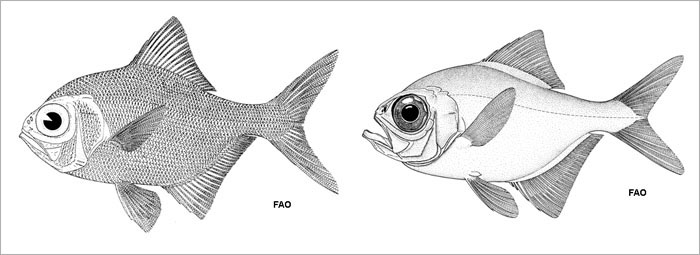 금눈돔의 체형도. Illustration of the shape of Alfonsino(Beryx decadactylus). Author/FAO. |
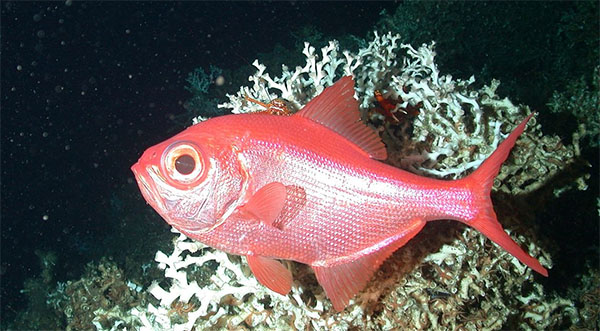 태양광이 도달하지 않는 깊은 수심에 서식하는 로펠리아 산호(Lophelia pertusa) 군락에 서식하는 금눈돔. 로펠리아 산호는 수심80m에서부터 3,000m 이상 수심에 산다. Underwater photo of Alfonsino(Beryx decadactylus). Hovering around a large Lophelia coral. Location/North Carolina Continental Slope. Lophelia lives at a temperature range from about 4–12 °C(39–54 °F) and at depths between 80 metres(260 ft) and over 3,000 metres(9,800 ft), but most commonly at depths of 200–1,000 metres(660–3,280 ft), where there is no sunlight. Author/Dr. Ken Sulak, USGS(NOAA) |
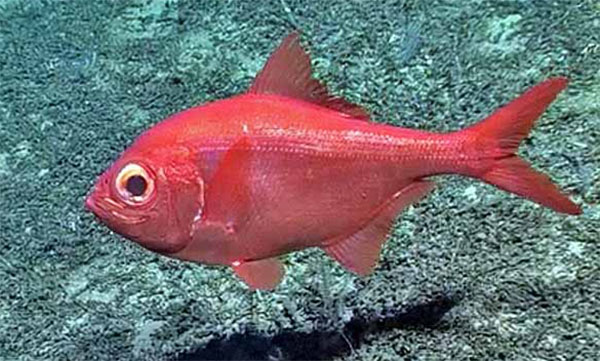 금눈돔. 수중사진. Underwater photo of Beryx decadactylus(alfonsino). Source/Smithsonian Tropical Research Institute) |
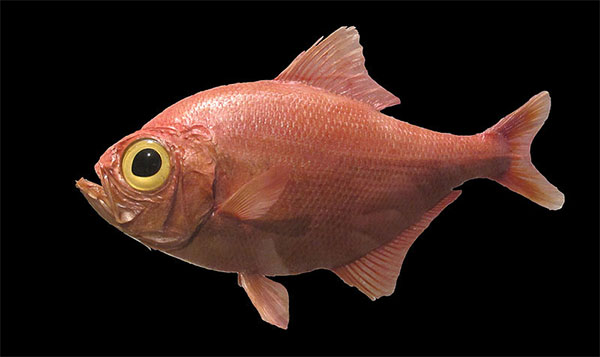 금눈돔. Beryx decadactylus(alfonsino). 프랑스 라로셸 박물관. Muséum d'histoire naturelle de La Rochelle. Author/Ismoon |
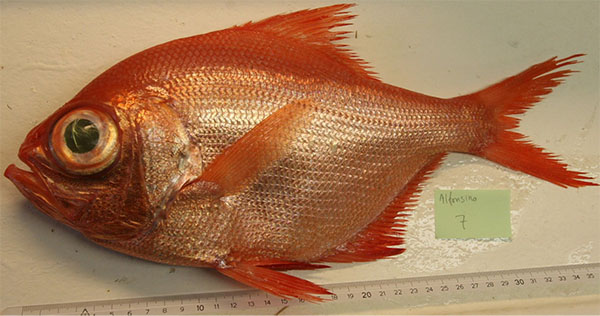 금눈돔. Beryx decadactylus(alfonsino). Collected in Ireland. Author/Naturalis Biodiversity Center. |
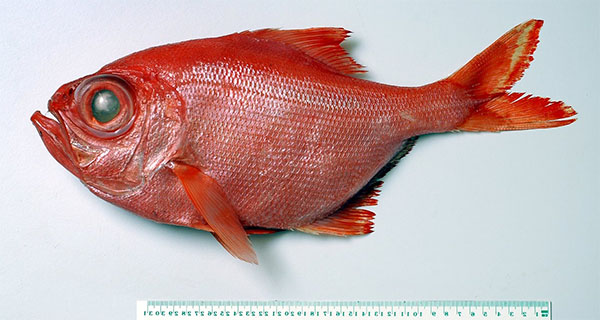 text on preparation금눈돔. Beryx decadactylus(alfonsino). A 32 cm long Alfonsino caught on hook and line by D. King at a depth of 400 m, east of Browns' Mountain, south-east of Sydney, New South Wales, July 2003 Author/Australian museum. (CC by NC). |
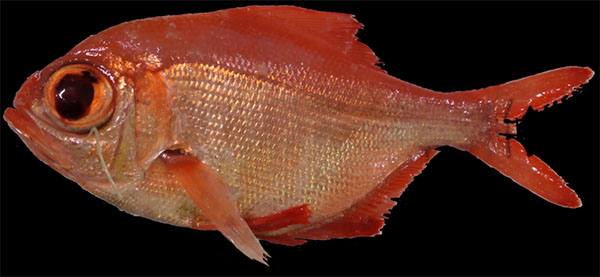 text on preparation스페인의 어시장에서 구입한 금눈돔의 사진. Beryx decadactylus(alfonsino). Edited from the photo taken at the market in Pasaia, Spain. Author/Ebachiller. (CC by NC). |
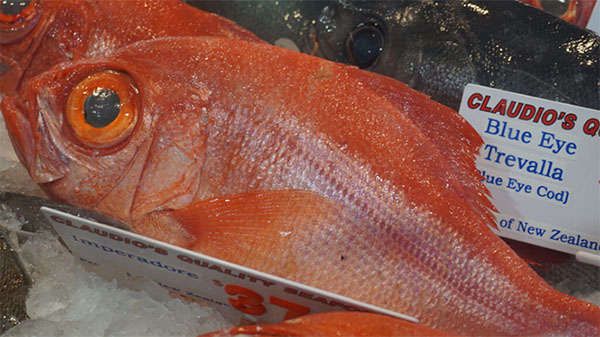 text on preparation마트에 진열되어 있는 금눈돔. Beryx decadactylus(alfonsino). Location/Possibly Sydney Fish Market. Source/Washoku lovers(washokulovers.com/) |
 Left/금눈돔의 잔 이빨을 보여주기 위한 사진. Detail of the dentition of Beryx decadactylus(alfonsino). Author/Amadalvarez. Right/금눈돔 누골에 난 가시. The spine of lacrimal bone in Beryx decadactylus(alfonsino). Source/fishesofaustralia.net.au(RIVO/Henk Heessen). (CC by NC). |
 text on preparationLeft/스페인 산티아고 데 콤포스텔라 시장 광장에서 판매되는 금눈돔. 품명을 적은 라벨은 올바르지 않으며 다른 종을 표기해 놓았다. English/Alfonsinos(Beryx decadactylus) for sale in the market square of Santiago de Compostela of Spain. The labelling is incorrect and corresponds to another species (Atlantic pomfret, Brama brama). Date/22 March 2014. Author/P.Lameiro. Right/일본식 금눈돔 조림 요리. Simmered Alfonsino, Japanese cuisine. Author/Koichi Oda |


|
| Copyright ⓒ FISHILLUST.COM All rights reserved. All contents can not be used without permission of the copyright holder. |


 검색
