Oder Beryciformes Family Berycidae(Alfonsinos)
Splendid alfonsino
Beryx splendens(Lowe, 1834). Max length/70.0 cm TL, common length : 40.0 cm TL. Max. published weight: 4.0 kg Max. reported age: 23 years
Korean name/bit-geum-nun-dom(빛금눈돔)
Japanese name/ キンメダイ(Kinmedai; 킨메다이)
Chinese name/紅金眼鯛 홍금안조
Australia, UK, South Africa/Slender alfonsino
D/spine 4 soft ray13~15. A/spine 4 soft ray 26~30. P1/16~18. P2/spine 1, soft ray 9, Lateral line scale/65~73
Distribution; Circumglobal in temperate and subtropical seas, excluding the northeast Pacific and Mediterranean Sea. Western Atlantic/Gulf of Maine to the Gulf of Mexico. Eastern Atlantic/off southwestern Europe and the Canary Islands to South Africa. Indo-Pacific/East Africa(including Saya de Malha Bank) to Japan, Taiwan, Southern China, Maldives, Hawaii, Australia, and New Zealand. Eastern Pacific/Chile. ※ The rare distribution in the western Pacific is probably due to the fact that deep-sea fishing is not prevalent below 200 m in depth. (Refer to the distribution map).
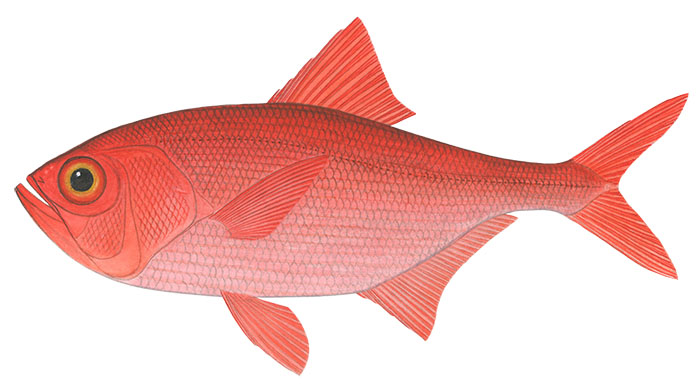
General; An easy way to distinguish between “Alfonsino” and “Splendid alfonsino” is the size of their body depth. The Alfonsino has higher body depth than the Splendid alfonsino, which is why in some countries the Splendid alfonsino is called as “Slender alfonsino”. The body of Splendid alfonsino is slightly taller and side flattened, oblong in shape. The standard body length is 2.5-2.9 times the body height. The head is large, laterally flat. The snout is blunt and short. Posterior nostrils elongated. Eyes rather large; lacrimal bones with short spines pointing backwards. Mouth large and obliquely cleft, rear end of maxilla reaches less than posterior edge of eyes, lower jaw slightly protruding; upper and lower jaws, hoe bone and palatine bone all have villiform teeth. The body is covered with round scales; the number of lateral line scales is 65-73. Dorsal fin single, unnotched, anal fin originating from the back of dorsal fin base. caudal fin deeply forked, upper and lower leaf margins pointed shape. The body is uniformly orange-red to red. Marine, benthopelagic, depth range 25-1300 m, usually 400-600 m. Subtropical; 45°N - 43°S, 180°W - 180°E
|

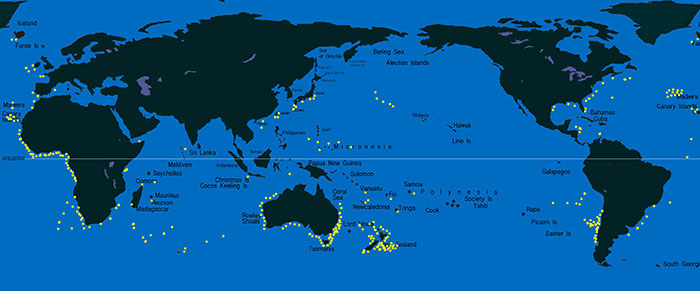 빛금눈돔 분포도. Distribution map of Splendid alfonsino(Beryx splendens). Main ref. GBIF. Edited by fishillust.com
 빛금눈돔(좌)과 금눈돔(우)의 체형 비교도. 체고의 높이가 서로 다른 것이 큰 차이이다. Comparison of the body shape of Beryx splendens(left) and Beryx decadactylus(right). A clear difference between the two species is the large difference in body height. Derived work from FAO materials.
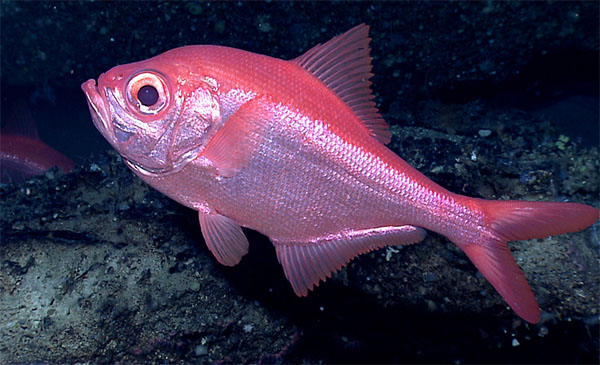 빛금눈돔 수중사진. 미국해양대기청 대심도 해저 탐사 프로그램 중 촬영됨. Underwater photo of Splendid alfonsino(Beryx splendens). Location: Gulf of Mexico, North. Author/NOAA Photo Library, NOAA Okeanos Explorer Program, Gulf of Mexico 2012 Expedition
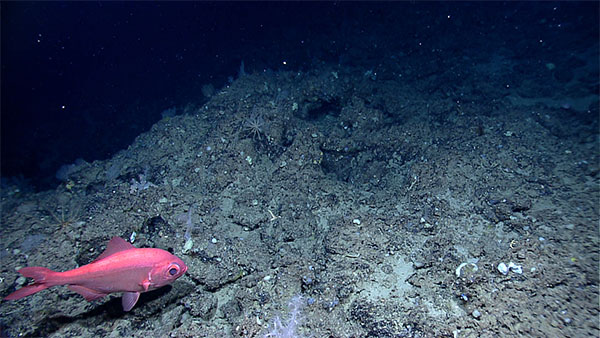 빛금눈돔이 서식하고 있는 대심도 해저 환경 모습. 미국해양대기청 대심도 해저 탐사 프로그램 중 촬영됨. A view of the deep seafloor environment where the Splendid alfonsino lives. Location: Gulf of Mexico, North. Author/NOAA Photo Library, NOAA Okeanos Explorer Program, Gulf of Mexico 2012 Expedition.
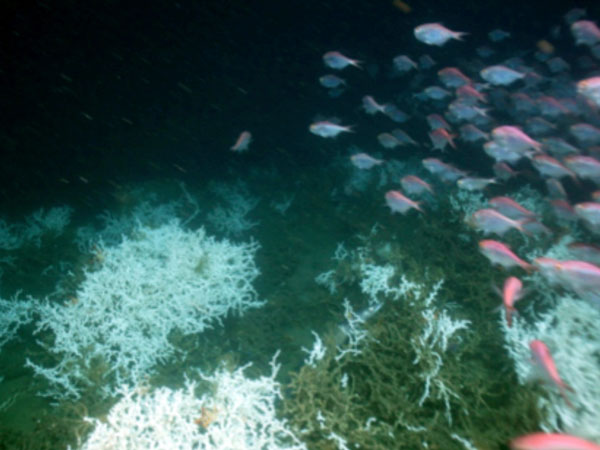 태양광이 도달하지 않는 깊은 수심에만 서식하는 산호(Lophelia pertusa) 군락에서 무리를 지어 돌아다니고 있는 빛금눈돔. 미국해양대기청 대심도 해저 탐사 프로그램 중 촬영됨. Splendid alfonsino(Beryx splendens) roaming in groups in a colony of coral(Lophelia pertusa) that lives only in deep water where sunlight does not reach. Location: Gulf of Mexico, North. Author/NOAA Photo Library, NOAA Okeanos Explorer Program, Gulf of Mexico 2012 Expedition.
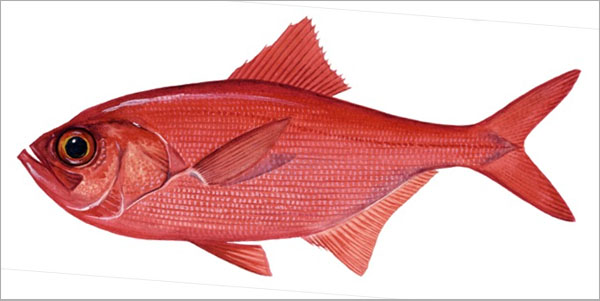 빛금눈돔 묘사도. illustration of Splendid alfonsino(Beryx splendens). Author/Scandinavian Fishing Year Book. Source/fish-commercial-names.ec.europa.eu/(official website of the European Union).
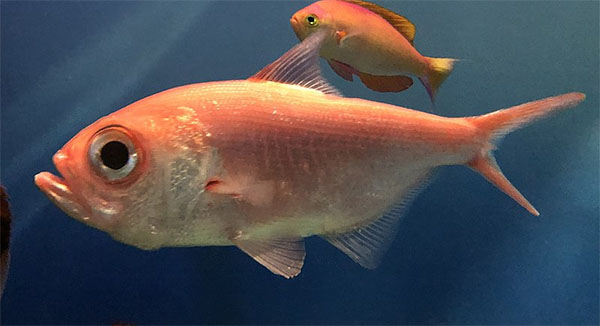 빛금눈돔. 일본 니가타 시(新潟市) 수족관 사진. Splendid alfonsino(Beryx splendens). Location/Aquarium in Niigata City, Japan. Author/Totti
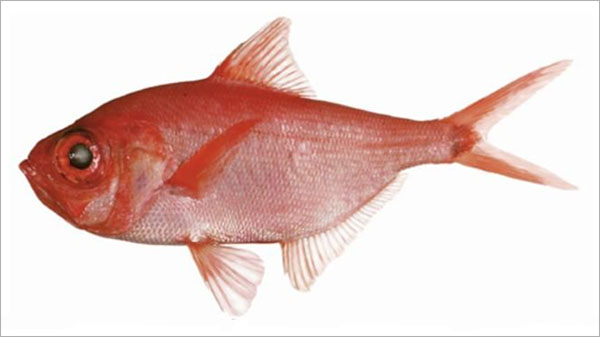 빛금눈돔. 보존 개체. Preserved specimen of Splendid alfonsino(Beryx splendens). Author/CSIRO(Australian National Fish Collection)
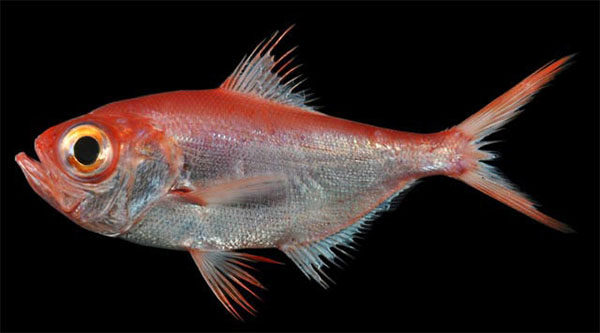 빛금눈돔. 보존 개체. Preserved specimen of Splendid alfonsino(Beryx splendens). Author/Robertson Ross. (CC BY-NC-SA)
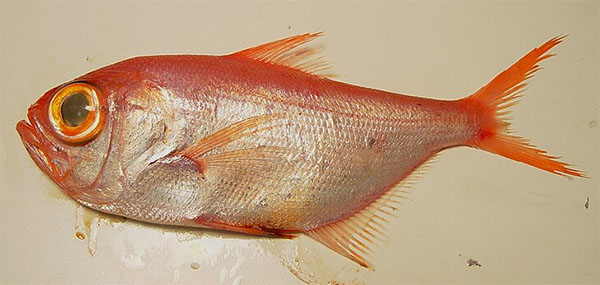 빛금눈돔. 보존 개체. Preserved specimen of Splendid alfonsino or slender alfonsino(Beryx splendens). Author/NOAA's Fisheries Collection
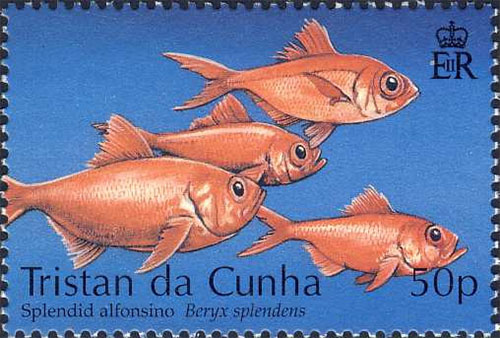 트리스탄다쿠냐가 발행한 빛금눈돔 우표, “Tristan da cunha”는 남대서양, 아프리카 남서단의 희망봉 서쪽에 위치하는 영국령의 트리스탄다쿠냐 제도를 의미함. Stamp of Beryx splendens issued by Tristan da Cunha, “Tristan da cunha” refers to the British Tristan da Cunha Islands located in the South Atlantic Ocean, west of the Cape of Good Hope at the southwestern tip of Africa. Author/Collection Georges Declercq
 일본 어시장의 빛금눈돔. For sale. Splendid alfonsino(Beryx splendens). Yanagibashi Central Market, Nagoya, July 2015. Author/Joel Abroad.
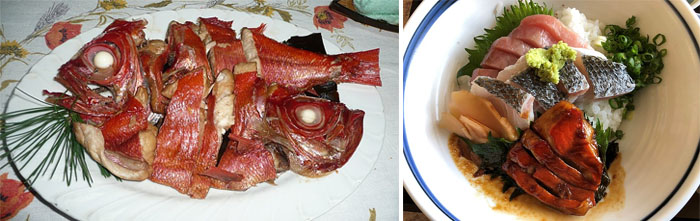 Left/일본의 빛금눈돔 조린 요리. Japanese dish of boiled down Splendid alfonsino. Location/Hamamatsu, Japan. Author/Brücke-Osteuropa. Right/일본의 빛금눈돔 사시미. Sashimi of Splendid alfonsino. Location/Muroto kinme-don at Tosa, Japan. Author/Totti
 Left/일본의 조린 빛금눈돔 요리. Japanese dish of boiled down Splendid alfonsino. Author/machu. Right/일본의 빛금눈돔 사시미. Sashimi of Splendid alfonsino. Location/Muroto kinme-don at Tosa, Japan. Author/Totti




 검색
