
사이트 로그인
사이트 로그인
경골상강→조기강→농어목→전갱이과→유전갱이(Coastal trevally; Carangoides coeruleopinnatus)
Superclass Osteichthyes→Class Actinopterygii→Order Perciformes→Family Carangidae→Coastal trevally; Carangoides coeruleopinnatus

|
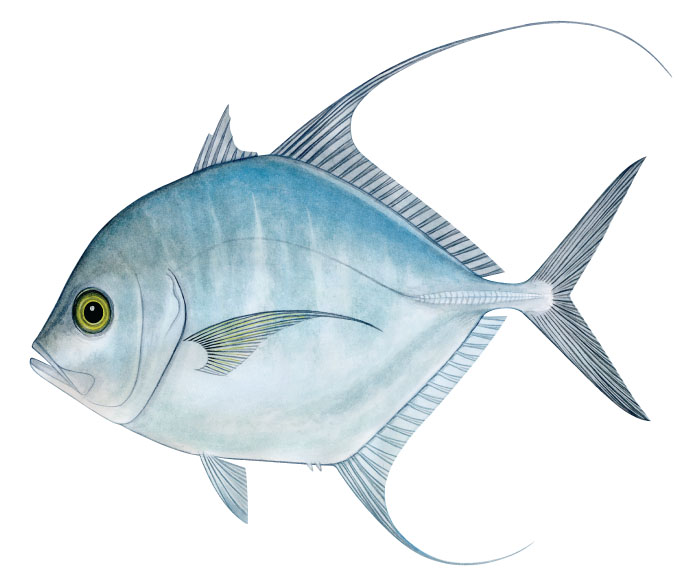
| [painting 1] 유전갱이의 기본체형. Lateral view. Ref. Live specimen photo and profile drawings by others. |
|
| [painting 2] 유전갱이의 유어. Juvenile. Ref. death specimen photos. |
농어목 전갱이과 Order Perciformes Family Carangidae(jacks and pompanos)
유전갱이(Coastal trevally)
Carangoides coeruleopinnatus (Rüppell, 1830). 41cm(TL)
D/spine8+1, soft ray21~23, A/spine2+1, soft ray18~19, Scutes/16~26.
※동종이명; Carangoides uii (Wakiya, 1924).
분포; 인도•서태평양/한국의 남해, 일본 남부, 동아프리카, 사모아, 통가, 오스트레일리아, 뉴칼레도니아에 분포.
일반개요; 체측에 수많은 작은 노랑색 점들이 있다. 노랑색 점들을 가진 다른 종에 비해 체고가 높은 것이 특징이다.
등지느러미가 2구역으로 분명하게 구분되며 제1등지느러미는 8개의 가시지느러미로 구성되었고 제2등지느러미는 첫 기조가 가시지느러미이며 그 뒤로 20-23개의 연조가 이어져있다. 등지느러미와 뒷지느러미의 첫 연조는 어렸을 때 실처럼 연장되어 있다가 성장하면서 연장부가 없어진다. 측선의 직선 부분에 16-20 개의 인판(scute)이 열 지어 있다. 측선 전체에는 31-50 개의 인판이나 인판비늘이 있다. 양턱에 융모(絨毛) 이빨로 이루어진 띠가 있으며 앞쪽으로 갈수록 띠 폭이 넓다. 살아 있을 때 등쪽은 청록색이며 밑으로 은회색이다. 측면에 많은 작은 노랑 점들이 있다. 아가미뚜껑 위 가장자리에 검정 점이 있다. 등지느러미, 뒷지느러미, 꼬리지느러미는 칙칙한 색이지만 꼬리지느러미는 연하게 노랑색을 띨 때가 많다. 가슴지느러미도 연한 노랑색을 띨 때가 있고 배지느러미는 투명하거나 회색이다. 어릴 때 어두운 세로 무늬들이 있다가 성장하면서 희미해진다. 작은 무리를 짓거나 단독으로 돌아다니며 크릴, 만티스, 새우, 작은 물고기, 오징어 등 외에 중층에 뜬 플랑크톤 먹이를 주식한다. 이빨이 융모 이빨로 약해서 큰 먹이를 물지 못한다. 생태에 관해 별로 알려진 것이 없다. 맛있는 식용어이기는 하지만 아시아에서 비싼 축에 들지는 못한다.
※국내의 학명은 “Carangoides uii (Wakiya, 1924)”로 기록되어 있으나 오류로 밝혀져 있다. “Carangoides coeruleopinnatus”가 국제적으로 공인된 학명이다. “Carangoides uii”는 1924년에 일본의 Yojiro Wakiya가 “Coastal trevally(Carangoides coeruleopinnatus)”의 어린 개체인 줄 모르고 처음 보는 모습의 개체에 붙인 학명이며 'Japanese trevally'라는 영명 이름으로 전 세계 문헌에 기록되어 나갔다. 본종은 1830년에 독일의 자연과학자 에드워드 류뻴(Eduard Rüppell)이 홍해에서 채집한 샘플로 최초의 과학적 동종을 하여 학명을 “Carangoides coeruleopinnatus”라 정한 것이며 이 샘플이 정기준(正基準) 표본(holotype)으로 지정되었었다. 1986년에 William Smith-Vaniz.가 “Carangoides uii”는 “Carangoides coeruleopinnatus”의 어린 개체인 사실을 밝혀 내고 학명을 “Carangoides coeruleopinnatus/Rüppell, 1830”로 통일하고 일반명을 “Coastal trevally”라고 정하였다.
※유전갱이의 첫 글자 ‘유’는 학명(Carangoides uii)의 uii 또는 일본명 중 하나인 Ui-aji에서 따온 것 같다. 한국어도보(정문기)에 ‘본종은 Mori가 1955년에 부산에서 입수하였다는 보고가 있다’라고 기술되어 있다. 학명 Carangoides uii에서 [‘유’전갱이]란 한국명이 생겼다면 Carangoides uii는 무효가 된 학명임으로 후에 “유”의 유래를 파악하기가 더 어려워질 것으로 보인다. ‘유전갱이’를 사용한 또 다른 한국명에 “점무늬유전갱이(Carangoides orthogrammus)”가 있다.
Order Perciformes(perch-likes), Family Carangidae(jacks and pompanos)
Coastal trevally
Korean. n. Yu-jeon-gaeng-i (유전갱이)
Carangoides coeruleopinnatus (Rüppell, 1830). 41cm(TL)
※synonym; Carangoides uii (Wakiya, 1924).
Distribution: Indo-West Pacific/East Africa to Samoa and Tonga, north to southern Korea, Japan, south to Australia and New Caledonia.
General: Numerous small yellow spots on body, differs from other yellow spotted species by having a deeper body. The dorsal fin is divided into two distinct sections, the first consisting of 8 spines, with the second consisting of a single spine followed by 20 to 23 soft rays. First rays of soft dorsal and anal fins equally prolonged in young, with growth, both ultimately becoming short. The straight section of the lateral line contains 16 to 20 scutes, with the lateral line having 31 to 50 combined scales and scutes over its entire length. Both jaws contain bands of villiform teeth, with the bands becoming wider anteriorly.
In life, the coastal trevally is bluish green above, fading to a silvery grey on the underside, with the sides having many small yellow spots. There is a small dark blotch on the upper margin of the opercle. The dorsal, anal and caudal fins are dusky, although the caudal is often slightly yellow, while the pectoral fins are pale yellow and the pelvic fins are hyaline to grey. Juveniles have dark vertical bands which fade as the fish become adults, and become indistinct at larger sizes. The species is known to occur both in small shoals and individually, and is a planktonivorous fish, consuming small midwater organisms including krill, mantis shrimp, small fish and squid. The mouth of the coastal trevally is soft, and the teeth fairly weak, which prevents the capture of larger prey items. It is a rather sluggish fish in comparison to other members of the Carangidae. Nothing is known of reproduction in the species, and its movements are also unknown. Due to its deep reef nature, the species is of little interest to anglers, and is rarely taken by them. The coastal trevally is considered to be a good table fish, however, and it has limited commercial value in Asia.
※The species was first scientifically described and named by the German naturalist Eduard Rüppell in 1830 based on a specimen collected from the waters of the Red Sea off Saudi Arabia, which was designated to be the holotype. In 1924, a juvenile specimen was named Caranx uii by Yojiro Wakiya, a name which became widespread throughout the literature, and was commonly known as the 'Japanese trevally', before being sunk into C. coeruleopinnatus in 1986 by William Smith-Vaniz.


|


 검색
