Order Ophidiiformes Family Carapidae(pearlfishes)
Pearl fish
Carapus acus(Brünnich, 1768). Max length: 20.8cm TL
FAO global name/Rubioca(Spanish)
Chinese name/无须潜鱼(무수잠어), 針潛魚(침잠어)
D/soft ray 37-39. A/soft ray 58. Vertebrae/48
Distribution; Eastern Atlantic/including the Mediterranean. Probably south to Ascension Island.
General; Pearl fish is mainly distributed in entire Mediterranean, common in western part and the coasts of north of central African continent in eastern Atlantic. Carapus acus is a laterally-compressed, elongated fish growing to a length of about 20 cm. The head measures about one eighth of the total length and there are 84 to 92 vertebrae, which gives the fish great flexibility. Cardiform teeth present but restricted to upper jaw symphysis, lacking enlarged dentary or premaxillary fangs, Swim bladder constricted forming two chambers. Possesses a free, movable maxilla. Dorsal and anal fin continuous. There is no caudal fin and the tail ends with a point. The gut loops back and the anus is located just behind the head, in front of the pectoral fins. This fish is translucent, with a number of silvery or reddish-gold iridescent spots on the operculum and the thoracic region. The peritoneum lining the body cavity is an opaque silvery colour.
Ecology; Carapus acus usually lives inside the respiratory tree or the body cavity of sea cucumbers. Neither the species nor the size of the host seem important in host choice, and the fish makes use of whatever sea cucumber it happens to encounter; the most common host are Parastichopus regalis and Holothuria tubulosa, while others include, H. poli, H. arguinensis, H. sanctori and H. mammata. The fish swims close to the seabed searching for a suitable host. When it finds one, it positions its head beside the sea cucumber's anus, from which a current of water is being expelled. Either it then bends its flexible tail around, inserts it in the sea cucumber's anus and works its way backwards inside, with the tail entering first, or less commonly. it thrusts its head into the orifice and enters with a sharp flick of its tail, turning round when inside the host. In either case, it positions itself with its head close to or protruding from the sea cucumber's anus. Because the fish's anus is located just behind its head, it is able to defecate into the open water without fouling its host.
Pearlfishes are able to produce sounds by means of certain muscles connected to the swim bladder, with each species producing a sound unique to its species. The function of these sounds is unclear, various hypotheses have been proposed including finding a mate, indicating the size of the fish while it is concealed in its host, and establishing a territory. Sometimes more than one fish can occupy the same host, and mating inside the host is possible. Breeding takes place between July and September. A cluster of eggs is produced which rises to the water surface. The eggs hatch into fish fry after three days. When these larvae have grown to a length of about 80 mm they undergo metamorphosis into juveniles, becoming elongated and laterally flattened. At this time they move to the seabed to find a suitable host. Juvenile fish may nibble the reproductive organs or the gills of their host; this causes little damage because sea cucumbers have great regenerative powers. Adults are nocturnal, spending the day inside its host, emerging at night to feed.from their host and feeding on small crustaceans, worms, and fish fry, before returning to their hosts.
|

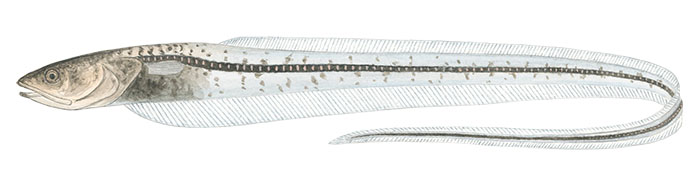
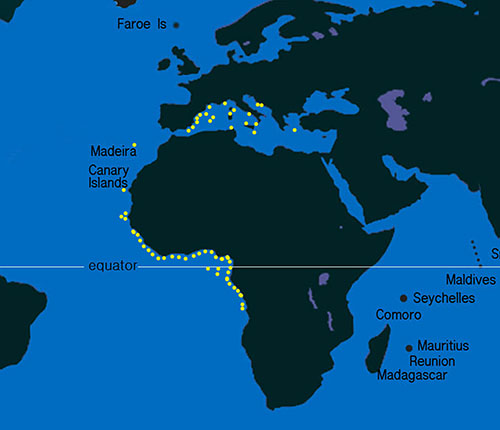 펄피시 분포도. Distribution map of Pearl fish(Carapus acus). Derived work. Author/Kim In Young(fishillust.com).
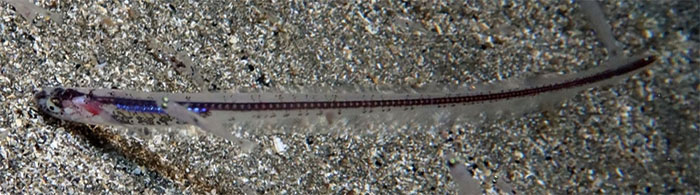 펄피시. Pearl fish(Carapus acus), observed in France. Original picture cropped and turned. Author/Xavier Rufray
 펄피시. Pearl fish(Carapus acus), Author/Michel DUNE
 펄피시. Pearl fish(Carapus acus), in Sicilian waters. Author/Etrusko25
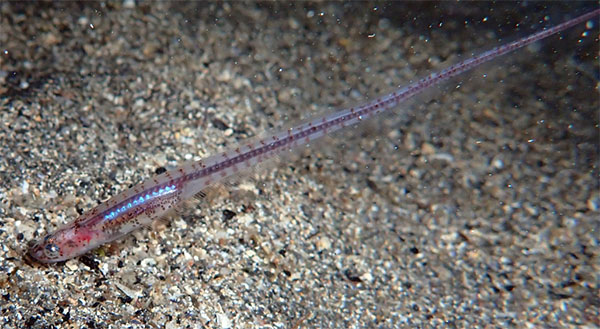 펄피시. Pearl fish(Carapus acus). Author/Sylvain Le Bris
 해삼의 항문으로 들어가고 있는 펄피시(종명 미상). BBC 동영상 캡처 사진. A Pearlfish entering the anus of a sea cucumber(species name unidentied). Captured from youtube BBC Earth.
 해삼의 항문으로 들어가서 몸을 돌려 머리를 밖으로 내밀고 있는 펄피시(종명 미상). BBC 동영상 캡처 사진. Pearlfish that entered the body cavity of sea cucumber, turned its body and stick its head out. Captured from youtube BBC Earth.




 검색
