
사이트 로그인
사이트 로그인
|
분류계보/경골상강→조기강→앨퉁이목→스토미아스과→슬론스 바이퍼피시(Sloane's viperfish; Chauliodus sloani) Copyright by Kim In Young. 김인영 그림
|
 |
| 슬론스 바이퍼피시 기본 모습. Lateral view of Sloane's viperfish(Chauliodus sloani) |
앨퉁이목 스토미아스과 Order Stomiiformes Family Stomiidae(Barbeled dragonfishes). 분포; 전세계 열대와 온대 바다에 분포. 슬론스 바이퍼피시는 주야간 수심 이동을 하는 다른 종들과 달리 낮이나 밤에나 200m-1000m 수심 범위에 머물러 있다. 어린 개체들 중 일부가 제한된 수심대에서 주야간 수심 이동을 하는 일이 발견되기는 한다. 지중해에서는 슬론스 바이퍼피시가 대서양 블루핀 튜나(Atlantic bluefin tuna)의 주식 먹이감이 된다. 턱의 구조; 슬론스 바이퍼피시의 가장 흥미있는 특징은 아주 큰 입에 있다. 아래 위 턱을 닫으면 이빨들이 맞물리면서 먹이감을 잡아 넣을 수 있는 가두리가 된다. 턱을 회전시키는 경첩을 풀어버릴 수가 있는데 이렇게 하면 입이 90° 각도로 벌어지며 자기 몸 크기의 63%에 해당하는 큰 먹이를 삼킬 수 있다. 이빨이 눌려지는 다른 종들과 달리 슬론스 바이퍼피시의 이빨은 턱뼈에 단단히 박혀 고정되어 있다. 이빨은 길고 턱에 고정되어 있으므로 입을 크게 벌릴 수 있어야 되는 것이다. 입을 더욱 크게 벌릴 수 있는 까닭은 입에 바닥이 없기 때문이다. 거의 모든 슬론스 바이퍼피시들은 이빨 개수, 크기, 위치가 일정하며 송곳니들은 매우 효율적으로 생겼다. 발광포로 먹이를 입으로 유인하기도 하고 등지느러미의 긴 기조를 입 앞으로 내려서 루어를 만들어 사냥감을 유인하기도 한다. 잎 앞에 유인된 큰 사냥감은 최 전방 턱에 있는 직선형 이빨에 찔려 걸려들고 그 다음 뒤에 있는 휘어진 이빨이 먹이를 장악한다. 작은 먹이감은 5개의 모든 이빨이 닫히면서 우리에 갇히게 된다. 슬론스 바이퍼피시의 주식은 샛비늘치(lanternfish/myctophidae)이며 그 외에 다른 물고기나 알 해조류도 먹는다. 갑각류를 주로 먹는 같은 속의 다른 종(예; C. danae)과 다른 특징이다. |
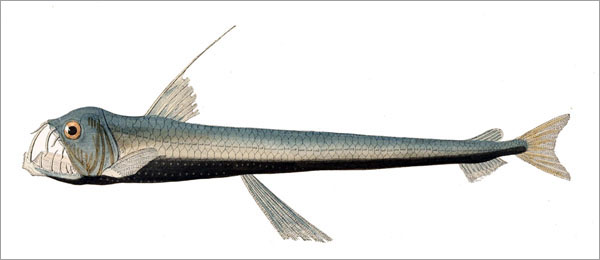 슬론스 바이퍼피시. Sloane's viperfish. 종명/Chauliodus sloani. Author/Gervais et Boulart. Date/1877 |
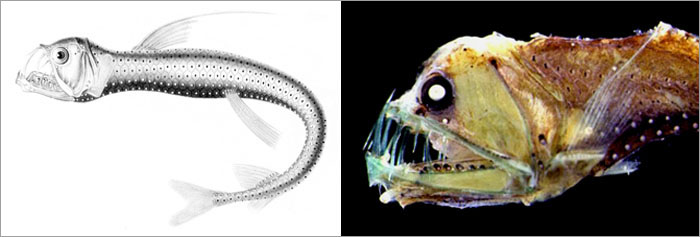 Left/슬론스 바이퍼피시. Sloane's viperfish. 종명/Chauliodus sloani. Author/Mlle Alberti Rightl/슬론스 바이퍼피시 표본의 머리 부분. Head and mouth portion of reserved Chauliodus sloani. Author/prof. Francesco Costa |
Order Stomiiformes Family Stomiidae(Barbeled dragonfishes). Distribution; Warm and temperate parts of all oceans but with several distributional gaps in the southern central Atlantic, northern Indian Ocean, eastern Pacific north of the equator, etc. Also found in the western Mediterranean. South China Sea and East China Sea. It generally stays at depths from 200 m-1000 m, both day and night, in contrast to C. danae, whose individuals exhibit diurnal migration. Some small individuals of C. sloani also exhibit some limited diurnal migration. In the central Mediterranean Sea, C. sloani is eaten as a primary part of the diet of the Atlantic bluefin tuna. Jaw Anatomy; The primary feature of interest in C. sloani is its enormous teeth. When the jaw is closed, the teeth fit together to form a cage in which prey can be trapped. Its jaw can be unhinged, allowing it to open its mouth up to 90° to catch prey up to 63% its own body size. Its teeth, however, are fixed in place, attached firmly to the jawbone rather than being depressible like in some other fish species. The immobility of its huge teeth requires it to be able to open its jaw so wide. Also helping with jaw expansion is the fact that its mouth does not have a floor. The size, shape, location, and number of teeth are consistent across individuals of C. sloani, and each fang is highly specialized. C. sloani likely lures prey to its mouth with its photophore, or by arching its long dorsal ray to dangle in front of its mouth. The foremost premaxillary tooth, which is relatively straight and has sharp ridges, may then be used to wound larger prey. The curved second premaxillary tooth is thought to be used like a dagger, retaining larger prey.5 All teeth come together into a cage to retain smaller prey. C. sloani is a major consumer of myctophidae, or lanternfish, having a significant effect on their population in the Arabian Sea. An average C. sloani individual probably consumes at least one lanternfish every twelve days. However, they are not picky in their diet - they also eat other fish, eggs, and algae. This is another thing that distinguishes them from the C. danae, which feeds mainly on crustaceans. |


|
| Copyright ⓒ FISHILLUST.COM All rights reserved. All contents can not be used without permission of the copyright holder. |


 검색
