
사이트 로그인
사이트 로그인
|
분류계통/경골상강→조기강→쏨뱅이목→성대과→블루핀성대 Copyright by Kim In Young. 김인영 그림
|
| ㅎㅎㅎㅎㅎㅎㅎㅎㅎㅎㅎㅎㅎㅎ |
| 블루핀성대 기본 모습. Lateral view of Bluefin gurnard(Chelidonichthys kumu) |
쏨뱅이목 성대과 Dorsal spines/9-10, Dorsal soft rays/15-16. Anal spines/0, Anal soft rays/14-16. P1/soft rays 13-14. P2/spine1, soft rays 5. Vertebrae/33-35. Gill rakers/8-10. Lateral line scales/70-80 분포; 인도-서태평양/오스트레일리아와 뉴질랜드에서 흔히 발견되며, 그 외에 모잠비크, 남아프리카, 한국의 남부 해역, 일본의 홋카이도 이남, 동중국해(타이완 홍콩)에 분포한다. 불루핀성대의 가슴지느러미는 크고 부채모양으로 생겼다. 가슴지느러미의 앞쪽 3개 연조는 지느러미 막 없이 각각 분리되어 있다. 이 3개 연조들을 “손가락”이라고 부르기도 하며 이를 이용하여 바닥을 서서히 걸어 다닌다. 또한 모래나 펄 바닥을 찔러서 숨어있는 먹이를 찾아내는 탐지기 역할을 한다. 자연상태의 정상적인 몸색은 올리브 색 또는 연한 황갈색이며 배쪽은 연하거나 백색이다. 몸색이 빨간 사진들이 많이 소개되고 있지만 스트레스를 받는 경우에만 몸이 적색으로 변한다. 큰 가슴지느러미는 색상이 화려히다. 가슴지느러미의 안쪽 면 바탕색은 올리브 그린색이거나 회색이거나 또는 자주색일 때가 있으며 이 위에 청색 점들이 산재하며 안쪽 면 전체의 테두리는 밝은 청색이다. 어떤 경우에는 안쪽 면 기부 쪽 가깝게 큰 검정 반점이 있고 그 위에 백색 또는 청색의 점들이 들어 있다. 화려한 가슴지느러미는 불루핀성대를 마치 바다의 나비처럼 보이게 하는데 이 특징의 목적이 무엇인지는 확실하게 밝혀지지 않았다. 짝을 유인하는데 쓰이거나 적을 놀라 도망가게 하는 기능을 가졌을 것이다. 부채 형 가슴지느러미는 헤엄칠 때 균형을 유지하는데도 도움이 될 것이다. 불루핀성대는 바닥에 사는 저서형 물고기이며 수심이 얕은 연안 바다를 선호하는데 대륙붕 가장자리 또는 모래나 펄 바닥이 있는 강 하구의 기수역에서도 발견될 수 있다. 수심 1m 바닥에서도 발견되지만 일반적인 서식 수심은 100-200m이며 최대 300m 수심에서도 발견된다. 기습 공격을 하기 위해 머리 꼭대기, 주둥이 그리고 눈 만 노출시킨 채 몸을 흙 속에 숨길 수 있다. 불루핀성대는 기회 섭식자이며 주로 갑각류를 먹으며 그 외에 작은 물고기와 갯지렁이류도 먹는다. 불루핀성대는 가시에 독이 있는지 없는지에 대해 설이 확실하지 않다 성장 생태/불루핀성대의 알은 7일 만에 부화하며 빨리 성장하여 2-3년 후에 성어가 된다. 성어가 된 후에는 성장이 매우 느리며 깊은 수심으로 이동한다. 깊은 수심에서 발견되는 개체들은 얕은 수심의 개체들보다 평균적으로 나이가 더 많고 크기도 더 크다. 보통 수컷은 26 cm 암컷은 33 cm로 암컷이 더 크다. 최대 수명은 12년이다. 식용으로 이용된다. ※ 본 종은 해양수산부 국립수산과학원이 2017∼2018년에 실시한 우리바다 경계해역에 대한 자원조사에서 채집된 어린 개체들 하나로 한국 미기록 종으로 판명된 것이며 아직 한국명이 부여되지 않는 물고기이다(2022년말 현재). |
Oder Scorpaeniformes Family Triglidae(Searobins) Dorsal spines/9-10, Dorsal soft rays/15-16. Anal spines/0, Anal soft rays/14-16. P1/soft rays 13-14. P2/spine1, soft rays 5. Vertebrae/33-35. Gill rakers/8-10. Lateral line scales/70-80 Distribution; Indo-West Pacific/south sea of Korea, south of Hokkaido Japan, East China Sea(Taiwan, Hong Kong, common in Australia and New Zealand, Delagoa Bay, Mozambique to the Cape, South Africa. The bluefin gurnard has large, fan-like pectoral fins. The pectoral fins’ first three rays are modified and separated from the rest of the fin. Free rays sometimes referred to as “fingers”. They ‘walk’ slowly over the seabed using their first three free-rays. Free-rays are also used as sensory organs, permitting it to probe the sea bottom to detect prey buried in the sand or the mud. Its natural colour is olive or brownish and the belly is paler or even white, although there are many pictures of red body color, generally only becoming red when stressed. The inner surface of the pectoral fin is olive-green to greyish or purplish with scattered blue spots, a blue margin around the fin. In some cases, with a large black blotch near the base of the inner surface with white or blue spots upon it. These spectacular pectoral fins make the blue gurnard look like a butterfly of the sea, however their role is not entirely known. They could be used to attract a mate or frighten off predators. These fan-like fins can also be used to give stability during swimming. As a benthic marine fish, the bluefin gurnard prefers shallow coastal waters and may be found from the edge of continental shelves to estuaries and brackish rivers with soft bottoms of sand, sandy-shell, or mud. It is found from shallow waters one meter deep but generally inhabits 100-200m but may have maximum depths of up to 300m. They can bury themselves in the substrate, with only the top of their head, their nostrils and eyes exposed in order to surprise prey. The bluefin gurnard is an opportunistic feeder, preying principally on crustaceans but also small fish and polychaete worms. It is unclear whether Bluefin gurnards are venomous or not. Growth/Bluefin gurnard eggs develop for 7 days before hatching, and grow rapidly until they reach maturity at 2–3 years old. After reaching maturity growth slows considerably and they move into deeper water where bluefin gurnards found in deeper strata were older and longer on average than those found inshore. Males are smaller than females at around 26 cm and 33 cm respectively and they may live for over 12 years. This fish is edible for humans. ※ This species is one of the juveniles collected in the resource survey of the boundary waters of Korean sea conducted in 2017-2018 by the National Institute of Fisheries Science of the Ministry of Oceans and Fisheries. Has been identified as an unrecorded species in Korea and has not yet been given a Korean name(as of the end of 2022). |
 블루핀성대 분포도. Distribution map of Bluefin gurnard(Chelidonichthys kumu). Author/fishillust.com, source/GBIF |
 블루핀성대. 유어. 수중사진. Bluefin gurnard(Chelidonichthys kumu). Juvenile. Location/Blairgowrie Yacht Squadron, Port Phillip, Victoria, Australia. Author/debaston. License:/CC By Attribution-NonCommercial. Source/inaturalist.org |
 블루핀성대. 수중사진. Bluefin gurnard(Chelidonichthys kumu). Location/Salt Rock, Durban, South Africa. Author/Duncan Pritchard. License:/CC BY-NC. Source/inaturalist.org |
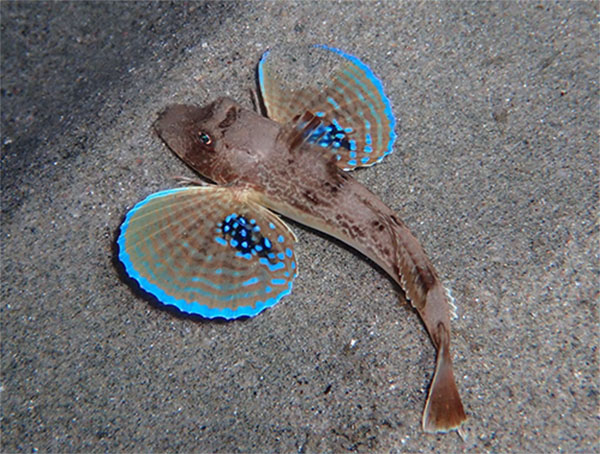 블루핀성대. Bluefin gurnard(Chelidonichthys kumu). Location/observed in France. Author/Sylvain Le Bris License:/CC BY-NC. Source/inaturalist.org |
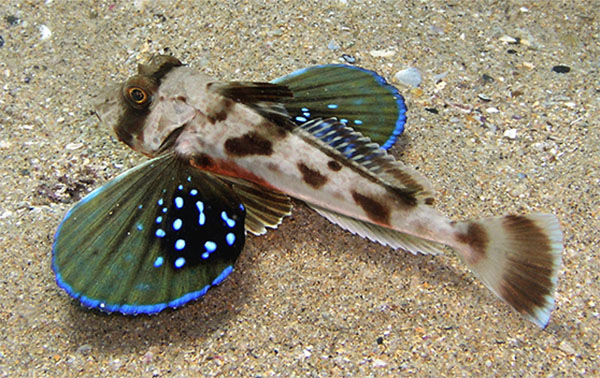 블루핀성대. 유어. 수중사진. Bluefin gurnard(Chelidonichthys kumu). Juvenile. Location/at the mouth of the Minnamurra River, New South Wales, Australia. Author/ Sascha Schultz. License:/CC By Attribution-NonCommercial. Source/inaturalist.org |
 블루핀성대. 수족관 사진. 가슴지느러미를 뒤집지 않은 정상적인 각도로 가지고 있기 때문에 안쪽의 화려한 청색 무늬가 보이지 않는다. Bluefin gurnard(Chelidonichthys kumu). Because it has its pectoral fins at normal angle that is not inverted, the colorful blue pattern on the inside is not visible. Aquarium photo. Location/Cape Town, South Africa. Author/Brian Gratwicke |
 블루핀성대. 수중사진. Bluefin gurnard(Chelidonichthys kumu). Location/Wellington Harbour, New Zealand. Author/Jojoe, photgraphy. License:/CC By Attribution-NonCommercial |
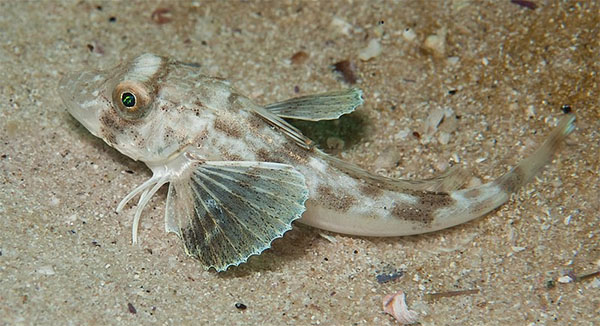 블루핀성대. 수중사진. 가슴지느러미를 뒤집지 않은 정상적인 각도로 가지고 있기 때문에 안쪽의 화려한 청색 무늬가 보이지 않는다. Bluefin gurnard(Chelidonichthys kumu). Underwater photo. Bluefin gurnard(Chelidonichthys kumu). Because it has its pectoral fins at normal angle that is not inverted, the colorful blue pattern on the inside is not visible. Location/Cape Town, South Africa. Author/Georgina Jones |
 블루핀성대. 수족관 사진. 가슴지느러미를 뒤집지 않은 정상적인 각도로 가지고 있기 때문에 안쪽의 화려한 청색 무늬가 보이지 않는다. Bluefin gurnard(Chelidonichthys kumu). Location/Ushaka Sea world(South Africa). Bluefin gurnard(Chelidonichthys kumu). Underwater photo. Bluefin gurnard(Chelidonichthys kumu). Because it has its pectoral fins at normal angle that is not inverted, the colorful blue pattern on the inside is not visible. Author/Amada44 |
 블루핀성대 묘사도. Illustration of Bluefin gurnard(Chelidonichthys kumu). Date/1921, Author/Edgar Ravenswood Waite(1866–1928) |
 블루핀성대 묘사도. 가슴지느러미가 뒤집혀지지 않은 정상적인 각도로 놓여 있기 때문에 안쪽의 화려한 청색 무늬가 표현되지 못했다. Illustration of Bluefin gurnard(Chelidonichthys kumu). Because the pectoral fins are placed at normal angle that is not inverted, the brilliant blue pattern on the inside is not expressed. Author/CAFSS |


|
| Copyright ⓒ FISHILLUST.COM All rights reserved. All contents can not be used without permission of the copyright holder. |


 검색
