
사이트 로그인
사이트 로그인
|
분류계통/경골상강→조기강→쏨뱅이목→성대과→성대 Copyright by Kim In Young. 김인영 그림
|
| image on preparing |
| 성대 기본 모습. Lateral view of Spiny red gurnard(Chelidonichthys spinosus) |
쏨뱅이목 성대과 분포;서북태평양/한국의 전 해역, 일본 홋카이도 이남, 황해, 타이완, 동중국해, 남중국해. 몸은 원통형으로 꼬리쪽으로 갈수록 심하게 가늘고 배쪽은 편평하여 바닥에 앉기 편하다. 머리는 위아래로 납작한 편이며 측면에서 보면 큰 삼각형이다. 머리는 단단한 골판으로 덮여 있고 여러 개의 융기부와 가시들이 있다. 그러나 후두골 홈(occipital groove)은 없다. 눈은 머리의 위에 있다. 눈 지름은 두 눈 사이 거리보다 크다. 콧구멍은 두 쌍이다. 몸은 매우 작은 둥근비늘로 덮여 있으나 가슴에는 비늘이 없다. 등지느러미 2개의 기부에 단단한 가시가 돋은 작은 골판들이 배열되어 있다. 꼬리지느러미 뒤 가장자리는 약간 안으로 패인 거의 수직에 가까운 형이다. 근육을 이용하여 부레를 압축시켜 소리를 낸다. 해질 무렵부터 밤 동안 가끔 부레를 이용하여 큰 소리를 낸다. 전체적인 색상은 올리브 색, 황갈색 또는 회갈색이며 스트레스를 받거나 죽은 후에는 진한 적색을 띤다. 가슴지느러미의 바깥쪽 면은 청색이며 안쪽 면의 하단 반 부분에는 많은 수의 밝은 점들이 있는데 살아있을 때는 청색이며 죽은 후에는 색이 옅어지거나 백색으로 변한다. 어떤 때는 가슴지느러미 안쪽 하단 부위 무늬가 검은 반점으로 나타날 수 있다. 가슴지느러미는 매우 크고 길며, 그 길이는 제2등지느러미의 중간부까지 이르지는 못한다. 가슴지느러미 아래쪽의 분리된 3연조는 손가락 형태로 크고 두꺼워 바다 밑바닥을 걸어 다니거나 먹이를 찾는 촉각으로 이용된다. 열대와 온대 해역에 살며 수심 20~30m에 있는 모래 바닥이나 모래와 펄이 혼합된 바닥에서 발견된다. 발견되는 최대 수심은 630m이다. 한국의 성대는 서해 개체군, 동중국해 개체군, 대마도 개체군, 3 개체군으로 구분되어 있다. 연 1회 산란하나 시기는 해역에 따라 약간씩 차이가 난다. 동중국해에서는 겨울에서 봄 사이에, 제주도 근해에서는 여름에 산란한다고 알려져 있다. 생후 4년이 지나면 성숙하여 산란을 시작한다. 먹이로는 주로 새우 등의 저서성 갑각류와 작은 물고기 등을 먹는다. 계절회유를 하며, 주로 저층 트롤어업, 안강망, 자망에 의해 어획된다. 살은 희고 맛이 담백하여 고급어로 취급된다. 냄비요리 외에 생선회•찜•생선구이 등으로 인기가 좋다. 방언에는 승대, 싱대, 잘대, 끗달갱이, 쌀대 등이 있다. |
Oder Scorpaeniformes Family Triglidae(Searobins) Distribution; Northwest Pacific/All coastal waters of Korean Peninsula, South of Hokkaido Japan(mainly west of Kyushu), Yellow Sea, Taiwan, East and South China Sea. Body is cylindrical, extremely tapering towards tail, and flat on the ventral side, making it easy to sit. The head is moderately depressed from top to bottom and has large triangular shape when viewed from the side. The head is covered with hard bony plate and bears a number of ridges and spines. However, there is no occipital groove. The eyes are on top of the head. The diameter of the eyes exceeds the distance between them. With two pairs of nostrils. The body is covered with very small round scales, but the breast lacks scales. The base of both the dorsal fins have small, robustly spined plates. The rear edge of caudal fin is almost vertical with a slight indentation. Can produce sound by compressing the air bladder using muscles. From dusk to night, it occasionally makes loud noises using its air bladder. The overall colour is olive, brownish or grayish brown, changing to red under stress. Outer side of pectoral fin is bluish. Lower half of the inner side of pectoral fin with scattered numerous pale spots(bluish in life, white or pale in preserved specimens). A black blotch appears occasionally on lower inner side of pectoral fin. Pectoral fin is very large and long, and the posterior end not reaching level of middle 2nd dorsal fin. The separated 3 soft rays of lower side are large and thick in the form of fingers and used for walking on the floor or as a sensor for finding food. Occurs in the tropical to warm temperate areas on sandy or sandy mud substrates ate depths of 25 to 630 m. The maximum depth found is 630 m. Spiny red gurnards of Korea are divided into three populations: the West Sea population, the East China Sea population, and the Tsushima population. It spawns once a year, but the timing varies slightly depending on the sea area. It is known to spawn between winter and spring in the East China Sea, and in summer in Jeju Island. After 4 years of age, they mature and start laying eggs. It mainly eats benthic crustaceans such as shrimp and small fish. They migrate seasonally, and are mainly caught by low-level trawling, snare nets, and gill nets. The flesh is white and the taste is light, so it is treated as a high-class fish. In addition to hot pot dishes, it is popular for sashimi, steamed fish, and grilled fish. |
 성대의 분포도. Distribution map of Spiny red gurnard(Chelidonichthys spinosus). Author/fishillust.com. Data sources: AquaMaps(2019, October). |
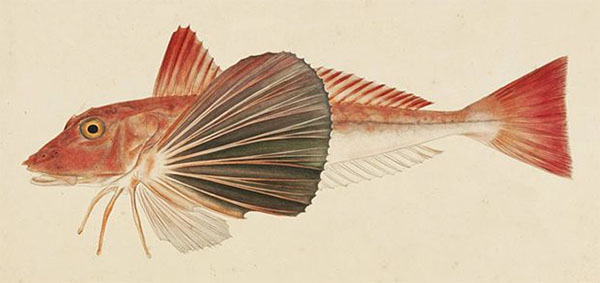 성대 묘사도. 가슴지느러미가 정상적으로 외측면을 보이고 있기 때문에 안쪽의 화려한 청색 무늬가 나타나 있지 않다. Illustration of Spiny red gurnard(Chelidonichthys spinosus). Because the pectoral fin normally shows the outside, the blue pattern on the inside does not appear. Date artwork/between 1823 and 1829. Author/Kawahara Keiga(1786–). Country/Japan |
 성대가 가슴지느러미의 안쪽 면을 펼쳐 보이 있을 때의 무늬 패턴들. 성대는 접근하는 포식자를 놀라게 하기 위해 화려한 색상의 가슴지느러미 안쪽 면을 갑자기 펼쳐 보인다. Patterns of pectoral fin when the Spiny red gurnards are unfolding the inner surface of the pectoral fin. The Spiny red gurnards suddenly unfold the brightly colored inner surface of the pectoral fins to frighten approaching predators. Author; left/Diego Delso, center/Izuzuki, right/kuroshio. |
 성대가 가슴지느러미의 안쪽 면을 펼치고 있을 때의 무늬 패턴들. 성대는 접근하는 포식자를 놀라게 하기 위해 화려한 색상의 가슴지느러미 안쪽 면을 갑자기 펼쳐 보인다. Patterns of pectoral fin when the Spiny red gurnards are unfolding the inner surface of the pectoral fin. The Spiny red gurnards suddenly unfold the brightly colored inner surface of the pectoral fins to frighten approaching predators. Author; left/Diego Delso, center/Izuzuki, right/kuroshio. |
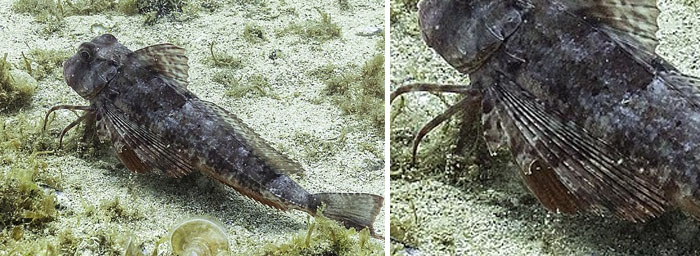 왼쪽은 성대 수중사진이며 오른쪽은 가슴지느러미를 클로즈업 시킨 사진이다. 가슴지느러미를 정상적인 각도로 유지하여 외측면이 밖으로 보이게 하고 있는 순간. Right; Spiny red gurnard at depth. Right; Close-up of the pectoral fin part from the left photo, in normal posture, the outer surface of the pectoral fins spread out. Location/Location/Arrábida Natural Park, Portugal. Author/Diego Delso |
 왼쪽은 성대 수중사진이며 가슴지느러미를 뒤집지 않은 정상적인 각도로 펼치고 있어서 지느러미의 외측이 나타나 있다 . 오른쪽은 가슴지느러미만 클로즈업 시킨 장면이다. Right; Spiny red gurnard at depth. Right; Close-up of the pectoral fin part from the left photo, in normal posture, the outer surface of the pectoral fins spread out. Location/Arrábida Natural Park, Portugal. Author/Diego Delso |
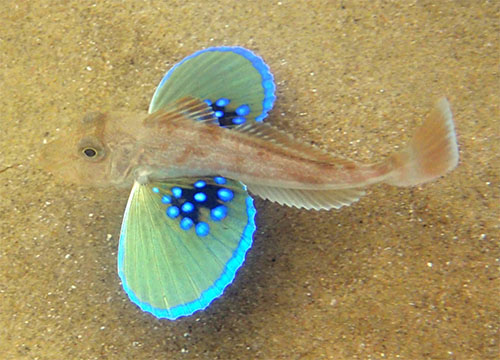 성대 수중사진. 가슴지느러미 뒤집어 내측 면을 보이고 있는 순간이어서 안쪽의 화려한 청색 무늬가 나타나 있다. Underwater photo. Spiny red gurnard(Chelidonichthys spinosus). At the moment when the inner side of the pectoral fin is showing, the brilliant blue pattern on the inside appears. Location/observed in Japan. Created 2020-06. Author/kuroshio |
 성대 수중사진. 가슴지느러미의 내측면을 보이고 있는 순간이어서 안쪽의 화려한 청색 무늬가 나타나 있다. Underwater photo. Spiny red gurnard(Chelidonichthys spinosus). At the moment when the inner side of the pectoral fin is showing, the brilliant blue pattern on the inside appears. Author/Izuzuki |
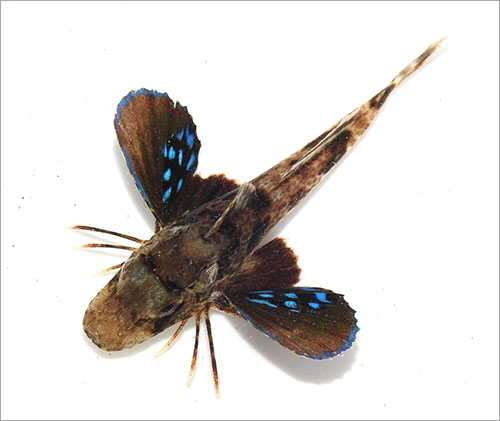 성대 죽은 개체 사진. 위에서 본 사진이어서 측면에서 본 뾰족한 주둥이 모양과 다른 넓적한 주둥이를 확인할 수 있다. Specimen in spirit. Spiny red gurnard(Chelidonichthys spinosus). This is a picture from above, so you can see the wide snout, which is different from the pointed snout seen from the side. Location/observed in Japan. Author/Rei Akiyama |
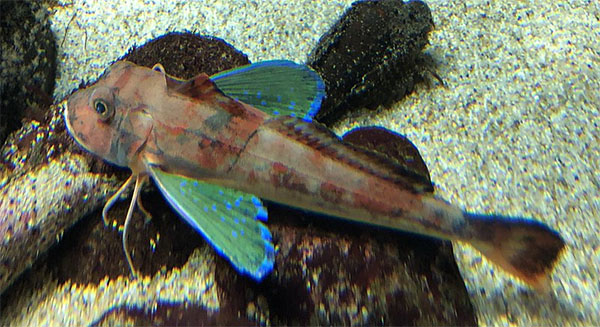 성대 수족관 사진. 가슴지느러미의 내측면을 보이고 있는 순간. Aquarium photo. Spiny red gurnard(Chelidonichthys spinosus). At the moment when the inner side of the pectoral fin is showing. Location/鶴岡市立加茂水族館飼育個体(Tsuruoka City Kamo Aquarium breeding individual in Japan). Created March 2018. Author/Totti |
 모래 속에 몸을 감추고 보호색을 띠고 있는 성대. Spiny red gurnard(Chelidonichthys spinosus). Hiding in the sand with protective coloration. Location/Madeira, Portugal. Author/Diego Delso |
 카메라맨의 접근을 피해 가슴지느러미를 활짝 펴서 헤엄쳐 도망가고 있는 성대. Spiny red gurnard(Chelidonichthys spinosus). Swimming away with its pectoral fins wide open due to the cameraman's approach. Location/Arrábida Natural Park, Portugal Author/Diego Delso. |
 생선으로서의 성대(중심에 있는 물고기) Spiny red gurnard as a food fish(specimen in the center). Location/台灣台南市(Taiwan). Author/tern911. Right/일본식 성대 요리. One of Japanese cuisine, boiled fish. Spiny red gurnard. Author/ChibaRagi |


|
| Copyright ⓒ FISHILLUST.COM All rights reserved. All contents can not be used without permission of the copyright holder. |


 검색
