
사이트 로그인
사이트 로그인
|
[분류계통도] 동물계(動物界)/Kingdom Animalia→척색동물문(脊索動物門)/Phylum Chordata→경골상강(硬骨上綱)/Superclass Osteichthyes→조기강(條鰭綱)/Class Actinopterygii 조기강(條鰭綱). Class Actinopterygii(ray-finned fishes) Class 6조기어류(ray-finned fishes) 조기어류(조기강)은 클라스키아 아강(Subclass Cladistia), 연질아강(Subclass Chondrostei), 신기아강(Subclass Neopterygii) 이렇게 3 아강으로 분리된다. 조기어류는 모든 척추동물 중에서 가장 수가 많은 집단이며 30,000종 이상의 물고기들 중 99%가 조기어류이다. 깊은 수심이든 고산지대의 하천이든 해수와 담수를 가리지 않고 어디에나 있다. 알려진 종 수에서 약 44%가 담수에 사는 종이다. 현생하는 경골어류 중에서 가장 작은 경골어는 잉어과(Cyprinidae)의 패도시프리스(Paedocypris) 속의 “Paedocypris progenetica”라는 물고기로 길이가 7.9mm이다. 그 다음으로 작은 것은 망둑어과의 난장이 피그미 고비(Dwarf pygmy goby; Pandaka pygmaea)로 길이가 9 mm이다. 이들은 척추동물 중에서 가장 작은 동물이 된다. 가장 큰 경골어는 개복치(ocean sunfish)로 최대 2300kg 나간다. 가장 긴 경골어는 산갈치(oarfish)이며 최대 11m 이상이다. 조기어류는 헤엄쳐야 하는 물고기임으로 몸의 형태가 입체적인 유선형으로 생기는 것이 원칙이겠으나 원칙에서 벗어난 형태가 많다. 나비고기와 가자미류는 아주 납작하지만 나비고기는 좁은 틈으로 돌아다니는데 그 특징을 이용하고 가자미류는 바닥에 밀착하는데 특징을 이용한다. 일부 메기류와 아귀류는 몸이 아래 위로 납작하여 바닥에 숨기에 유리하다. 어떤 물고기는 몸이 경직성이지만 뱀장어처럼 유연한 것도 있다. 복어는 가시 돋은 큰 공으로 변하여 적을 물리친다. 물고기들이 모두 꼬리지느러미 힘으로 헤엄치는데 반하여 해마류는 수직으로 서서 등지느러미 힘으로 헤엄치고 꼬리지느러미는 해초를 꽉 붙잡는데 사용한다. 해마류는 진공청소기처럼 흡입력을 가진 입으로 먹이를 삼키며 수컷이 배에 육아낭을 가지고 있다. 해마류의 이런 특수한 구조는 판타지 소설가도 상상해내기 어려운 것이다. 조기어류 중에는 몸에 각종 형태의 장식 술들이 많이 달린 것들이 많은데 물 속의 무중력성 때문에 자유스럽게 펼쳐진다. 그 대표적인 것이 드래곤 피쉬(Dragon fish)이다. 조기어류의 색깔과 무늬 패턴들은 이해할 수 없는 점이 많다. 산호암초에 사는 조기어류들은 그 색상이 모두 화려하고 빛나는데 자신을 광고해대는 것인지 아니면 눈을 속이려는 것인지 알 수가 없다. 조기어류의 번식방법 과(科/ family)를 기준해서 말하면 거의 모든 과가 체내 수정보다는 체외 수정을 한다. 경골어류 422개과 중 79%는 난생(卵生)이며 이들은 낳은 알을 보호하지 않는다. 422개과 중 나머지 21%는 태생(viviparity)과 난태생(ovoviviparity) 또는 다른 특수한 개체발생 형태이며 이들은 수컷이든 암컷이든 또는 암수 공동으로든 알이나 새끼를 보호한다(어버이양육/parental care). 조상의 조건(ancestral condition)은 어버이양육을 안 하는 것일 것이다. 태생은 경골어류 중 약 6%로 드물다. 어버이양육은 암컷보다는 수컷이 하는 경우가 더 많다. 수컷의 텃세 행위는 어버이양육의 사전 적응 현상이다. 몇 종은 단성생식(또는 처녀생식/Self-fertilise 또는 parthenogenesis)을 한다. 맹그로브 리불루스 (mangrove rivulus/송사리과 리불루스속)는 양서류처럼 살 수 있는 물고기인데 암수 성분이 동시에 한 몸에 있는 “동시발생 자웅동체(simultaneous hermaphrodite)”이다. 한 몸 안에서 알을 배고 자체 내에서 수정이 일어난다. 이 번식 방법은 물 밖에서 장시간 보내야 하는 홍수림(mangrove forests) 환경에 기인한 것으로 보인다. |
 전형적인 조기어류의 해부도(시클리드의 경우/cichlid) Anatomy of a typical ray-finned fish (cichlid) A. 등지느러미(dorsal fin): B. 지느러미의 기조(fin rays): C. 측선(lateral line): D. 신장(kidney): E. 부레(swim bladder): F. 웨버 기관(Weberian apparatus): G. 내이(inner ear): H. 뇌(brain): I. 콧구멍(nostrils): L. 눈(eye): M. 아가미(gills): N. 심장(heart) O. 위장(stomach): P. 쓸개(gall bladder): Q. 지라(spleen): R. 내부생식기관(internal sex organs;ovaries or testes): S. 배지느러미(ventral fins): T. 가시(spine): U. 뒷지느러미(anal fin): V. 꼬리지느러미(tail/caudal fin). 표시가 안된 부분/수염, 기름지느러미, 외부 생식기. Possible other parts not shown: barbels, adipose fin, external genitalia(gonopodium) |
조기어류 진화계통도 Evolution steps of ray-finned fishes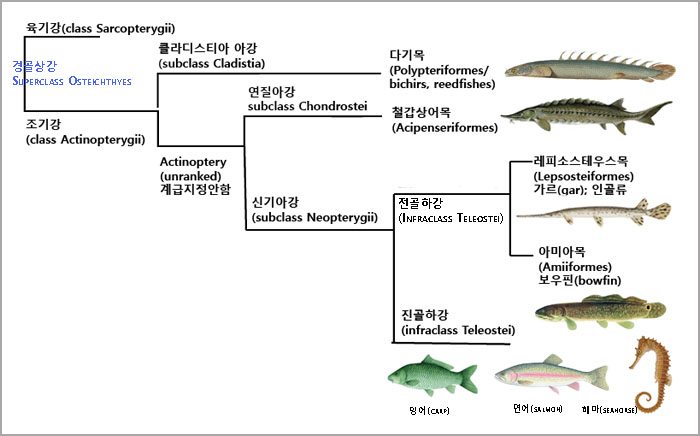 조기강 진화계통도 약도. 조기어류(조기강)은 클라스키아 아강(Subclass Cladistia), 연질아강(Subclass Chondrostei), 신기아강(Subclass Neopterygii) 이렇게 3 아강으로 분리된다. Abridged cladogram of Actinopterygii(ray-finned fishes) evolution-Steps. Class Actinopterygii comprises three subclasses; Subclass Cladistia), Subclass Chondrostei), Subclass Neopterygii |
|
비처는 몸이 길고 7개 내지 18개의 독립된 작은 등지느러미를 갖고 있다. 각 소형 지느러미들은 상단 끝 꼭지점이 2개로 갈라져있다. 등지느러미들은 모두 가시를 가지고 있으며 몸의 나머지 지느러미들은 모두 연조로만 되어있다. 몸에는 두꺼운 골질의 마름모꼴 비늘이 덮여있다. 턱은 경골어류보다는 사지동물에 더 가깝다. 원시어류의 특징으로 육기어처럼 가슴지느러미가 살이 쪘다. 크기가 25 cm에서부터 100 cm가 넘는 것까지 있다. 비처는 폐가 2개 쌍이며 성문을 경유해 식도와 연결되어 있다. 이들은 공기를 호흡해야만 살 수 있는 물고기이며 산소가 부족한 물에서 수면에 올라가 공기를 마신다. 폐는 기체 교환을 위해 혈관이 발달되어 있다. 비쳐는 관상어로 인기가 높다. 수족관에서 10년 수명을 기록했다. |
[분류계통도]. 경골상강(硬骨上綱)/Superclass Osteichthyes→조기강(條鰭綱)/Class Actinopterygii→다기아강(多鰭亞綱; Subclass Cladistia; 클라스티아 아강)→피처목(Polypteriformes)→피처과 (Polypteridae) 다기아강(또는 클라스티아 아강)의 대표적인 물고기. 위 두 물고기 이름은 모두 나일피처(Nile Bichir; Polypterus bichir bichir)이다. 최대 74 cm. Above 2 illustrations are “Nile bichir”. The Nile bichir, is a fish which lives in the Nile and some of its tributaries in Africa. Max length : 74.0 cm TL. 출처;고전문헌. Source/classic literature. |
연질아강(軟質亞綱/Subclass Chondrostei) |
[분류계통도]. 경골상강(硬骨上綱)/Superclass Osteichthyes→조기강(條鰭綱)/Class Actinopterygii→ 연질아강(軟質亞綱/Subclass Chondrostei)→철갑상어목(Order Acipenseriformes)→철갑상어과 (Family Acipenseridae) 연질아강의 대표적인 물고기 철갑상어류. 왼쪽/대서양 철갑상어. 오른쪽/미시시피 주걱철갑상어. Representative fishes of Subclass Chondrostei. Left/Atlantic sturgeon(Acipenser oxyrinchus). Right/Mississippi paddlefish(Polyodon spathula). Author/Raver Duane, U.S. Fish and Wildlife Service |
|
신기아강(新鰭亞綱/Subclass Neopterygii) |
|
신기아강은 전골하강과 진골하강으로 구성되어있다. 전골하강(全骨下綱/Infraclass Holostei) 전골어의 학명 홀로스타이(Holostei)의 어원은 그리스어 holos와 osteon의 결합어이다. 홀로스는 영어의 whole(전부), 오스테온은 뼈(bone)의 뜻이다. 골격이 뼈대로 이루어져 있다는 뜻이다. 전골하강(全骨下綱)은 분류방식에 따라 전골상목(全骨上目/super order Holostei)으로도 분류된다. 전골하강은 아미아 목(Amiiformes)과 레피소스테우스 목(Lepisosteiformes) 2개 목으로 구성되어 있고 아미아 목에는 1종(Bowfin/Amia calva)만 있으며 레피소스테우스 목에는 7종이 있으며 가르(gar)라고 부르는 물고기들이다. 이 무리는 측계통군(paraphyletic group)으로 판정되고 있다. [※측계통군은 단계통군(monophyletic group)과 상치되는 분류군으로 종의 계통 유연관계를 온전히 반영하고 있지 않아 자연분류군으로 인정하지 않는 분류 단위이다]. 전골어류(전골하강 또는 전골상목)는 연질아강 보다는 진골하강에 더 가깝다. 분수공은 흔적만 남아있고 뼈는 가볍게 골질화되어 있다. 두꺼운 굳비늘(ganoid scale)을 가지고 있는 가르(gar)가 보우핀(bowfin) 보다 더 원시형이다. 전골어류는 조기어류 중 진골류가 아닌 다른 무리(예; 연질어류/철갑상어와 다기어류/비처)와 같이 진골어와 상어류의 특성을 혼합해 가지고 있다. 그러나 전골어류가 다른 무리보다 더 진골어류에 가까운데 예를 들어 상어와 연질어류는 분수공이 있지만 전골어류에는 흔적만 있고 없다. 보우핀은 주로 연질 성분인 뼈대 표면에 얇은 골질 막이 덮여있다. 가르의 꼬리지느러미가 성어처럼 상엽이 약간 큰 부등미(不等尾/heterocercal)이기는 하지만 연질어류(철갑상어)처럼 뚜렷하지는 않다. 보우핀은 많은 살(ray)로 이루어진 조기 지느러미를 가지고 있으며 동시에 비처처럼 공기 호흡을 한다. 가르는 철갑상어의 특징인 두꺼운 굳비늘을 갖고 있는데 반하여 보우핀은 진골어류처럼 얇은 골질 비늘을 갖고 있다. 이 점에서 전골어류 중 가르가 보우핀보다 더 원시적이라 할 수 있다. |
[분류계통도]. 경골상강(硬骨上綱)/Superclass Osteichthyes→조기강(條鰭綱)/Class Actinopterygii→ 신기아강(新鰭亞綱/Subclass Neopterygii)→전골하강(全骨下綱/Infraclass Holostei)→레피소스테우스목/Order Lepisosteiformes(Gars)→레피소스테우스과/Family Lepisosteidae(Gars) 대형 민물고기. Left/롱노즈 가르(Longnose gar, 학명;Lepisosteus osseus). Longnose gar(Lepisosteus osseus). Max length : 200 cm TL. Author/Svdmolen. Right/악어 가르(Alligator Gar 학명; Atractosteus spatula). Author/Clinton & Charles Robertson. Gars are freshwater fishes in North and Central America |
[분류계통도]. 경골상강(硬骨上綱)/Superclass Osteichthyes→조기강(條鰭綱)/Class Actinopterygii→ 신기아강(新鰭亞綱/Subclass Neopterygii)→전골하강(全骨下綱/Infraclass Holostei)→아미아목/Order Amiiformes(Bowfins)→아미아과/Family Amiidae (Bowfins) Left/보우핀(Bowfin 학명; Amia calva). 그림(Illustration). Author/Duane Raver/U.S. Fish and Wildlife Service. Right/강에서 잡힌 보우피시. 보우피시는 북아메리카 산 민물고기이다. Bowfin. Bowfins are freshwater fishes in North America. Author/Everglades NPS from Homestead, Florida, United States. |
|
진골하강(眞骨下綱/Infraclass Teleostei) ※진골하강은 신기아강의 다음 아래 단계 분류군임 [분류계통도]. 경골상강(硬骨上綱)/Superclass Osteichthyes→조기강(條鰭綱)/Class Actinopterygii→ 신기아강(新鰭亞綱/Subclass Neopterygii)→진골하강(眞骨下綱/Infraclass Teleostei) |
진골하강(眞骨下綱/Infraclass Teleostei)의 진화계통도 |
 신진골아부(Subdivision Euteleostei)의 어류들. |
[분류계통도]. 경골상강(硬骨上綱)/Superclass Osteichthyes→조기강(條鰭綱)/Class Actinopterygii→ 신기아강(新鰭亞綱/Subclass Neopterygii)→Order †Semionotiformes 신기아강 어류 중 세미오노투스목(Semionotiformes)의 멸종 화석어. 민물고기들임. 왼쪽(종명; Lepidotes 속의 한 종)은 화석 사진이며 오른쪽(종명; Semionotus elegans)은 화석을 토대로 복원시켜본 그림이다. 트라이아스기와 백악기에 살았던 물고기이다. Examples of fossil species in extinct Semionotiformes. Semionotiformes ("flag-back form") is an order of primitive, ray-finned, primarily freshwater fish from the Triassic to the Cretaceous. Left/Genus †Lepidotes. Author/Ghedoghedo. Right/Life restoration of Semionotus elegans. Author/Smokeybjb |
 경골어류를 종합적으로 소개한 옛날 도감. 1889년 영국에서 출판된 자연과학 교양서적에 있는 내용. 확대 이미지와 종 설명은 영문 텍스트 다음에 편집하였다. 원본의 종명은 현재와 많이 달라서 필자가 수정하였다. From an old publication(1889) in Great Britain, enlarged images with captions are placed at the bottom after English text. Many incorrect(or old) scientific names are corrected by Kim In Young. |
Class Actinopterygii(Ray-finned fishes) Class 6 The earliest known fossil actinopterygiian is Andreolepis hedei, dating back 420 million years (Late Silurian). Remains have been found in Russia, Sweden, and Estonia. Actinopterygii, or ray-finned fishes, constitute a class or subclass of the bony fishes. The ray-finned fishes are so called because they possess lepidotrichia or "fin rays", their fins being webs of skin supported by bony or horny spines ("rays"), as opposed to the fleshy, lobed fins that characterize the class Sarcopterygii which also, however, possess lepidotrichia. In terms of numbers, actinopterygians are the dominant class of vertebrates, comprising nearly 99% of the over 30,000 species of fish (Davis, Brian 2010). They are ubiquitous throughout freshwater and marine environments from the deep sea to the highest mountain streams. Extant species can range in size from Paedocypris, at 8 mm (0.3 in), to the massive ocean sunfish, at 2,300 kg (5,070 lb), and the long-bodied oarfish, to at least 11 m (36 ft). In nearly all ray-finned fish, the sexes are separate, and in most species the females spawn eggs that are fertilized externally, typically with the male inseminating the eggs after they are laid. Development then proceeds with a free-swimming larval stage. However other patterns of ontogeny exist, with one of the commonest being sequential hermaphroditism. In most cases this involves protogyny, fish starting life as females and converting to males at some stage, triggered by some internal or external factor. This may be advantageous as females become less prolific as they age while male fecundity increases with age. Protandry, where a fish converts from male to female, is much less common than protogyny. Most families use external rather than internal fertilization. Of the oviparous teleosts, most(79%) do not provide parental care. Viviparity, ovoviviparity, or some form of parental care for eggs, whether by the male, the female, or both parents is seen in a significant fraction(21%) of the 422 teleost families; no care is likely the ancestral condition. Viviparity is relatively rare and is found in about 6% of teleost species; male care is far more common than female care. Male territoriality "preadapts" a species for evolving male parental care. There are a few examples of fish that self-fertilise. The mangrove rivulus is an amphibious, simultaneous hermaphrodite, producing both eggs and spawn and having internal fertilisation. This mode of reproduction may be related to the fish's habit of spending long periods out of water in the mangrove forests it inhabits. 3 subclasses in Class Actinopterygii Subclass Cladistia is consisted of 2 order; Guildayichthyiformes and Polypteriformes; Guildayichthyiformes is extincted prehistoric order. Cladistia is a clade of bony fishes that currently consists of few anguilliform(eel-shaped) remnants of an ancient diversity. Their major synapomorphies are a dorsal fin with independent rays, and a posteriorly elongated parasphenoid. Bichirs are elongated fish with a unique series of dorsal finlets which vary in number from seven to 18, instead of a single dorsal fin. Each of the dorsal finlets has bifid(double-edged) tips, and are the only fins with spines; the rest of the fins are composed of soft rays. The body is covered in thick, bonelike, and rhombic(ganoid) scales. Their jaw structure more closely resembles that of the tetrapods than that of the teleost fishes. Bichirs have a number of other primitive characteristics, including fleshy pectoral fins superficially similar to those of lobe-finned fishes. Bichirs have a maximum body length ranging from 25 cm(9.8 in) to over 100 cm(39 in) depending on specific species and morphology. Bichirs possess paired lungs which connect to the esophagus via a glottis. They are obligate air-breathers, requiring access to surface air to breathe in poorly oxygenated water. Their lungs are highly vascularized to facilitate gas exchange. Bichirs are popular subjects of public and large hobby aquaria. Bichirs in captivity have life expectancies up to 10 years. Subclass Chondrostei(Sturgeons and paddlefishes) Chondrostei(cartilage bone) are primarily cartilaginous fish showing some ossification. It comprises sole order; the Acipenseriformes(sturgeons and paddlefishes); and this order comprises 2 families(Acipenseridae/sturgeons) and Polyodontidae/paddlefishes). It is thought that the chondrosteans evolved from bony fish but lost the bony hardening of their cartilaginous skeletons, resulting in a lightening of the frame. Elderly chondrosteans show beginnings of ossification of the skeleton, suggesting that this process is delayed rather than lost in these fish. This group has at times been classified with the sharks: the similarities are obvious, as not only do the chondrosteans mostly lack bone, but the structure of the jaw is more akin to that of sharks than other bony fish, and both lack scales. Additional shared features include spiracles and, in sturgeons, a heterocercal tail(the vertebrae extend into the larger lobe of the caudal fin). However the fossil record suggests that these fish have more in common with the Teleostei than their external appearance might suggest.. Subclass Neopterygii(new fins) Neopterygii (new fins) appeared somewhere in the Late Permian, before the time of the dinosaurs. There are only few changes during their evolution from the earlier actinopterygians. They are a very successful group of fishes, because they can move more rapidly than their ancestors. Their scales and skeletons began to lighten during their evolution, and their jaws became more powerful and efficient. While electroreception and the ampullae of Lorenzini is present in all other groups of fish, with the exception of hagfish, Neopterygii has lost this sense, though it later re-evolved within Gymnotiformes and catfishes, who possess nonhomologous teleost ampullae. Infraclass Holostei or Superorder Holostei In other classification system, this group is categorized in Superorder Holostei. The name Holostei derives from the Greek, holos meaning whole and osteon meaning bone: a reference to their bony skeletons. There are eight species divided among two orders, the Amiiformes represented by a single living species, the Bowfin (Amia calva), and the Lepisosteiformes, represented by seven living species in two genera, the gars. Further species are to be found in the fossil record and the group is often regarded as paraphyletic. Holosteians are closer to teleosts than are the chondrosteans, the other group intermediate between teleosts and cartilaginous fish. The spiracles are reduced to vestigial remnants and the bones are lightly ossified. The thick ganoid scales of the gars are more primitive than those of the bowfin. Holostei share with other non-teleost ray-finned fish a mixture of characteristics of teleosts and sharks. In comparison with the other group of non-teleost ray-finned fish, the chondrosteans, the Holostei are closer to the teleosts and further from sharks: the pair of spiracles found in sharks and chondrosteans is reduced in holosteans to a remnant structure: in gars, the spiracles do not even open to the outside; the skeleton is lightly ossified: a thin layer of bone covers a mostly cartilaginous skeleton in the bowfins. In gars, the tail is still heterocercal but less so than in the chondrosteans. Bowfins have many-rayed dorsal fins and can breathe air like the bichirs. The gars have thick ganoid scales typical of sturgeons whereas the bowfin has thin bony scales like the teleosts. The gars are therefore in this regard considered more primitive than the bowfin. Infraclass Teleostei Teleostei(Greek: teleios, "complete" + osteon, "bone") are by far the largest infraclass in the class Actinopterygii, the ray-finned fishes, and make up 96% of all extant species of fish. This diverse group arose in the Triassic period, and members are arranged in about 40 orders and 448 families. Over 26,000 species have been described. Teleosts range from giant oarfish measuring 7.6 m (25 ft) or more, and ocean sunfish weighing over 2 t (2.0 long tons; 2.2 short tons), to the minute male anglerfish Photocorynus spiniceps, just 6.2 mm (0.24 in) long. Including not only torpedo-shaped fish built for speed, teleosts can be flattened vertically or horizontally, be elongated cylinders or take specialised shapes as in anglerfish and seahorses. Teleosts dominate the seas from pole to pole and inhabit the ocean depths, estuaries, rivers, lakes and even swamps. |
|
|
|


|
| Copyright ⓒ FISHILLUST.COM All rights reserved. All contents can not be used without permission of the copyright holder. |


 검색
 다음 도표에 연속. Continued to below cladogram
 Plate;1. Description; (a)개복치(Sunfish/Mola mola). (b)실고기(Greater pipefish/Syngnathus acus). (c)해마(Sea Horse/ Hippocampus hippocampus). (d)바다나방(Short dragonfish/Eurypegasus draconis). (e)뱀장어(Eel/Anguilla fluviatilis). (f)전기뱀장어(Electric Eel/Electrophorus electricus). (g)곰치(moray eel/ Muraenidae). (h)늑대고기(Atlantic wolffish/Anarhichas lupus). (i)황새치(Sword-fish/Xiphias gladius).
 Plate;2. Description. (a)베도라치류(Blenny/scientific name unidentified). (b)둑중개류(Longspined bullhead/Taurulus bubalis). (c)빨판상어(Live sharksucker/Echineis naucrates). (d)씬벵이류(Red scorpionfish/Scorpaena scrofa). (e)대서양고등어(Atlantic mackerel/Scomber scombrus). (f)대서양참다랑어(Atlantic bluefin tuna/Thunnus thynnus). (g)큰가시고기(Three-spined stickleback/Gasterosteus aculeatus). (h)등목어(Climbing perch/Anabas testudineus). (i)검정망둑(Black Goby/Tridentiger obscurus). (j)쭉지성대류(Flying Gurnard). ※쭉지성대과(Dactylopteridae). (k)성대류(Grey Gurnard/Eutrigla gurnardus). ※성대과(Triglidae).
 Plate;3. Description/신기아강(Subclass Neopterygii)→진골하강(Infraclass Teleostei). (a)옐로퍼치(American yellow perch/Perca flavescens). (b)유럽가자미(European plaice/Pleuronectes platessa). (c)대서양가자미(Atlantic halibut/Hippoglossus hippoglossus). (d)달고기(John dory/Zeus faber). (e)파이크퍼치(Pike-perch/Sander lucioperca). (f)러페농어(Ruffe/Gymnocephalus cernua). (g)촉수류(Red Mullet/Mullus barbatus barbatus).※촉수과 Mullidae. (h)지중해 무지개놀래기(Mediterranean rainbow wrasse/Coris julis). (i)납작머리 회색 숭어(Flathead grey mullet/Mugil cephalus).
