close_btn

청어(Pacific herring). Clupea pallasii pallasii(Valenciennes, 1847) → Family 97

분류계보/경골상강→조기강→청어목→청어과→청어(Pacific herring;Clupea pallasii pallasii)
Superclass Osteichthyes→Class Actinopterygii→Order Clupeiformes→Family Clupeidae→Pacific herring; Clupea pallasii pallasii

Copyright by Kim In Young. 김인영 그림
Clupea_pallasii_pallasii_mypainting_700.jpg
청어의 기본 모습. Lateral view of Pacific herring(Clupea pallasii pallasii)

청어목 청어과 Order Clupeiformes Family Clupeidae(Herrings, shads, sardine, menhadens)
청어(Pacific herring)
Clupea pallasii pallasii(Valenciennes, 1847). 46cm TL.
Korean.name/Cheong-eo
D/spines 0, soft ray 13-21. A/spines 0, soft rays 12-23. Vertebrae/46 - 58.

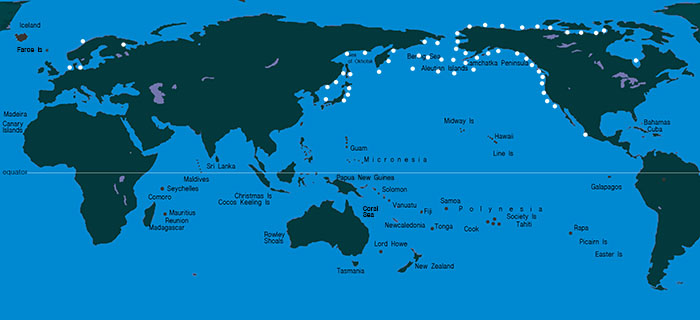
분포; 북극해/백해, 서태평양/베링해의 아나디르 만(Anadyr Bay), 캄차카반도 동부, 알류샨 열도, 일본, 한국, 동태평양/캐나다의 켄트 반도, 보퍼트 해에서 남으로 멕시코의 바하 캘리포니아 북부까지 분포.
일반개요; 몸은 옆으로 납작(측편)하고 아래턱이 앞으로 돌출해 있다. 한류성 어종으로 등쪽은 암청색, 배쪽은 은백색인 등푸른 생선의 한 종류이다. 비늘은 벗겨지기 쉬운 둥근 비늘이다. 청어속(Clupea)의 물고기들은 측선이 없다. 생김새가 정어리와 아주 닮았으나 청어는 주새개골에 방사상 융기선이 없는 것, 옆구리에 반점이 없는 것 등이 다르다. 몸길이는 정어리보다 크다. 동해안 지역의 겨울철 별미인 과메기의 원래 재료이기도 하다. 눈 주위에 지방질로 된 기름눈꺼풀이 있다. 위턱에는 이빨이 없고 아래턱 앞에는 흔적뿐인 이빨이 있다. 몸의 배쪽 정중선을 따라 날카로운 모비늘이 1줄로 나 있다. 용골(keel)은 뚜렷하지 않다. 위턱에 중간 홈날(노치; notch)이 없다. 아가미뚜껑(주새개골)에 방사상 융기선(radiating bony striae)이 없다. 몸이나 지느러미에 어두운 점이 없다. 백해에서는 대서양 청어(Atlantic herring; Clupea harengus)와 혼동되고 있으며 두 종은 척추골 수와 배지느러미 뒤쪽 배의 모비늘(稜鱗;능린; Scute) 수가 다르다. 등쪽은 암청색 배쪽은 은백색이다.

연안성 어종이며 무리를 지어 산다. 육지에 갇혀 살아온 개체군도 존재한다. 성어들은 연안을 이동하여 기수로 들어가 산란을 한다. 해조류에 알을 붙여 낳는다. 1년생 어린 개체들은 여름에 수심이 얕은 만이나 좁은 입구 채널에 모여 무리를 지으며 수면에서 무리를 볼 수 있다. 가을에는 무리가 깊은 수심으로 내려가 2-3 년 동안 수면에서 보이지 않는다. 어린 새끼들은 작은 갑각류와 십각류 및 연체동물의 애벌레를 잡아먹는다. 성어는 좀 큰 갑각류와 작은 물고기를 잡아먹는다. 청어는 연안성이며 멀리 이주해 다니지 않기 때문에 지역적 개체군이 서로 혼합될 가능성이 작다. 동태평양에서는 아시아에 청어 알을 수출하기 위해 청어가 어획된다. 청어가 알을 낳도록 켈프 밭을 만들어 알을 수확한다. 청어 알은 일본에서 고급 음식이며 카주노코 콤부(kazunoko-kombu)라고 부른다. 청어는 한약재로도 쓰인다. 청어의 최대 서식 수심은 475m이다.

솔치(어린 청어 건어물) 
마트나 시장에서 건어물 형태로 파는 솔치는 청어의 새끼(치어)이다. 크기는 7-10cm 정도이다.  멸치나 밴댕이와 비슷하게 생겼다. 멸치와 달리 등푸른 생선 특유의 성분이 풍부하다. 멸치보다 기름기가 많아 국물을 우렸을 때 비린내가 거의 없고 구수하며 깊은 감칠맛이 난다.  특히 멸치처럼 쓴맛을 내는 내장(똥)과 머리를 따로 떼어내는 손질 없이 통째로 육수를 내거나 볶아 먹을 수 있어 매우 편리하다. 주의: 그러나 해양수산부는 2022년 자원 보호를 위해 20cm 이하의 어린 청어는 포획 및 유통을 금지시키는 수산자원관리법에 포함시켰다. 따라서 솔치의 거래는 불법이며 단속 대상이다. 


Order Clupeiformes Family Clupeidae(Herrings, shads, sardine, menhadens)
Pacific herring
Clupea pallasii pallasii(Valenciennes, 1847). 46cm TL.
Korean.name/Cheong-eo
D/spines 0, soft ray 13-21. A/spines 0, soft rays 12-23. Vertebrae/46 - 58.

Distribution; Arctic/White Sea eastward to Ob inlet. Western Pacific:/Anadyr Bay, eastern coasts of Kamchatka, possibly the Aleutian Islands southward to Japan and west coast of Korea. Eastern Pacific/Kent Peninsula at 107°W and Beaufort Sea southward to northern Baja California, Mexico.
General; Without prominent keel; no median notch in upper jaw. Gill cover without radiating bony striae. No distinctive dark spots on body or fins. Overlaps Clupea harengus in White Sea, but distinguished by fewer vertebrae(usually 52 to 55; cf. usually 55 to 57) and fewer post-pelvic scutes (10 to 14; cf. 12 to 16). Dark blue to olivaceous above, shading to silver below. Species in Clupea have no lateral line,

Neritic species. A coastal and schooling species. Landlocked populations exist. Mature adults migrate inshore, entering estuaries to breed. During the summer of their first year, young form schools in shallow bays, inlets and channels that appear at the surface; these schools disappear in the fall and remain in deep water for the next 2-3 years. Young feed mainly on crustaceans, but also take decapod and mollusk larvae; adults prey mainly on large crustaceans and small fishes. Because it does not undertake extensive coastal migrations, the mixing of local populations is relatively rare. In the eastern Pacific, the fish is mainly caught for roe markets in Asia. There is a fishery for eggs laid on kelp, which when salted, is called kazunoko-kombu, and is considered an delicacy in Japan. Used in Chinese medicine. Utilized fresh, dried or salted, smoked, canned, and frozen; eaten pan-fried, broiled, and baked. Possibly to 475 m depth. max. reported age: 19 years.

Solchi (Dried Juvenile Herring)
Locally known as “Solchi”, sold as a dried fish in supermarkets and traditional markets, consists of juvenile herring. The fish are usually about 7–10 cm long. They resemble anchovies or Japanese sardinella(Sardinella zunasi) in appearance. Unlike anchovies, they are rich in the distinctive nutrients characteristic of blue-backed fish. Because they contain more oil than anchovies, they produce a rich, savory broth with little of the fishy odor often associated with dried fish. Another advantage is that, unlike anchovies, there is no need to remove the bitter-tasting innards (guts) and head before use. The fish can be used whole to make soup stock or can be stir-fried and eaten as they are, making them very convenient. Note: However, the Ministry of Oceans and Fisheries included juvenile herring measuring 20 cm or less under the Fisheries Resources Management Act as part of a resource-conservation measure, prohibiting their capture and distribution from 2022. Therefore, the trade of Solchi is illegal and subject to enforcement.
 

Map_Clupea-pallasii_청어2.jpg  청어의 분포 해역. Distributing map of Pacific herring(Clupea pallasii pallasii). Author/Kim in young(fishillust.com)
herring_egg.jpgLeft/청어새끼. Pacific herring (Clupea pallasii) fingerling. NOAA(Alaska Fisheries Center)  Right/해초에 붙여 낳은 청어 알. Herring egg mass attached to sea weeds. NOAA(Alaska Fisheries Center). Photo by Mandy Lindeberg.
Gwamegi_crop600.jpg 과메기.왼쪽부터 과메기, 파, 미역. Korean traditional dish; half-dried pacific herring(Gwamegi; 과메기). From left; half-dried fish, chives and sea mustard. Author/Nicole Cho


Copyright ⓒ FISHILLUST.COM  All rights reserved. All contents can not be used without permission of the copyright holder.