
사이트 로그인
사이트 로그인
|
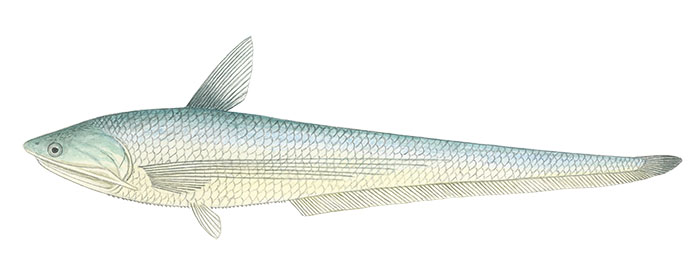
분류계통/경골상강→조기강→청어목→멸치과→웅어(Japanese grenadier anchovy; Coilia nasus). Copyright by Kim In Young. 김인영 그림
|
 |
|
웅어 기본 모습. 체형은 아래에 소개한 David Starr Jordan(1851–1931)의 그림에 기준하였음. Lateral view of Japanese grenadier anchovy(Coilia nasus). This drawing based on “David Starr Jordan(1851–1931)” introduced below. |
 고문헌 생물학 서적의 웅어 그림. Illustration of Coilia nasus(synonym; Coilia ectenes) in old scientific books. David Starr Jordan(1851–1931). |
[소하성(遡河性)/anadromous] 분포; 북서태평양/한반도의 서해와 남해 연안과 큰 강 하류, 일본 남부의 아리아케 해(Ariake Sea;有明海), 광둥성의 동중국해와 양자강. 양자강 상류 1000 km 이상 올라간다. 웅어는 형태와 색상이 싱어와 매우 비슷해서 구별이 어려움으로 한국의 일부 자료에서는 분류학적으로 동일 종이 아닐까 하는 의심의 논란이 있지만 해외 자료(예; fishbase 등등)에서는 웅어와 싱어가 분명히 별개로 소개되어 있다. 웅어는 싱어에 비해서 비늘이 작고 수가 훨씬 많으며 가스지느러미 상단의 실 같은 6개 연조들이 더 길다. 또 싱어 보다 몸이 더 길고 크다. 웅어는 소속된 속(genus Coilia; 웅어 속) 안에서 가장 큰 편에 든다. 배지느러미 앞까지 몸의 앞 쪽은 체고가 높고 통통하지만 뒤로는 꼬리 쪽으로 갈수록 급하게 가늘어지면서 옆으로 납작하다. 눈은 머리의 앞쪽에 치우쳐 있다. 주둥이는 짧고, 그 끝은 둥글게 튀어나와 있다. 입은 크고 비스듬히 경사져 있다. 하악은 짧아서 상악의 밑에 가려진다. 전상악골(premaxillary)의 뒤끝(위턱의 후방 연장 뼈)은 매우 길어서 가슴지느러미 기부를 지난다. 양 턱에는 작은 이빨이 1줄로 나 있다. 비늘은 둥근비늘(원린)이며 떨어지기 쉬운 성질이다. 배쪽 가장자리는 칼날처럼 날카롭다. 몸의 배쪽 정중선을 따라 뒷지느러미의 기부 앞까지 날카로운 모비늘이 43~61 개 나 있다. 등지느러미와 뒷지느러미에는 가시가 없다. 등지느러미는 1개로 몸의 앞쪽에 치우쳐 있고 기저의 길이가 매우 짧다. 뒷지느러미 기저의 길이가 유난히 길어 꼬리지느러미와 이어져 있다. 꼬리지느러미는 부정형(不正形))이다. 가슴지느러미의 위쪽 6 연조는 불 분지 기조이며 실처럼 매우 길어서 뒤끝이 뒷지느러미의 기부를 훨씬 지난다. 몸 등쪽은 푸른빛(또는 청록색)을 띠며, 중앙과 배쪽은 연한 노란색 또는 은백색을 띤다. 색상에 대하여 청록색, 청색, 황색, 백색 등 여러 가지 설명이 나와있는데 인터넷 상의 여러 사진들을 종합해 보면 싱싱하거나 살아있을 때는 전체적으로 황백색이라는 설명이 맞는 것으로 보인다. 대부분의 지느러미는 무색 투명하지만, 뒷지느러미와 꼬리지느러미는 어둡다. 해수, 담수, 기수에서 살며 수심 50m까지 발견된다. 소하성(溯河性/anadromous/바다에서 강으로 올라가 산란하는 어류)이다. 다른 나라에는 평생을 담수 호수에 갇혀 사는 개체군도 있다고 한다. 아주 깨끗한 물이나 아주 더러운 물에서는 살 수 없다. 밤에는 강의 깊은 수역으로 이동한다. 요각류(copepod)를 주로 먹으며 그 외 새우류, 게류 등 갑각류를 먹는다. 중국과 일본 연안에서는 산란 기간 동안 자망(刺網; gill net)에 의하여 상당히 많은 어획량을 올리고 있다. 중국에서는 가장 비싼 물고기 중 하나로 여겨진다. 웅어는 예전 임금님에게 진상하던 귀한 물고기로 조선 말기에는 행주에 ‘위어소(葦漁所)’를 두어 이것을 잡아 왕가에 진상하던 것이 상례였다. 웅어는 낮은 물에 잘 자라는 갈대 속에서 많이 자라서 갈대 ‘위(葦)’자를 써서 위어(葦魚, 갈대고기)라고도 하였다.부산광역시의 사하구의 하단어촌계(下端漁村契)에서는 매년 5월 낙동강 하류에서 잡은 웅어로 웅어 축제를 열기도 한다. 웅어 속 멸치류 13종 명단. 13 species in genus Coilia(grenadier anchovies) |
 웅어, 죽은 개체. Dead specimen of Japanese grenadier anchovy(Coilia nasus). author/CAFS(Chinese Academy of Fishery Sciences). |
 위와 아래 사진 설명/부산 사하구 하단포구에서 매년 5월경 웅어축제가 열린다. 오래 전부터 미식가들만 몰래 찾았던 ‘계절 음식’이요 ‘웰빙 식품’인“ 웅어 회” 맛의 비밀을 공개하는 축제 한 마당이다. 행사내용/웅어회, 웅어구이 무료 시식회 및 염가 판매, 사물놀이 공연, 어업인 장기자랑 및 노래자랑 출처/사하구청 홈페이지 홍보 캡처 사진. Caption for picture above and below/Annual food festival for Coilia nasus takes place in May at a cove town(Hadan) of Busan city, Korea. Source/home page of Saha-gu ward office. |
|
 웅어로 만든 회. 일본의 음식. Sashimi of Etsu(エツ; Japanese name for Coilia nasus). location/Japan. Author/Nissy-KITAQ |
[anadromous] Distribution; Northwest Pacific/Canton north to Ariake Sound, southwestern Japan, including all of Yellow Sea and off western and southern coasts and adjacent rivers in Korea. Penetrates over 1000 km up the Yangtze River. it is a relatively large species for its genus. Anterior body ahead of pelvic fin base deep in depth and plump; strongly tapered posteriorly and compressed. Eye situated at front part of head. Snout short and with rounded tip. Mouth large and slightly slanted upward. Lower jaw shorter than upper jaw. Bone of upper jaw(premaxillary) exceptionally extended posteriorly surpassing the base of pectoral fin. A row of small teeth on both jaws. With cycloid and deciduous scales. Bottom of abdomen sharply edged like a blade. With 43 to 61 keeled scutes from isthmus to anus. Spines absent in dorsal and anal fins. With single dorsal fin; located close to anterior body and its base very short. The base of anal fin very long and connected to caudal fin. Caudal fin heterocercal, slender and with pointed end. The first 6 soft rays(not branched) of pectoral fin filamentous and extended surpassing the base of anal fin. Bluish(or bluish green) dorsally, flank and belly with pale yellow or silvery white. Fins colorlessly transparent but anal and caudal fins with dark shades. It is found in marine, freshwater, and brackish water at depths down to 50 m. Anadromous fishes but other groups out of Korea have been reported to be resident in freshwater lakes during their entire life cycle. Migrate every spring up to rivers before their final gonadal maturation in order to spawn in the middle and lower reaches of streams. The spherical eggs floating down and hatching near the river mouth. When grew to 35㎜, fin development completed. Move to marine water in August to September for wintering. Spawns around three times in a lifetime and spawning occurs in between reeds. Penetrates over 1000 km up the Yangtze River, about 15 km up the Chikugo River in Japan Lives in not really clean water but not really turbid water either. Goes to the deep water areas of rivers at night. Feed mainly on copepod including shrimps, crabs and other crustaceans. Large amount fished by gill net in spawning season in China and Japan. A traditional delicacy, the species is commercially fished in Korea, China and Japan. In China it is one of the most expensive fish in the world. In Korean dynasties, this fish offered to the king and royal family. |


|
| Copyright ⓒ FISHILLUST.COM All rights reserved. All contents can not be used without permission of the copyright holder. |


 검색
 Caption above
