
사이트 로그인
사이트 로그인
|
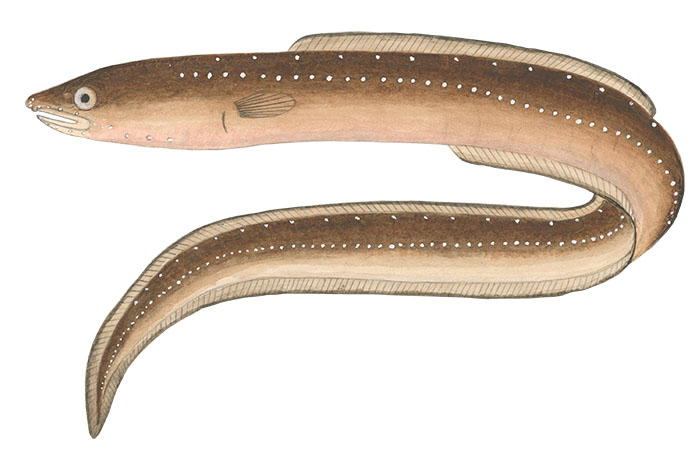
분류계통/경골상강→조기강→뱀장어목→붕장어과→붕장어 Copyright by Kim In Young. 김인영 그림
|
|
| 붕장어 기본 모습. Lateral view of Whitespotted conger(Conger myriaster) |
뱀장어목 붕장어과 분포; 서북태평양/한국의 전 연해, 일본 홋카이도 이남, 대만, 동중국해에 분포한다. 등지느러미 기점은 가슴지느러미 뒤에 있다. 가슴지느러미는 잘 발달하여 있다. 배지느러미는 없다. 꼬리지느러미 끝은 뾰족하다. 지느러미들의 기조는 분절형이다. 항문은 몸 중앙보다 약간 앞쪽에 위치한다. 측선은 머리에서부터 꼬리 끝까지 연장되어 있다. 측선은 주새개골 위에서 시작하여 앞부분은 등쪽에 치우쳐 있지 후반부로 가면서 중앙을 가로지른다. 측선공 수는 모두 134‒141개이며 각 측선공들은 백색 점 안에 들어 있으며 마치 체측 중심선에 백색 점 무니가 길게 있는 것처럼 보인다. 머리의 감각공들도 작은 백색 점으로 나타나 있다. 몸의 등 쪽에도 백색 점들이 일정한 간격으로 길게 1열로 늘어서 있는데 측선공의 백색 점들은 크기가 크고 간격이 촘촘하고 백색이 뚜렷한데 비하여 등쪽의 흰점들은 크기가 훨씬 작고 그 간격이 측선공 간격에 비하여 훨씬 넓으며 색상도 덜 하얗다. 항문전 측선공 수는 40-42 개이다. 머리의 감각공들은 다음과 같다. 안상골공(superorbital pores)/4개, 안하골공(infraorbital pores)/6, 전새개하악골공(preoperculomandibular)/ 9~10, 상측두골공(supratemporal pores)/1 개이다. 몸색은 어두운 갈색이며 배쪽은 연하다. 가슴지느러미의 후단 반은 희다. 포르말린 고정 개체는 회색이며 배쪽은 희다. 등지느러미, 뒷지느러미, 꼬리지느러미의 가장자리가 검다. 수컷은 산란기에 혼인색을 띠는데 등쪽의 갈색이 진해지고 배쪽에는 노란색이 나타난다. 연안의 해초가 많은 모래와 개펄 바닥에 서식한다. 뱀장어와 달리 바다에서만 서식한다. 주로 작은 어류와 새우류, 조개류, 갯지렁이류 등 저서무척추동물을 섭식한다. 붕장어는 한국과 일본에서 붕장어과 중 가장 보편적인 종이며 중요한 수산 종이다. 일본에서 양식된다. 야행성으로 산란장은 분명하지 않으며, 아열대 해역 가까운 곳까지 남하한 후 봄~여름에 걸쳐 산란하여 부화하면 뱀장어처럼 어린 시기에 투명한 버들잎처럼 생긴 렙토세파루스(leptocephalus) 유생기를 거치며, 쿠루시오 난류를 타고 우리나라 연안으로 이동하여 변태한다. 완전히 자라기까지 8년 정도가 소요되며, 서식장소도 바뀌는데 어릴수록 얕은 내만에 서식하다가 4년생 이상은 먼 바다로 나간다. 몸 길이는 성별에 따라서 차이가 있으며, 수컷은 약 40cm 정도인 반면, 암컷은 약 90cm 정도이다. 생선유통시장에서 '아나고'란 이름으로 통용되는 곳이 많지만 아나고(アナゴ, 穴子)는 일본명이다. 자산어보(玆山魚譜)에서는 해대려(海大鱺)라 하였고 속명 붕장어(弸張魚)라고 하였다(※鱺/정보를 알 수 없는 한자. 弸/가득할 붕, 강한 활 붕). 1908년에 간행된 『한국수산지(韓國水産誌)』 제1집에 의하면 한국에서는 옛날에 붕장어를 먹지 않았다. 주로 일본인들 어획하여 자기네 나라로 수송하였다. 일제 강점기부터 한국인들이 먹기 시작하였다. 지금은 많은 한국인들이 그 회를 좋아하며 부산의 붕장어회는 유명하다. 붕장어는 붕장어류 중에서 제일 맛이 좋은데 특히 여름철에 맛이 좋다. 그러나 가격이 비싸다. |
Oder Anguilliformes Family Congridae(Conger and garden eels). Distribution; Northwest Pacific/all around Korean Peninsula, south of Hokkaido Japan, Taiwan and the East China Sea. The anus is located slightly in front of the center of the body. The lateral line starts above the opercula bone, and the front part is skewed toward the dorsal side, but passes through body center as it goes to tail. Dorsal fin origin behind tip of pectoral. Pectoral fin well developed. Pelvic fin absent. Tip of caudal fin pointed. Fin-rays segmented. Lateral line extended from behind head to tail end. Lateral line pores(total)/134‒141. Each lateral line pores is contained within a distinct white dot, thus it looks as if a long line of white dots. Also a dot line on upper dorsal side of the body, this upper side dots are much smaller and less white than lateral line dots and spaced much sparsely than lateral line dots. Sensory pores on head also contained within small white dots. The number of lateral line pores before anus is 40-42. Head pores: SO 4, IO 6 (5 on upper jaw + 1 behind rictus), POM 9 or 10 (6 or 7 on lower jaw, 3 behind rictus), ST 1. Color; body dark brown above, lighter below, posterior half of pectoral fin pale. When preserved, dorsal surface light grayish, ventral surface paler The edges of dorsal, anal and caudal fins are black. In spawning season, males have a marital color, and the back becomes deep brown and the abdomen becomes yellow. Inhabits weedy sand and mud bottoms in coastal waters. Unlike Anguilla eels, it lives only in the sea. It mainly feeds on benthic invertebrates such as small fish, shrimp, shellfish, and worms. It is nocturnal, and the spawning field is not clear. Spawns and hatches from spring to summer after migrate south to a subtropical sea area, hatchlings pass through the transparent willow-like leptocephalus larvae in childhood like an eel. It moves to the coast and transforms. It takes about 8 years to fully grow, and the habitat also changes with growth. The younger it is, the more it lives in shallow inner bays, and more than 4 years old goes to the far sea. Body length varies according to sex, and males are about 40 cm long, while females are about 90 cm long. Conger myriaster is the most common species of Conger in Japan and Korea and is an important commercial species. Cultured for fishery in Japan. In some market place in Korea, the Whitespotted conger(Conger myriaster) is called as “anago”, but this term is Japanese language which means the “eel”. According to the first volume of the Korean Fisheries Paper(한국수산지(韓國水産誌)) published in 1908, conger eel was not eaten in Korea in the old days. They were mainly caught by Japanese and transported to their own country. Koreans began to eat from the period of Japanese occupation. Nowadays, many Koreans particularly like it as sashimi, and the conger eel sashimi in Busan city is famous nationwide. Whitespotted conger(Conger myriaster) tastes best among conger eels, especially in summer. But the price is high. |
 붕장어의 감각공 배치도. Layout of sensory pores in Whitespotted conger(Conger myriaster). Illustrated by Kim In Young. |
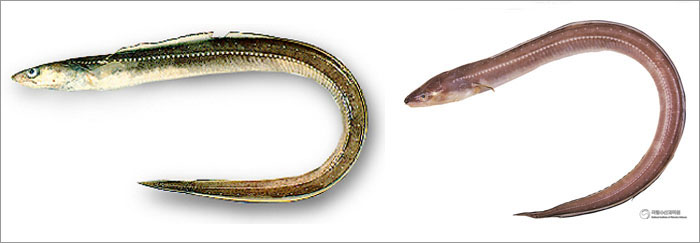 붕장어. 죽은 개체 사진. Dead specimens of Whitespotted conger(Conger myriaster). Author/left; fao, right; nifs(국립수산과학원). |
 Left/붕장어. Whitespotted conger(Conger myriaster). Location/Suma Aqualife Park, KOBE, japan. Author; OpenCage. Right/Author; muzina |


|
| Copyright ⓒ FISHILLUST.COM All rights reserved. All contents can not be used without permission of the copyright holder. |


 검색
