Order Beloniformes Family Exocoetidae(Flyingfishes)
Yellowing flyingfish
Cypselurus poecilopterus(Valenciennes, 1847) max length/27.0 cm(TL)
Korean name/sae-nal-chi(새날치)
Japanese name/アヤトビウオ(Aya-tobi-uo)
Chinese name/花鰭燕鰩魚
Taiwanese name/斑鰭飛魚
D/Soft ray 11-13. A/soft ray 7~19. P1/14~16. P2/6. Lateral line scales/45-48. Vert/40-42. Gill raker/5-7 +16-17 = 21-24.
Distribution; Indo-West Pacific/Waters far from southern Madagascar, Mauritius, Gulf of Aden, Arabian Sea, Maldives, Northwest Australia, Timor Sea, Northeast Queensland, Papua New Guinea, Samoa, Indonesia Banda Sea, Sulawesi Sea, Vietnam, Philippines, Palau, Taiwan, South of central Japan, Okinawa, the Ryukyu Islands, and the East and South Seas of Korea.
General; The epithet name poecilopterus is combination of the Greek words ‘poecilo(spotted)’ and ‘pterus(winged)’. Yellowing flyingfish's yellowing is more like the adjective "yellowed," but here we think it's short for Yellow Wing.
Body elongated, slightly compressed laterally. Compared to other flying fish, the body is short and thick, and the head is large. The length of the head is shorter than the distance from the origin of the dorsal fin to the origin of the upper lobe of the caudal fin. The snout is blunt and short. Mouth open at front, lower jaw slightly shorter than upper jaw. Both jaws with 3 peaked(cuspidate) teeth; palatine bone with weak teeth. Two pairs of nostrils, large in shape, close to the eyes. Gill slit wide, membranes of opercular bone(gill membrane) free on throat isthmus. The swim bladder is large and extends backward; the intestine is simple, without pylorus and caecum. Body covered with round scales, large and thin, easy to fall off. There are parts without scales on the head. Lateral line very low, near ventral margin, unbranched on thorax, dorsal anterior scales 25-28; Number of horizontal scale rows 8-10.
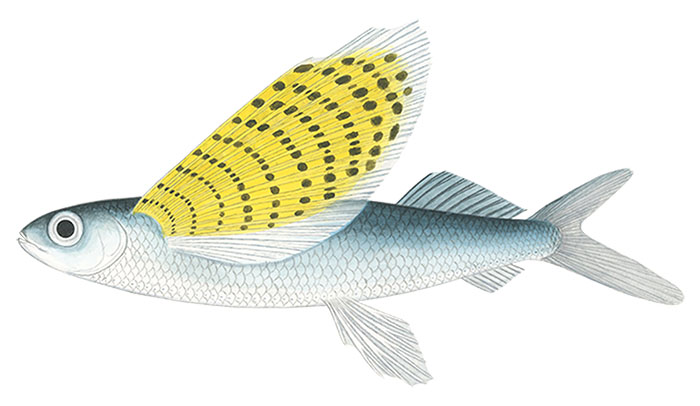
Dorsal fin without spines, located behind body, no black or gray spots on fin membrane. Origin of anal fin is below base of soft rays 5-7 of dorsal fin. Pectoral fin very long, end of pectoral fin reaches behind the rear base of dorsal fin, the first ray of pectoral fin is not branched, and the rest soft rays branched. The pectoral fins are yellow, but large areas of the posterior and lower margins are colorless and transparent. Numerous oval blackish-brown dots, about 1/5 to 1/2 the diameter of the eye, are arranged in six to ten rows on yellow area of the fin. The dots are circular when the fins are fully extended. As the fins are retracted, the dots become smaller and appear oval to square. The pelvic fin long, ending at middle of anal fin base. Pelvic fin base is located in the center of the distance between the rear edge of the operculum and the base of lower caudal fin lobe. Caudal fin is well developed, deeply forked, and lower lobe is longer than upper lobe. Flying fish often have whiskers when juvenile, but juveniles of this species do not, and dorsal fin not tall.
Ocean migratory fish species, living in the surface water layer of offshore or shallow waters. When threatened, they jump into the air above the water to escape and glide long distances using specially evolved pectoral fins. It mainly feeds on plankton such as copepods and amphipods. The egg masses produced have sticky filaments, which can be attached to drifts or benthic algae. Every spring and early summer, along with the Kuroshio Current, they migrate to the southeast coast of Taiwan, which is the main fishing season. In japan, they visit from summer to autumn. Regarding the season in Korea, no information found. It can be caught by fishing methods such as drift nets or fixed nets, or woven straw mats to collect flying fish eggs. It is small, but the body is fatty and delicious. Adult fish are suitable for sashimi, braised, soup, salt-grilled and can also be dried, fish roe can be used for salting, which has a good flavor.
|

 새날치 분포도. Distribution map of Yellowing flyingfish(Cypselurus poecilopterus). Main ref. GBIF. As of April 2023.
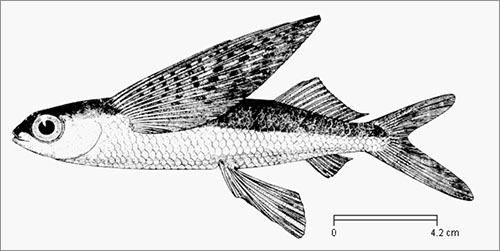 새날치 묘사도. Illustration of Yellowing flyingfish(Cypselurus poecilopterus). Author/FAO
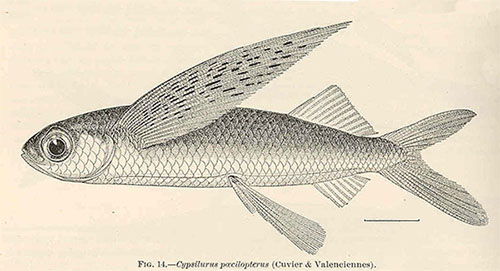 새날치 묘사도. Illustration of Yellowing flyingfish(Cypselurus poecilopterus). Author/David Starr Jordan(1851–1931)
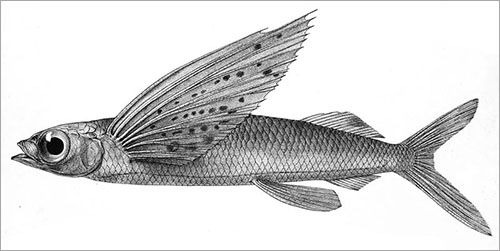 새날치 묘사도. 평가/등지느러미에 있는 검은 반점은 저작자의 실수로 들어간 것 같다. Illustration of Yellowing flyingfish(Cypselurus poecilopterus). Author/Robert Mintern (1840–1908). Evaluation/The black blotch on the dorsal fin seems to have been added by mistake by the illustrator.
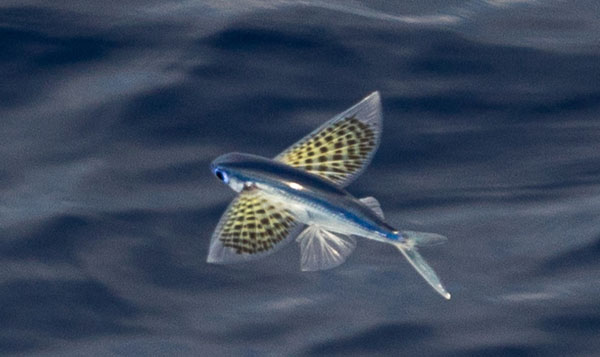 photo 1
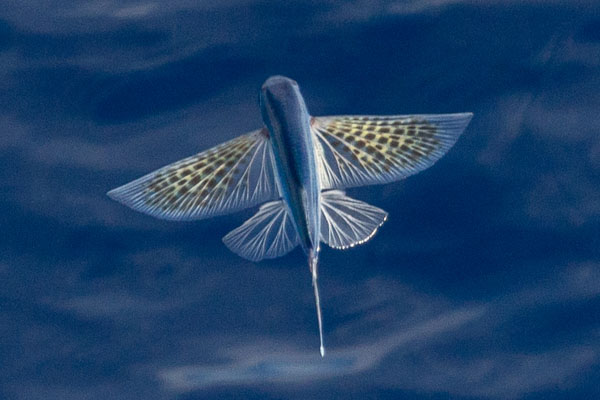 photo2
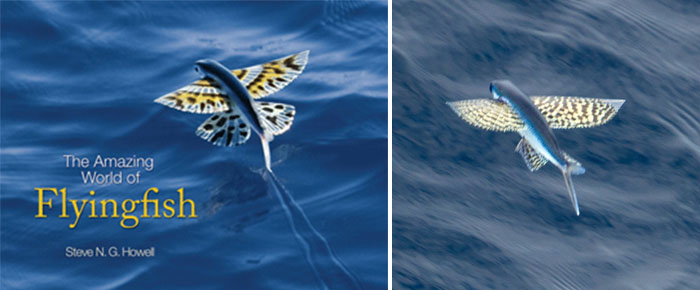 위 2 사진은 새날치와 닮았으나 오나멘티드 날치(Ornamented flyingfish(Cypselurus callopterus)인 것으로 판단된다. 새날치는 배지느러미가 투명 무색이며 무늬가 없지만 사진의 날치들은 배지느러미가 가슴지느러미와 동일한 무늬 패턴을 갖고 있다. 왼쪽 사진은 책 표지 사진이며 표지에 종명이 표기되어 있지 않다. 오른 쪽 사진은 새날치(Cypselurus poecilopterus)라고 표기되어 있다. 그러나 다른 관련 자료들을 참고해 보면 이들 2 사진은 모두 Cypselurus callopterus 인 것으로 유추된다.
 새날치 유어의 수중사진. Juvenile Yellowing flyingfish in the water(just below the surface). Author/Izuzuki(izuzuki.com)
 새날치 죽은 개체 표본. Dead specimen of Yellowing flyingfish(Cypselurus poecilopterus. Author/ Williams, Jeffrey T.(Smithsonian Institution)
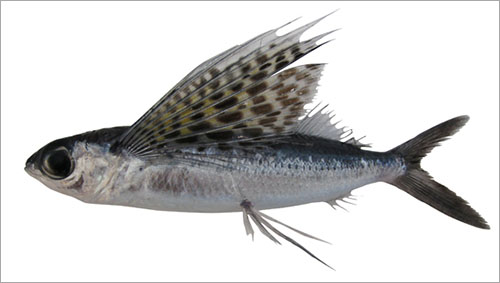 새날치 죽은 개체 표본. Dead specimen of Yellowing flyingfish(Cypselurus poecilopterus. Author/ Australian National Fish Collection, CSIRO.




 검색
