
사이트 로그인
사이트 로그인
|
분류계통/경골상강→조기강→쏨뱅이목→죽지성대과→별죽지성대 Copyright by Kim In Young. 김인영 그림
|
 |
| [painting 1] 별죽지성대 기본 모습. 가슴지느러미를 완전히 접어 몸에 붙이고 있는 경우. Lateral view of Starry flying gurnard(Dactyloptena peterseni). When the pectoral fins are completely folded and attached to the body side. |
|
Copyright by Kim In Young. 김인영 그림
|
 |
| [painting 2] 별죽지성대 기본 모습. 가슴지느러미를 완전히 접지 않고 늘어뜨리고 있는 경우. Lateral view of Starry flying gurnard(Dactyloptena peterseni). When the pectoral fins are not fully folded and hanging down. |
쏨뱅이목 죽지성대과 분포; 인도-서태평양/러시아 피터 대제 만과 올가 만(Olga Bay), 한국의 제주도와 남해, 일본 남부, 유구열도, 오가사와라 제도, 괌, 타이베이, 홍콩, 중국, 필리핀, 인도네시아, 안다만 제도, 인도, 요르단, 파푸아뉴기니, 아라푸라해, 호주 북부, 모잠비크. 레위니옹 섬, 남아프리카 공화국. 앞쪽 몸이 대략 원통형이면서 머리와 몸이 위아래로 다소 납작하며 뒤로 갈수록 옆으로 납작하고 배 부분은 편평하다. 주둥이 위쪽은 급경사이다. 머리 위에는 강한 골질판이 덮여 있고 몸 전체에 인판(鱗板)형 비늘이 덮고 있어서 전체적으로 갑옷을 입은 모양새다. 눈이 크고 두 눈 사이의 머리부분이 움푹 패여 있어서 눈이 튀어나온 것처럼 보인다. 입은 머리 아래에 있고 아래턱은 위턱보다 짧다. 양턱에 작은 이빨이 있고 구개골과 서골(보습뼈)에는 이빨이 없다. 꼬리자루(미병부) 끝 위와 아래에 골질 융기부가 있다. 아가미뚜껑 하부에는 전새개골에서 발달한 긴 가시가 1개 있으며 그 끝은 배지느러미 기점을 약간 지난다. 가슴지느러미는 상당히 크고 길어서 꼬리 끝까지 이른다. 등지느러미는 2개이다. 제1등지느러미(극조부)는 7개의 가시로 구성되어 있는데 머리 바로 뒤 등에 한 개의 긴 가시(제1번 가시)가 외따로 있고 그 다음에 서로 연결된 5개 가시 기조가 있으며 바로 그 뒤이며 제2등지느러미 직전에 독립된 매우 작은 가시가 있다. 죽지성대와 다른 점은 죽지성대는 제1가시와 5개 가시가 연결된 묶은 지느러미 사이에 작은 독립된 가시 1개가 있으나 별죽지성대에는 이 중간 가시가 없는 점이다. 다시 말하면 죽지성대는 가시 기조가 8개이지만 별죽지성대는 7개이다. 등지느러미의 1번 가시는 아가미뚜껑 뒤 가장자리보다 약간 앞에 있고 매우 길며 기조막은 좁은 폭으로 붙어 있다. 제2등지느러미의 기점은 몸통 중앙보다 약간 뒤에 있다. 뒷지느러미 기점은 제2등지느러미 기점보다 뒤에 있다. 배지느러미 기점은 제1등지느러미 본체의 기점보다 약간 앞에 있으며 뒤 끝은 항문에 이르지 못한다. 항문은 뒷지느러미 앞이며 제2등지느러미 기점 아래인 위치에 있다. 제1등지느러미와 제2등지느러미의 살(ray)에는 모두 띠 모양의 검은 점들이 일정 간격으로 있다. 꼬리지느러미 뒤 가장자리는 안으로 약간 휘어있지만 거의 절단형이다. 몸 전체가 홍색(red orange)이며 머리 위쪽과 몸 등 쪽이 특히 진하다, 등과 측면 위쪽에 눈 동자 크기의 검은 홍갈색 둥근 점이 흩어져 있다. 머리와 몸의 밑면은 유백색 내지 백색이다. 제1등지느러미는 전반적으로홍색이다. 연안과 대륙붕 가장자리 부근의 모래 바닥에 살며 주로 깊이 50~210m 정도에서 생활한다. 새우나 게 등의 갑각류 또는 작은 물고기를 잡아먹고 산다. 이들의 번식과 생태에 대한 정보는 많지 않으나 어린 치어가 5~10월 사이에 나타나는 것으로 보아 봄과 여름 사이에 산란이 이루어지는 것으로 추정하고 있다. 다른 물고기를 잡기 위한 저인망어업에 의해 부수적으로 잡히는 경우가 대부분이다. 거의 식용하지 않는다. |
Oder Scorpaeniformes Family Dactylopteridae(Flying gurnards) Distribution; Indo-West Pacific/Russia in Peter the Great Bay, northward to Olga Bay, Jeju Island and southern sea of Korea, southern Japan, Ogasawara Is., Ryukyu Islands, Guam, Taipei, Hong Kong, China, Philippines, Indonesia, Andaman Is., India, Jordan, Papua New Guinea , Arafura Sea, northern Australia, Mozambique. Reunion I. South Africa The pectoral fins are quite large and long, reaching the posterior end of tail. With two dorsal fins. The first dorsal fin(spine part) consists of seven spines, with one isolated long spine(the first spine) located just behind the head, followed by five interconnected spines, and just behind these, just before the second dorsal fin, a very small independent spine. The difference between the starry flying gurnard and the oriental flying gurnard is that the oriental flying gurnard has one small independent spine between the first spine and the spinous fin, while the starry flying gurnard does not have this intermediate spine. In other words, the Oriental flying gurnard has eight spines in total, while the Starry flying gurnard has seven. The first spine of the first dorsal fin is located slightly in front of the posterior margin of the gill cover and is very long, and the membrane is attached narrowly. The origin of the second dorsal fin is slightly behind the center of trunk. The origin of the anal fin is behind the origin of the second dorsal fin. The origin of the pelvic fin is slightly in front of the origin of the continuous spinous part of first dorsal fin, and its rear end does not reach the anus. The anus is in front of the anal fin and below the origin of the second dorsal fin. The all rays both of the first and second dorsal fins have black spots in the shape of band at regular intervals. The rear edge of the caudal fin is slightly curved inward, but is almost truncated. The entire body is red-orange, especially deep on dorso-side of the head and the body. Dark reddish-brown round spots the size of the pupil scattered on the dorsal and upper sides. The underside of the head and body is milky white to white. The first dorsal fin is overall red. They live on sandy bottoms near the coasts and the edge of the continental shelf, and mainly live at depths of 50 to 210 m. They feeds on crustaceans such as shrimp and crabs, and small fish. There is not much information on their reproduction and ecology, but judging from the fact that young fry appear between May and October, it is estimated that they spawn between spring and summer. They are mostly caught as a by-catch of bottom trawl fishing for other fish. They are rarely used as food fish. |
 별죽지성대 부포도. Distribution map of Starry flying gurnard(Dactyloptena peterseni). Edited by Kim in young. Main Ref. GBIF |
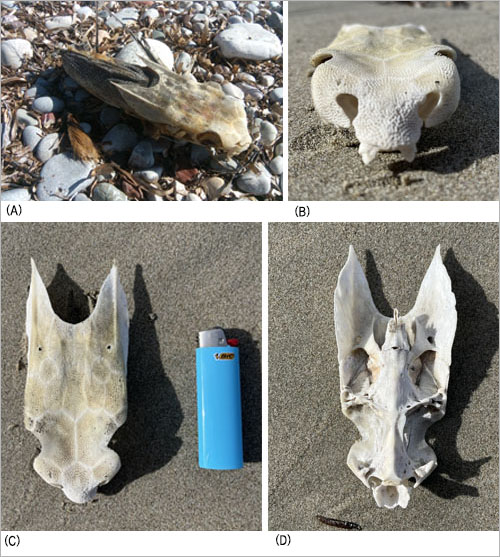 [죽지성대과 어류의 머리 골격 특징] 머리의 밑면을 제외한 측면과 위가 투구처럼 골판으로 감싸여 있다. 사진(A); 해변에서 말라 죽은 개체의 잔해. 몸 부분이 일부 남아 있다. 몸을 덮고 있는 비늘은 골질 성분을 가지고 있어서 사체 껍질이 오래 동안 남아 있을 수 있다. 나머지 3 사진(B,C,D)은 동일 샘플이다. 사진(B); 머리 해골의 정면 사진, 사진(C); 머리 해골의 등면, 사진(D); 머리 해골의 밑면. 머리 투구의 뒤는 등쪽으로 연장되어있다. 이 개체의 종명은 Flying gurnard(Dactylopterus volitans)이다. [Feature of head skeleton of Family Dactylopteridae] The sides and top of the head, except for the underside, are covered with bony plates like a helmet. Photo (A); Remains of a dried-up specimen on the beach. Some body parts remain. The scales covering the body have bony component, allowing the dried carcass to remain for a long time. The rest three photos are of the same sample. Photo (B); Frontal view of the skull, Photo (C); Dorsal view of the skull, Photo (D); Underside of the skull. The back of the skullcap extends dorsally. Author/Photo A; aleksandr5x5, locaton; Bar, Montenegro. Photo B,C,D; raeubertochter, locaton; Ogliastra, Sardegna, Italy. |
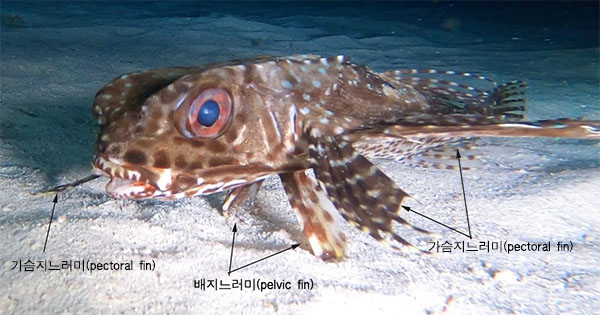 죽지성대류는 배지느러미와 가슴지느러미의 앞부분을 사용하여 바닥을 걸어 다니며 가슴지느러미 앞부분은 바닥을 후벼 파서 먹이를 찾는 기능도 겸한다. 예로 든 사진의 물고기 종명은 Flying gurnard(Dactylopterus volitans)이다. Members of Flying gurnards use their pelvic and anterior part of pectoral fin to walk along the bottom, and the anterior pectoral fins also function to dig into the bottom in search of food. Location/San Andrés Providencia, Colombia. Author/ sofiajimenez2. (CC BY NC). Additional edits by Kim in young. The species name of the fish in the example photo is Flying gurnard (Dactylopterus volitans). |
 죽지성대 묘사도. Illustration of Starry flying gurnard(Dactyloptena peterseni). Author/FAO. (CC BY NC). |
 별죽지성대 묘사도. Illustration of Starry flying gurnard(Dactyloptena peterseni). Date/1908 Author/Jordan, Richardson. (CC BY NC). |
 별죽지성대. 한국 서귀포 성산에서 저인망으로 포획된 개체. Starry flying gurnard(Dactyloptena peterseni). Location/specimen caught with trawling net in Seongsan, Seogwipo, Jeju Island, Korea. Author/오도현(Oh Do-hyeon(CC BY NC). |
 별죽지성대. Starry flying gurnard(Dactyloptena peterseni). Author/CSIRO(Australian National Fish Collection). (CC BY NC). |
 별죽지성대. Starry flying gurnard(Dactyloptena peterseni). Location; collected in Northern Mariana Islands. Author; University of Kansas Biodiversity Institute. (CC BY NC). |
 별죽지성대. Starry flying gurnard(Dactyloptena peterseni). Location/Guam. Author/Brent Tibbatts(Guam DAWR). (CC BY NC). |
 별죽지성대 가슴지느러미의 백색 점 무늬 배열은 개체마다 다르다. The arrangement of white spots on the pectoral fin of Starry flying gurnard varies from individual to individual. left/location; collected in Northern Mariana Islands. Author; University of Kansas Biodiversity Institute. Center/location; from south of Guam(depth about 200 m). Author; Brent Tibbatts(Guam DAWR). Right/preserved specimen, location Mozambique, author; South African Institute for Aquatic Biodiversity, |
 별죽지성대. Starry flying gurnard(Dactyloptena peterseni). Location/Taiwan. Author/Taiwan- Fisheries Laboratory(台湾 水產試驗所). (CC BY NC). |


|
| Copyright ⓒ FISHILLUST.COM All rights reserved. All contents can not be used without permission of the copyright holder. |


 검색
