Oder Scorpaeniformes Family Dactylopteridae(Flying gurnards)
Flying gurnard
Dactylopterus volitans(Linnaeus, 1758). 50.0 cm SL
Italian name/Pesce civetta
Japanese name/Nishisemihoubou
Chinese name/离棘真豹鲂鮄
D/spine 7, soft ray 8, A/soft ray 6. P1/Soft-rays 34-35. P2/speine 1, soft ray 4. Scales on lateral line/60 - 69
Distribution; Eastern Atlantic/English Channel to Angola, including the Mediterranean, Madeira, and the Azores. Western Atlantic: Canada to Massachusetts, USA and the Gulf of Mexico to Argentina.
General; The English common name for Family Dactylopteridae is “Flying gurnards”, but the English common name for a member species, “Dactylopterus volitans”, is also “Flying gurnard”, which can be confusing. This is because the name of this species was selected as the representative common name of the family. The word “Flying gurnard” hereinafter refer to fish with the species name Dactylopterus volitans. Flying gurnard, also known as the Helmet gurnard. This is the only species in the monotypic genus Dactylopterus which distribute only in Atlantic Ocean and the Mediterranean Sea. There are a total of 7 species in Family, the rest 6 species are all in Genus Dactyloptena, and all are distributed in the Indo-Pacific. The Latin “volutans” who is flying, referring to the old belief that these fishes might flying out of the water. Actually Dactylopterus volitans too heavy for doing this, they can only glide over short distances over the bottom
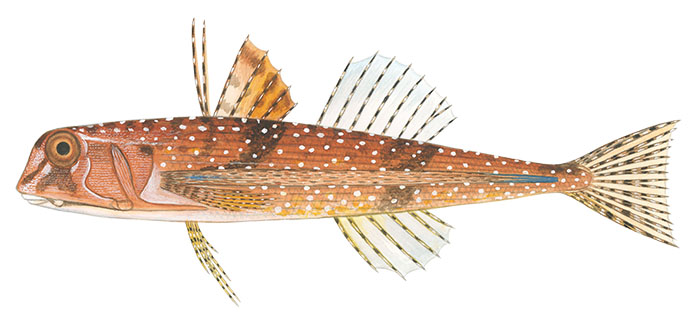
Moderately elongate; body squarish, tapering behind. Head blunt. The sides and top of the head, except for the underside, are covered with bony plate like a helmet. Mouth small, on underside of head; jaws with a band of small, nodular teeth. Lower corner of preopercle with a long spine, with a serrated keel. The fish has large eyes. With two dorsal fins. The first dorsal fin(spinous ray) consists of seven spines, the front two spines being independent and spaced apart from the main first dorsal fin. These two independent spines are very long and are connected to each other only by a basal membrane.
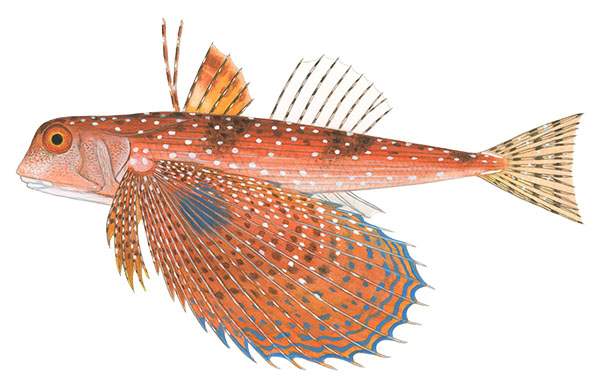
Pectoral fin very large and fan-like that reaches tail fin base. The pectorals are formed by two separate and well distinct parts; a broad part, of elliptic shape, which may have even thirty very flexible rays, and a forward one, formed by six more rigid rays, united forming almost some “legs”, with important touch functions allowing the flying gurnard to walk on the bottom and dig it looking for preys. In addition to walking function of pectoral fins, pelvic fins also act as legs as they slowly make their way across the bottom in search of food.
When threatened, the fish spreads its greatly enlarged pectoral fins like "wings", The flaring of large fins is designed to scare away predators. Like the true gurnards(sea robins), to which they are related, they possess a swim bladder with two lobes and a ‘drumming muscle’ that can beat against the swim bladder to produce sounds. This grunting sound is used by the flying gurnards to communicate with one another. Tail fin slightly concave, with 2 sharp keels at its base; scales hard, bony, with sharp keels.
The color is variegated, multicolored, and flamboyant. The base color is usually red, orange, tan, greenish, or beige, with scattered white and black spots, and the fan-shaped pectoral fin has blue stripes and spots. Found on sand, mud bottoms, or over rocks in sandy areas, often found around reefs. Feeds primarily on benthic crustaceans, especially crabs, clams and small fishes. The reproduction occurs in summer, with several pelagic eggs, and a very fast embryonic development, with variable geometry, with different forms in the various stages of growth. Depth range: 1-150 m. It is very common in Italy and is edible, but not prized.
|

 플라잉 구르나르드(플라잉 죽지성대) 분포도. Distribution map of Flying gurnard(Dactylopterus volitans). Ref. GBIF. Edited by Kim in young(fishillust.com)
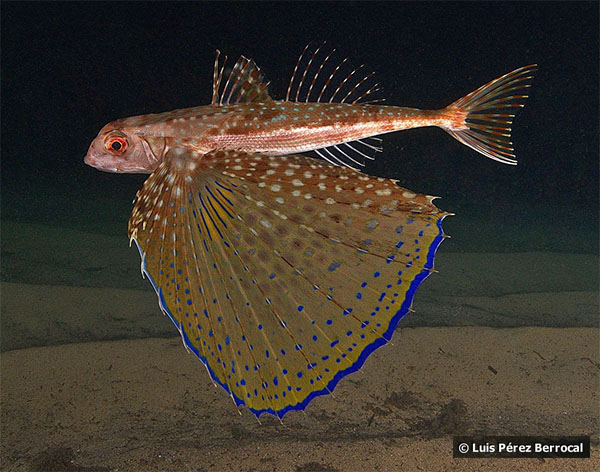 플라잉 구르나르드 수중 사진. Underwater photo of Flying gurnard(Dactylopterus volitans). location/Islas Baleares, Spain. Author/Luis P. B.(CC BY NC)
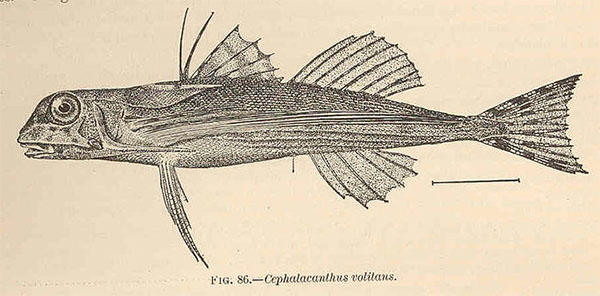 플라잉 구르나르드 묘사도. Depiction of Flying gurnard(Dactylopterus volitans). Date/1902. Author/Barton Warren Evermann(1853–1932).
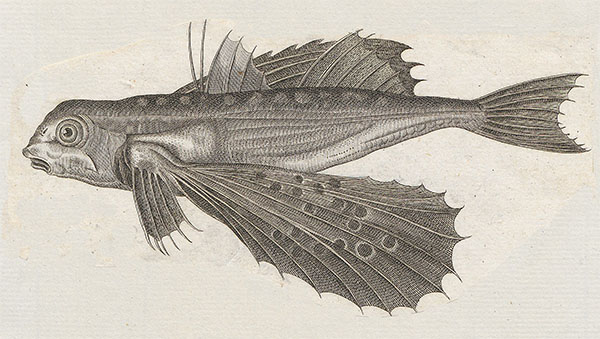 플라잉 구르나르드 묘사도. Depiction of Flying gurnard(Dactylopterus volitans). Date/between 1700 and 1880. Collection/Special Collections of the University of Amsterdam.
 플라잉 구르나르드의 투구형 머리 뼈(성대과의 모든 종이 공유하는 특징임). 머리의 밑면을 제외한 측면과 위가 투구처럼 골판으로 감싸여 있다. 사진(A); 해변에서 말라 죽은 개체의 잔해. 몸 부분이 일부 남아 있다. 몸을 덮고 있는 비늘은 골질 성분을 가지고 있어서 사체 껍질이 오래 동안 남아 있을 수 있다. 나머지 3 사진은 동일 샘플이다. 사진(B); 머리 해골의 정면 사진, 사진(C); 머리 해골의 등면, 사진(D); 머리 해골의 밑면. 머리 투구의 뒤는 등쪽으로 연장되어있다.
 플라잉 구르나르드 묘사도. Depiction of Flying gurnard(Dactylopterus volitans). Date/1905. Author/Bean, Barton A.
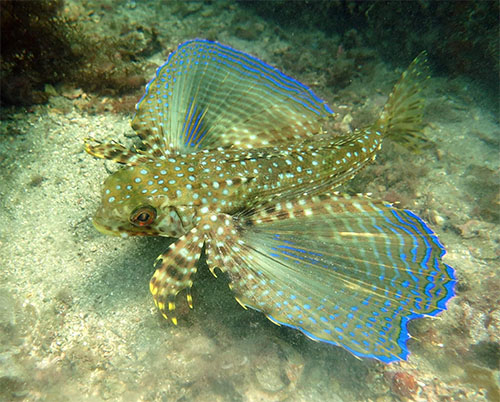 플라잉 구르나르드 수중 사진. Underwater photo of Flying gurnard(Dactylopterus volitans). location/Rio de Janeiro, Brazil. Author/Rodrigo Canalli. (CC BY NC)
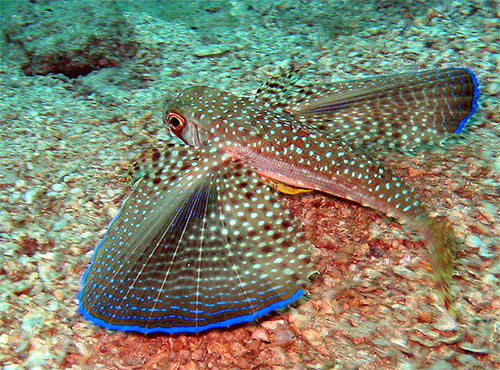 플라잉 구르나르드 수중 사진. Underwater photo of Flying gurnard(Dactylopterus volitans). location/Ilha Grande, Angra dos Reis, Brazil.. Author/cralize. (CC BY NC)
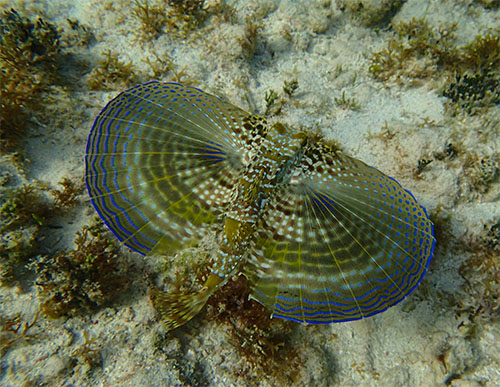 플라잉 구르나르드 수중 사진. Underwater photo of Flying gurnard(Dactylopterus volitans). location/George Town, Cayman. Author/Rachel Andres-Beck. (CC BY NC)
 플라잉 구르나르드 수중 사진. Underwater photo of Flying gurnard(Dactylopterus volitans). location/Haute-Corse, Corse, France(Mediterranean). Author/Frédéric ANDRE. (CC BY NC)
 플라잉 구르나르드, 가슴지느러미를 펼치지 않은 상태의 측면 사진. Lateral view when not flared pectoral fins. Flying gurnard(Dactylopterus volitans). Author/Barry Peters from Greer, SC
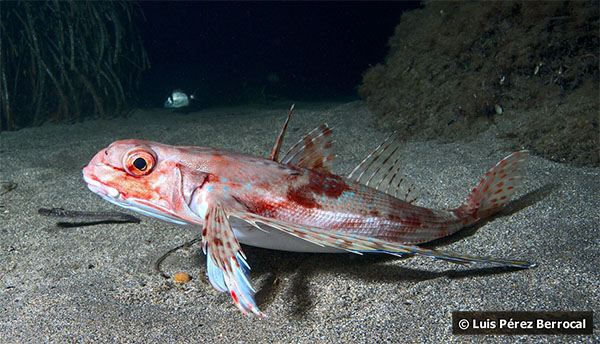 플라잉 구르나르드 수중 사진. Underwater photo of Flying gurnard(Dactylopterus volitans). location/Region of Murcia, Spain(Mediterranean). Author/ Luis P. B. (CC BY NC)
 Left/플라잉 구르나르드 수중 사진. Underwater photo of Flying
gurnard(Dactylopterus volitans). location/Haute-Corse, Corse, France(Mediterranean).
Author/Le Gallais. (CC BY NC). Right/플라잉 구르나르드의 아주 어린 치자어. 손바닥 위에 놓여 있음. A very
young juvenile of Flying gurnard(Dactylopterus volitans) resting on the palm.
Location/ Monmouth County, New Jersey, US. Author/AVNJ. (CC BY NC)


 검색
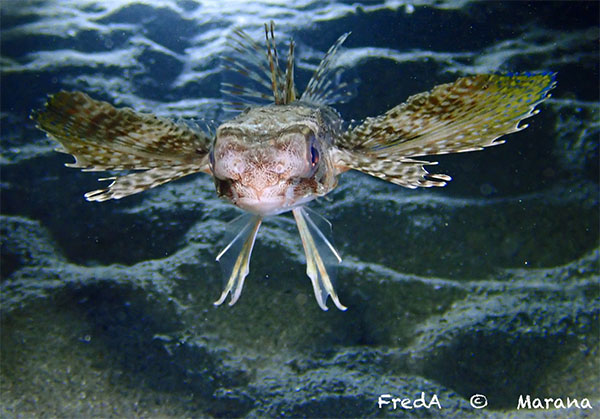 플라잉 구르나르드 수중 사진. 바닥에서 이륙한 순간. Underwater photo of Flying gurnard(Dactylopterus volitans). The moment it takes off from the ground. Location/Haute-Corse, Corse, France(Mediterranean). Author/Frédéric ANDRE. (CC BY NC)
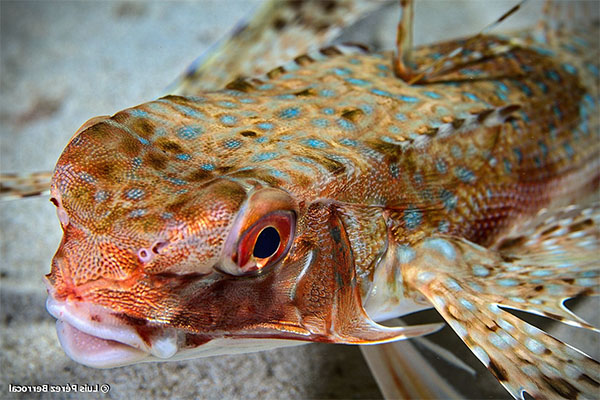 플라잉 구르나르드의 머리 앞쪽 모양. The front view of the Flying Gurnared's head.Location/Islas Baleares, Spain(Mediterranean). Author/Luis P. B. (CC BY NC)
 성대류는 배지느러미와 가슴지느러미의 앞부분을 사용하여 바닥을 걸어 다니며 가슴지느러미 앞부분은 바닥을 후벼 파서 먹이를 찾는 기능도 겸한다.
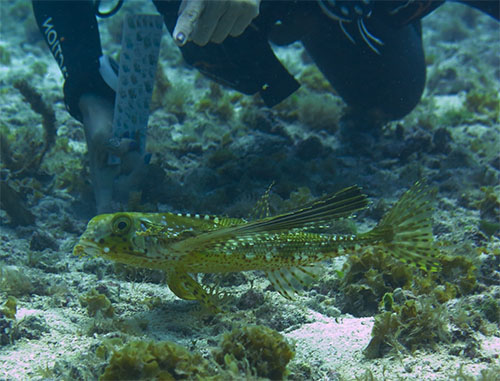 text on preparation스쿠바 다이버와 플라잉 구르나르드. A scuba diver and Flying gurnard(Dactylopterus volitans). Location/Cozumel, Quintana Roo, Mexico. Author/mothpup. (CC BY NC)
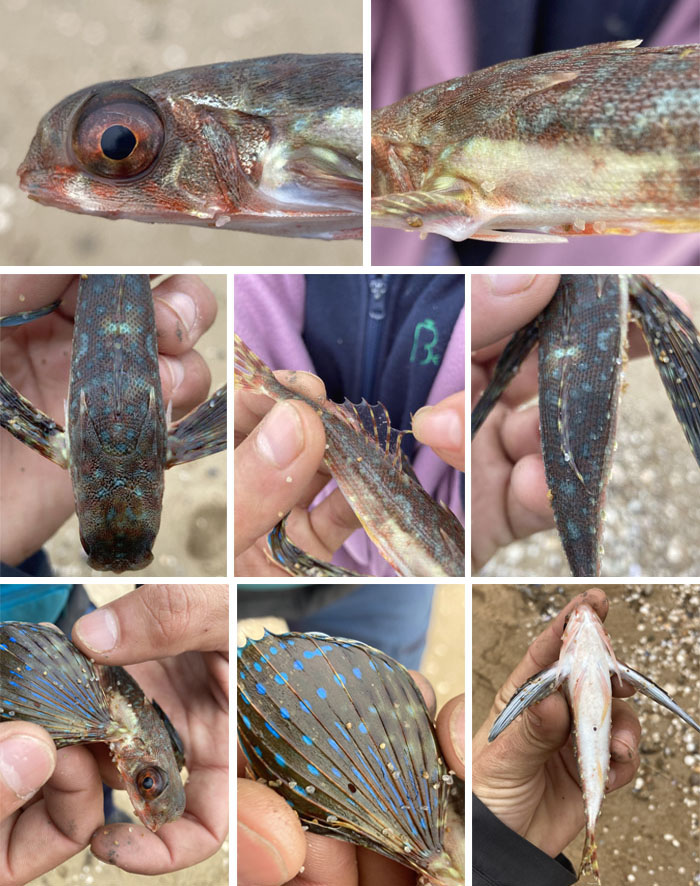 플라잉 구르나르드의 여러 부분을 보여주기 위한 사진 모음. A collection of photos showing various parts of Flying gurnard(Dactylopterus volitans). Location/Rocha, Uruguay. Author/Martin Coronel Varela. (CC BY NC)
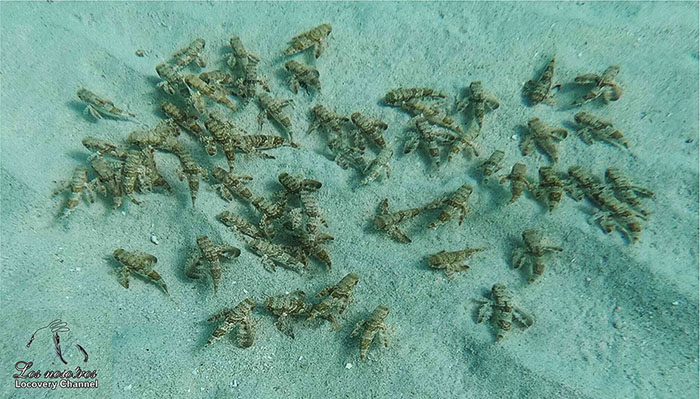 무리를 이룬 플라잉 구르나르드. 나(편집자)는 짝짓기 계절의 풍경이 아닐까 상상해 본다. A schooling of Flying gurnard(Dactylopterus volitans). I (the editor) guess that this might be a scene from the mating season. Location/Cardenas, Matanzas, Cuba. Author/ellocovaradero. (CC BY NC).
 생선 가게의 플라잉 구르나르드, 장소/몰타 공화국. Flying gurnard(Dactylopterus volitans) in a fishmonger. Place/Malta. Author/Kritzolina


