
사이트 로그인
사이트 로그인
|
분류계통/경골상강→조기강→샛비늘치목→샛비늘치과→디오게네스 랜턴피시 Copyright by Kim In Young. 김인영 그림
|
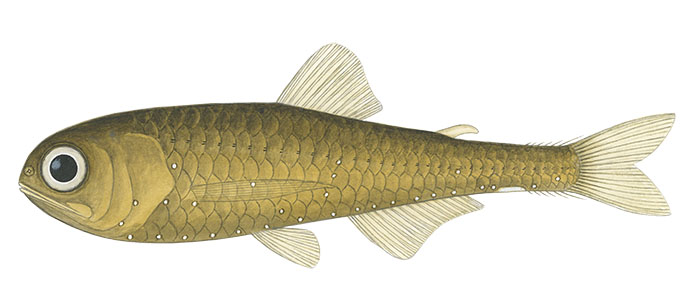 |
[추정] 디오게네스 랜턴피시의 기본 모습. [Assumption] Lateral view of Diogenes lanternfish. |
샛비늘치목. 샛비늘치과 분포; 미국 캘리포니아와 멕시코까지의 동태평양에 밀집 분포하며 칠레까지 이어진다. 아프리카 서부의 대서양 연안과 인도양에 드물게 분포한다. 서태평양의 중북부 위쪽인 남중국해, 필리핀, 미크로네시아, 마리아나 제도, 타이완, 일본 남부, 한국의 제주도 남부 등에 많지 않은 해역에 분포한다. 디오게네스 랜턴피시(Diogenes lanternfish는 몸이 약간 긴편이며 체형은 타원형이며 옆으로 측편되어 있다. 몸의 앞쪽 체고가 매우 높고 뒤로 꼬리지느러미 기부까지 가면서 가늘어진다. 체측과 복부를 따라 여러 개의 발광기관들이 열 지어 있다. 성어의 머리는 크다. 머리에는 비례에 맞지 않게 큰 눈을 가지고 있으며 지름이 주둥이 길이보다 크다. 주둥이는 짧고 앞이 뭉툭하고 둥글다. 성어의 입은 크고 위로 휜 입이며 주둥이 끝에서 열리는 입이다. 상악은 길고 좁으며 뒤 끝은 동공의 뒤 가장자리에 이르며 말단부는 확장된 모양이다. 양턱에는 강모형 이빨이 있으며 뒤쪽의 이빨을 앞으로 휘어져있다. 서골, 구개골에도 이빨이 있다. 몸은 크기가 크고 잘 떨어져나가는 성질의 비늘로 덮여 있으며 얇은 원형비늘이다. 측선은 직선이다. 등지느러미는 1개이며 몸의 중간에 위치한다. 등지느러미는 앞 부분이 높다. 몸 뒤쪽에 기름지느러미가 있다. 뒷지느러미의 기저부는 등지느러미의 기저부 보다 길다. 꼬리지느러미는 안으로 깊게 패인 가랑이 형이다. 몸 색상은 적갈색이다. 표해수층(表海水層)과 중심해층(中深海層)에 사는 종이며 수심 649 m 까지 발견된다. 조밀하게 무리를 짓는 물고기로 믿어지며 야간에는 수면 쪽으로 수직 이동해서 동물플랑크톤을 먹다가 낮에는 포식 당하지 않기 위해 바닥 층으로 내려간다. 수면에서 밝은 불을 켜고 있으면 이 물고기들이 찾아오며 이 때 뜰채 그물로 잡으면 채집할 수 있다. 수많은 물고기와 해양 포유동물의 먹이감이 된다. 난생이며 알과 부화된 새끼는 플랑크톤으로 부유하는 생활을 한다. 디오게네스 랜턴피시는 아직 연구가 많이 되지 않은 물고기여서 생태나 행태에 관해 정보가 제한적이다. |
Order Myctophiformes(lanternfishes). Family Myctophidae(Lanternfishes) Distribution; Concentrated in the Pacific coasts from California and Mexico to northern South America. Sparsely in western Atlantic of Africa and Indian Ocean. Moderately sparse waters above central western Pacific such as South China Sea, Philippines, Micronesia, Mariana Island, Taiwan, southern Japan, and southern Jeju Island of Korea The Diogenes Lanternfish has moderately elongated oval body profile that is much deeper anteriorly and tapers to caudal fin base. Compressed laterally. Have a series of prominent photophores along their sides and belly. The head of adult is large. Has disproportionately large eyes, longer than snout. Snout short, blunt and round. Adult with large upturned terminal mouth. Maxilla is long and narrow, extending to the posterior edge of pupil. Upper and lower jaws with bristle teeth, the posterior line is curved forward, and the vomer, palatine bones are toothed. The body is covered with large and thin round scales, which are easy to fall off; the lateral line is straight. Dorsal fin is single, located in the middle of the body, and another adipose fin at the back. The front of the dorsal fin is high. Base of the anal fin is longer than the base of the dorsal fin. Caudal fin forked. They are red-brown in color. The Diogenes Lanternfish are an epipelagic and mesopelagic species found at depths up to 649 m (2,130 feet). They are believed to form dense aggregations near the coast and to migrate vertically toward the surface at night to feed on zooplankton, then retreat toward the bottom at night to avoid predation. They can be attracted by lights at night and collected with dip nets. They are heavily preyed upon by numerous marine fish and mammals. Reproduction is oviparous with pelagic planktonic eggs and larvae. The Diogenes Lanternfish is poorly studied with very limited information available about their lifestyle and behavioral patterns including specific details on age, growth, longevity, movement patterns, diet, habitat use, and reproduction. |
 디오게네스 랜턴피시 분포도. Distribution map of Diogenes lanternfish(Diogenichthys laternatus). Author/Kim in young(fishillust.com) |
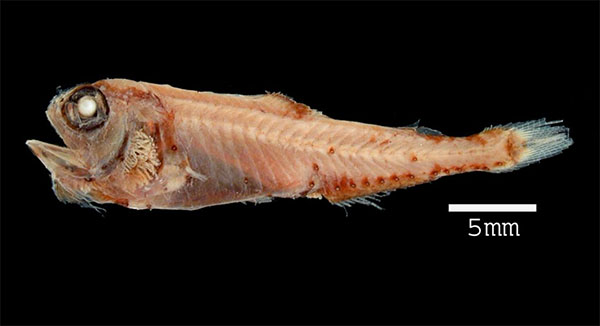 디오게네스 랜턴피시. 연구실 보존 개체. 전장 약 3cm Preserved specimen of Diogenes lanternfish(Diogenichthys laternatus). Collected in Mexico. Total length/approximately 3cm. Author/Museum of Comparative Zoology, Harvard University |
 그림 설명; 제목/Diogenes. 프랑스의 화가/Jean-Léon Gérôme(1824–1904) 그리스의 철학자 디오게네스(404-323 BC)가 아테네 메트룬(Metroon) 신전 모퉁이에 있는 그의 노깡(토관) 집 안에 앉아있다. 대낮인데도 랜턴에 불을 켜고 있다. 이 랜턴은 순수한 사람을 찾아내기 위해 그가 늘 들고 다니던 것이었다. 그의 친구들은 개들이었으며 이는 그의 소박한 생활을 강조하는 냉소철학(Cynic philosophy)의 심볼이었다. 그의 제자 중 한 사람은 견유학파 철학(Cynics 犬儒學派)을 창시하게 된다. 제롬은 이 작품을 전시한 뒤 3년 후에 프랑스 국립미술학교 에콜 데 보자르(Ecole des Beaux-Arts)의 교수가 되어 많은 프랑스인과 외국인들을 가르쳤다. Title/Diogenes. Author/Jean-Léon Gérôme(1824–1904) The Greek philosopher Diogenes(404-323 BC) is seated in his abode, the earthenware tub, in the Metroon, Athens, lighting the lamp in daylight with which he was to search for an honest man. His companions were dogs that also served as emblems of his "Cynic"(Greek: "kynikos," dog-like) philosophy, which emphasized an austere existence. Three years after this painting was first exhibited, Jean-Léon Gérôme(1824-1904) was appointed a professor of painting at the Ecole des Beaux-Arts where he would instruct many students, both French and foreign. |
|


|
| Copyright ⓒ FISHILLUST.COM All rights reserved. All contents can not be used without permission of the copyright holder. |


 검색
 Left picture/그림 제목 “램프를 들고 착한 사람을 찾아 다니는 디오게네스”. 디오게네스는 밝은 대낮에도 램프를 들고 돌아다녔다. 사람들이 뭐 하는 거냐고 물으면 “정직한 사람을 찾는 중이라오”라고 대답하였다. Title; “Diogenes is looking for a good man with a lamp”. Diogenes used to stroll about in full daylight with a lamp; when asked what he was doing, he would answer, "I am just looking for an honest man". Author/Johann Heinrich Wilhelm Tischbein(요한 하인리히 빌헬름 티슈바인).
