[fresh water]
Order Gymnotiformes(Knifefishes) Family Gymnotidae(Naked-back knifefishes)
Electric eel
Electrophorus electricus(Linnaeus, 1766). Max length/250 cm SL. max.weight: 20.0 kg.
Global name/Electric eel South
American names/Pilaké(French Guiana), Puxundu(Brazil), Anguila(Ecuador and Peru)
Japanese name/Denki unagi(電気ウナギ)
Chinese name/電鰻
Dorsal fin rays/0. Pelvic fin rays/0. Anal fin rays/over 400. Pectoral fin rays/32-38. Lateral-line pores/88-101. Vertebrae/max number; 300 vertebrae, Electric eels grow for as long as they live, adding more vertebrae to their spinal column.
Distribution; South America/restricted to the Guiana Shield. The Guiana Shield underlies Guyana, Suriname, French Guiana, southern Venezuela, parts of Colombia and Brazil.
General; Their electrical capabilities were first studied in 1775, contributing to the invention in 1800 of the electric battery. The electric eel is a fish belonging to the Family Gymnotidae of the Order Gymnotiformes. It was classified in independent family Electrophoridae for a long time and then moved to the Family Gymnotidae. Despite their name, electric eels are not closely related to the true eels(Anguilliformes), but more closely related to catfish(Order Siluriformes). For a very long time, it was known that there is only one species of electric eel(species name: Electrophorus electricus), but research results(by C. David de Santana and colleagues) were published in 2019 suggesting that the known electric eel should be separated into three species. In other words, there are actually 3 species, but had been mistakenly thought as 1 species. The three species are Electric eel(Electrophorus electricus), Volta’s electric eels(Electrophorus voltaic), and Vari’s electric eel(Electrophorus varii). Therefore, the common name “electric eel”, which has been used for a long time, has come to refer to only one-third of electric eels. Simply put, the difference in appearance between the three types of electric eel; Electrophorus electricus has a flat head up and down and U-shaped snout when viewed from above, Electrophorus voltai has somewhat oval-shaped head, although it is flat on top and bottom, and emits up to 860 V of electricity. Electrophorus varii has thicker head(skull) than the other two species, and its shape is more variable.
Distribution and habitat of three species of electric eels/The three species have largely non-overlapping distributions in the northern part of South America. E. electricus is northern, confined to the Guiana Shield, while E. voltai is southern, ranging from the Brazilian shield northwards; both species live in upland waters. E. varii is central, largely in the lowlands. The lowland region of E. varii is a variable environment, with habitats ranging from streams through grassland and ravines to ponds, and large changes in water level between the wet and dry seasons. All live on muddy river bottoms and sometimes swamps, favouring areas in deep shade. In water lacking oxygen, they rise to the surface and breathe air.
Morphology/Electric eels have long, stout, eel-like bodies, being somewhat cylindrical at the front but more compressed towards the tail end. The mouth is at the front of the snout, and opens upwards. They have smooth, thick skin with no scales. They have over 100 precaudal vertebrae(excluding the tail), there can be as many as 300 vertebrae in total(As long as the electric eel lives, its body continues to grow longer and the number of vertebrae increases). The anal fin extends much of the length of the body on the underside and has over 400 bony rays. There is no clear boundary between the anal fin and tail fin. Electric eels rely on the wave-like movements of their elongated anal fin to propel themselves through the water. All of the vital organs are packed in near the front of the animal, taking up only 20% of space and sequestered from the electric organs. Males are larger than females. Body color is brown-to-black with a yellow or red underbelly.
Producing Electricity/Electric eel produces both strong(up to 600 volts) and weak(<1 V) electric discharges, for use in predation, communication and navigation, respectively. The maximum discharge from the main organ is at least 600 volts, making electric eels the most powerful of all electric fishes. Freshwater fishes like the electric eel require a high voltage to give a strong shock because freshwater has high resistance; powerful marine electric fishes like the torpedo ray give a shock at much lower voltage but a far higher current. In self-defence, electric eels have been observed to leap from the water to deliver electric shocks to animals that might pose a threat. The shocks from leaping electric eels are powerful enough to drive away animals as large as horses.
Air Breathing/Electric eels are obligate air-breathing animal, get most of their oxygen by breathing air using buccal pumping. This enables them to live in habitats with widely varying oxygen levels including streams, swamps, and pools. Uniquely among the gymnotids, the buccal cavity is lined with a frilled mucosa which has a rich blood supply, enabling gas exchange between the air and the blood. About every two minutes, the fish takes in air through the mouth, holds it in the buccal cavity, and expels it through the opercular openings at the sides of the head. Unlike in other air-breathing fish, the tiny gills of electric eels do not ventilate when taking in air. The majority of carbon dioxide produced is expelled through the skin. These fish can survive on land for some hours if their skin is wet enough.
Sense Organs/Electric eels have small eyes and poor vision. Electric eels can locate their prey using electroreceptors derived from the lateral line organ in the head. The lateral line itself is mechanosensory, enabling them to sense water movements created by animals nearby. The lateral line canals are beneath the skin, but their position is visible as lines of pits on the skin. Electric eels use their high frequency-sensitive tuberous receptors, distributed in patches over the body, for hunting other fish. They are capable of hearing via Weberian apparatus, which consists of tiny bones connecting the inner ear to the swim bladder.
Reproduction/Electric eels reproduce during the dry season, from September to December. During this time, male-female pairs are seen in small pools left behind after water levels drop. The male makes a nest using his saliva and the female deposits around 1,200 eggs for fertilisation. Spawn hatch seven days later and mothers keep depositing eggs periodically throughout the breeding season, making them fractional spawners. When they reach 15 mm(0.59 in), the hatched larvae consume any leftover eggs, and after they reach 9 cm(3.5 in) they begin to eat other foods. Adults feed mainly on fishes. Males becoming reproductively active at 1.2m(3 ft 11 in) in length and growing larger than females; females start to reproduce at a body length of around 70 cm(2 ft 4 in). The male provides prolonged parental care lasting four months for both the young and the nest. E. electricus and E. voltai, the two upland species which live in fast-flowing rivers, appear to make less use of parental care. Electric eels are able to produce electrical discharges when they are as small as 7 cm (2.8 in). Captive specimens have sometimes lived for over 20 years. Electric eels grow for as long as they live, adding more vertebrae to their spinal column.
|


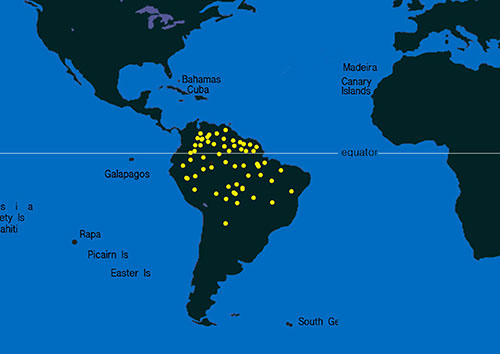 전기뱀장어 분포도. Distribution map of Electric eel(Electrophorus electricus). Basic data; GBIF. Author/Kim in young).
 전기뱀장어 3종의 차이. 위 열은 머리 측면 X레이 사진, 아래 열은 배면에서 본 머리 모양의 묘사도. 왼쪽 첫 번째 a(Electrophorus electricus)가 원래 알려져 있던 “전기뱀장어”이다. Difference between 3 species of Electric eels/Top, radiographs of lateral view of the anterior portion of body(skull and pectoral girdle highlighted red). Bottom, illustrations of ventral view of the head. The first “a”(Electrophorus electricus) on the left is the originally known “Electric eel.” Author/C. David de Santana et al. (CC BY-NC).
 전기뱀장어의 전기기관, 다음 3부분으로 구성되어 있다. 메인 기관(Main organ), 헌터스 기관(hunter’s organ), 작스기관(Sachs’ organ). The illustrations shows the three electric organs of electric eels in genus Electrophorus. Author/Chiswick Chap. (CC BY-NC).
 전기뱀장어의 머리와 몸의 등쪽과 측면에 구멍(감각공)들이 열을 지어있다. 이 열을 따라 피부 밑에 감각관이 묻혀있다. 감각공들은 먹이감들이 일으키는 물의 움직임을 감지하는 기계적감각기(mechanosensors) 역할과 가까운 거리에 있는 사냥감을 감지하는 전류감지기 역할을 한다. Head of electric eel, showing rows of lateral line pits on top and sides. Sensory canals are buried beneath the skin along these rows. These function both as mechanosensors, detecting water movements caused by animals such as prey, and electrosensors, able to detect prey at a short distance. Location/in Gdynia Oceanarium, Poland. Author/Oleksandr(Alex)Zakletsky. (CC BY-NC)
 전기뱀장어. 수족관 사진. 측선 감각공이 뚜렷하다. Electric Eel(Electrophorus electricus). Aquarium photo. The lateral line sensory pores clearly visible. Location/Not described. Author/Sander van der Wel from Netherlands. (CC BY-NC)
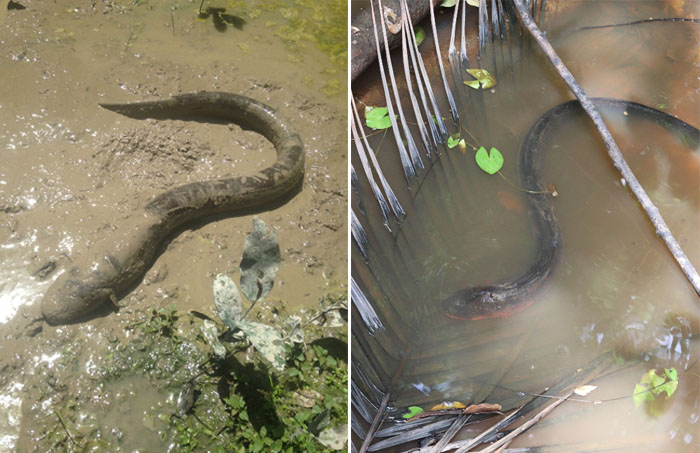 Left/전기뱀장어. Electric Eel(Electrophorus electricus). Location/Potaro-Siparuni, Guiana. Author/Lance Caldwell. (CC BY-NC Right/전기뱀장어. Electric Eel(Electrophorus electricus). Location/French Guiana. Author/lejocelyn. (CC BY-NC)
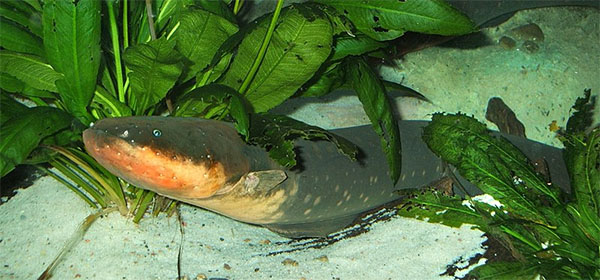 전기뱀장어. 수족관 사진. Electric Eel(Electrophorus electricus). Location/Taken at the New England Aquarium (Boston, MA). Author/Steven G. Johnson. (CC BY-NC)
 전기뱀장어. 수족관 사진. Electric Eel(Electrophorus electricus). Location/Taken at the Steinhart Aquarium in San Francisco. Author/Stan Shebs. (CC BY-NC)
 전기뱀장어. Electric Eel(Electrophorus electricus). Location/Puerto Rondón, Arauca, Columbia. Author/ jairo-md. (CC BY-NC

 전기뱀장어. Electric Eel(Electrophorus electricus). Location/Roura, Cayenne, French Guiana. Author/accidentalshrike. (CC BY-NC)
 Left/바리스 전기뱀장어(Vari’s electric eel, 학명/Electrophorus varii). Location/Sucumbios, Ecuador. Author/miguelaporta. Right/바리스 전기뱀장어(Vari’s electric eel, 학명/Electrophorus varii). Location/Caquetá, Columbia Author/Héctor Andres
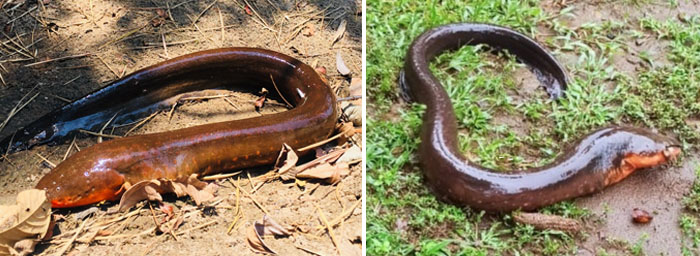 Left/바리스 전기뱀장어(Vari’s electric eel, 학명/Electrophorus varii). Location/Caquetá, Colombia. Author/Mauricio Ramirez. Right/바리스 전기뱀장어(Vari’s electric eel, 학명/Electrophorus varii). Location/Sucumbios, Ecuado. Author/Fuente_celia
 바리스 전기뱀장어가 수면 위로 입을 내놓고 공기를 마시는 장면. A scene where the Vari’s electric eel raises its mouth above the water and breathes air. Location/Peru. Author/Anthony Giardenelli
 바리스 전기뱀장어의 머리. 전기뱀장어보다 머리 두께가 높다. The head of Vari’s electric eel. The head is thicker than the Electric eel. Location/San Martín, Peru. Author/Ronald Mori Pezo
 조리를 하기 전의 바리스 전기뱀장어로 보인다. It appears to be a Vari’s electric eel before cooking. Location/Napo Ecuador. Author/Marco Abril
 바리 전기뱀장어의 몸통 피부 클로즈업 사진. A close-up photo of the body skin of Vari’s Electric Eel(Electrophorus varii). Location/Shushufindi, Sucumbios, Ecuador. Author/miguelaporta




 검색
