Order Ophidiiformes Family Carapidae(pearlfishes)
Pinhead Pearlfish
Encheliophis boraborensis(Kaup, 1856). Max length: 30.0 cm TL
Japanese name/Bôzu-kakureuo
Chinese name/博拉細潛魚
D/soft ray; around 160~180. A/soft ray; around 170~190. P1/??. P2/not exist. Vertebrae/119~126
Distribution; Indo-Pacific/East of South Africa, Mauritius, Andaman Islands Maldives, Vietnam, Sumatra, Papua New Guinea, Australia's northeast Queensland, Solomon Islands, Samoa Islands, Polynesia, north to Taiwan, Pacific coast of central Japan, Yaeyama Islands, Mariana Islands.
General; The pinhead pearlfish is a slender, tapering, eel-like fish. can grow to a length of 30 cm. It has very small eyes Maxilla free and movable, cardiform teeth present, lacking enlarged dentary or premaxillary fangs, vomer with short conical teeth, narrow band of stout conical teeth in palatines. Anterior end of external lower jaw with villiform papillae. With star-shaped melanophores near the jaws which are more numerous in older specimens. This fish has no scales or pelvic fins, but does have short pectoral fins about half of maxillary length. C. boraborensis is the only species in the family to have melanophores on its anal fins. It is highly pigmented brown-coloured fish. Body thick, robust. Much enlarged swim bladder that occupies most of its body cavity. Branchiostegal membranes partly or completely united.
Found in depth range of 1~150 m. E. boraborensis is normally found living within the body cavity of a sea cucumber which it enters through the anus. The leopard sea cucumber(Bohadschia argus) is favoured and the pineapple sea cucumber(Thelenota ananas) is also used for this purpose. Competition between carapid fish occurs for the right to occupy a host. Two male adults were observed to fight when inside the sea cucumber until one was killed, other fish have been found with bite marks on its tail and one adult was found to have a juvenile silver pearlfish(Encheliophis homei) in its stomach. Whereas Encheliophis homei emerges at night from its host to forage, Encheliophis boraborensis, with its small eyes and specialised mouthparts, may at least in part feed on its host's tissues.
When E. boraborensis enters a host and finds a carapid fish already present, it makes a noise. The sounds emitted are regular pulses and the timing in males and females is different, so it is possible to tell the sex of the fish from the sounds it makes. If the fish already present is the closely related silver pearlfish, the sound is often reduced to a single longer pulse. When E. homei enters a sea cucumber already occupied by E. boraborensis, the sound it emits is also often reduced to a single pulse, but in this case it is shorter than its normal call. Both fish are able to change their calls, adapting them to whichever species of fish they encounter inside their hosts.
|


 핀헤드펄피시 분포도. Distribution map of Pinhead Pearlfish(Encheliophis boraborensis). Derived work. Author/Kim in young(fishillust.com)
 핀헤드 펄피시 체형도. 부속 그림은 서골의 이빨 확대도. Body shape illustration of Pinhead Pearlfish(Encheliophis boraborensis). Enlarged vomerine teeth added. Author/SFSA
 핀헤드 펄피시. Pinhead Pearlfish(Encheliophis boraborensis). from Moorea, French Polynesia. Author/John E. Randall
 핀헤드 펄피시. Pinhead Pearlfish(Encheliophis boraborensis). Author/John E. Randall
 해삼의 항문에 들어가 밖을 내다보고 있는 핀헤드 펄피시. A Pinhead pearlfish(Encheliophis boraborensis) looking out of the anus of a sea cucumber. Night dive in Indonesia. Author/orangkucing
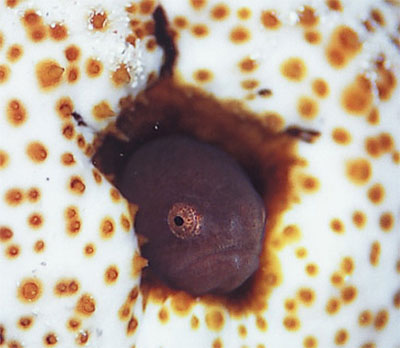 위 사진의 확대 이미지 해삼의 항문에 들어가 밖을 내다보고 있는 핀헤드 펄피시. Enlarged image of above picture. A Pinhead pearlfish(Encheliophis boraborensis) looking out of the anus of a sea cucumber. Night dive in Indonesia. Author/orangkucing




 검색
