[Freshwater]
Order Esociformes Family Esocidae(pikes)
Northern pike
Esox Lucius(Linnaeus, 1758) max length/137 cm TL
Korean name/buk-bu-gang-kko-chi-go-gi(북부강꼬치고기=northern river pike)
Japanese name/カワカマス(Kawakamasu=pike=꼬치고기).
Chinese name/白斑狗魚(백반구어=White Spotted Dogfish).
D/soft rays 17-25. A/soft rays 14~18. P1/15. P2/11-12. Caudal/19. Lateral line scale/105-148. Vertebrae: 57-65.
Distribution; Circumpolar in fresh water. North America: Atlantic, Arctic, Pacific, Great Lakes and Mississippi River basins from Labrador to Alaska and south to Pennsylvania, Missouri and Nebraska, USA. Eurasia: Caspian, Black, Baltic, White, Barents, Arctic, North and Aral Seas and Atlantic basins, southwest to Adour drainage; Mediterranean basin in Rhône drainage and northern Italy. Widely distributed in central Asia and Siberia easward to Anadyr drainage(Bering Sea basin). Historically absent from Iberian Peninsula, Mediterranean France, central Italy, southern and western Greece, eastern Adriatic basin, Iceland, western Norway and northern Scotland. Widely introduced and translocated throughout Europe. Several countries report adverse ecological impact after introduction.
General; Diagnosed from all other freshwater fishes in Europe by the combination of the following characters: long snout; large mouth; dorsal fin origin slightly in front of anal origin; and lateral line with 105-148 scales. Distinguished by its long, flat, 'duck-bill' snout; its large mouth with many large, sharp teeth; and the rearward position of its dorsal and anal fins. Gill rakers present only as patches of sharp teeth on gill arches. Pike can grow to a relatively large size: the average length is about 40–55 cm, with maximum recorded lengths of up to 150 cm and published weights of 28.4 kg.
Northern pike are most often olive green, shading from yellow to white along the belly. The flank is marked with short, light bar-like spots and a few to many dark spots on the fins. Sometimes, the fins are reddish. Younger pike have yellow stripes along a green body; later, the stripes divide into light spots and the body turns from green to olive green. The lower half of the gill cover lacks scales, and it has large sensory pores on its head and on the underside of its lower jaw which are part of the lateral line system. Dorsal located far to the rear; anal located under and arising a little behind dorsal; pectorals low on body, base under opercle; pelvic fins low on body; paired fins rounded, paddle-shaped. Caudal fin with 19 rays.
Occurs in clear vegetated lakes, quiet pools and backwaters of creeks and small to large rivers. Usually solitary and highly territorial. Enters brackish water in the Baltic. Adults feed mainly on fishes, but at times feed heavily on frogs and crayfish. The northern pike is a relatively aggressive species, especially with regards to feeding. For example, when food sources are sparse, cannibalism develops, starting around five weeks in a small percentage of populations. Northern pike fight for survival, such as turning on smaller pike to feed. Because of cannibalism when food is short, pike suffer a fairly high young mortality rate. Aggressiveness also arises from a need of space. Young pike tend to have their food stolen by larger pike. In arctic lakes, it is sometimes the only species present in a given water body. In such cases, juveniles feed on invertebrates and terrestrial vertebrates; large individuals are mainly cannibals. Cannibalistic as juveniles.
Pike are aggressive if not given enough space because they are territorial. Pike are capable of "fast start" movements, which are sudden high-energy bursts of unsteady swimming. Many other fish exhibit this movement as well. Most fish use this mechanism to avoid life-threatening situations. For the pike, however, it is a tool used to capture prey from their sedentary positions. Feces of pike are avoided by other fish because they contain alarm pheromones. Deposits feces at specific locations, distant from its foraging area. Eggs and young are preyed upon by fishes, aquatic insect larvae, birds, and aquatic mammals. Does not generally undertake long migrations, but a few may move considerable distances.
Oviparous. Pike are physically capable of breeding at an age of about two years, spawning in spring when the water temperature first reaches about 9 °C. Spawners move inshore or upstream to the marsh areas to spawn. Generally, spawning occurs during the day. The sexes pair and a larger female is usually attended by one or two smaller males. They swim through and over the vegetation in water usually less than 17.8 cm, releasing eggs and sperm simultaneously at irregular intervals. Eggs are deposited in flooded areas and on submerged vegetation over a period of 2-5 days. Only 5 to 60 eggs are released at a time. This act is repeated every few minutes for up to several hours, after which the fish rest for some time before resuming. During the resting period, both male and female may take new mates, or they may continue together for several days until all eggs are extruded. Spawned-out adults may stay on the spawning grounds for as long as 14 weeks, but most leave within 6. The color of the sticky eggs is yellow to orange; the diameter is 2.5 to 3 mm. The embryos are 7.5 to 10 mm in length and able to swim after hatching, but stay on the bottom for some time. The embryonic stage is five to 16 days, dependent on water temperature and 10 °C, respectively. Under natural circumstances, the survival from free-swimming larva to 75-mm pike is around 5%.
This fish can be heavily infested with parasites, including the broad tapeworm which, if not killed by thorough cooking, can infect human; is used as an intermediate host by a cestode parasite which results to large losses in usable catches of lake whitefish(Coregonus clupeaformis) in some areas; also suffers from a trematode which causes unsightly cysts on the skin. Excellent food fish; utilized fresh and frozen; eaten pan-fried, broiled, and baked. Valuable game fish. In spite of numerous attempts to culture this species, it was never entirely domesticated and does not accept artificial food. Locally impacted by habitat alterations.
|


 북부강꼬치고기 분포도. Distribution map of Northern pike(Esox Lucius). Author/Andrew69. (CC BY-NC).
 북부강꼬치고기 묘사도. Illustration of Northern pike(Esox Lucius). Author/David Starr Jordan(1851–1931)
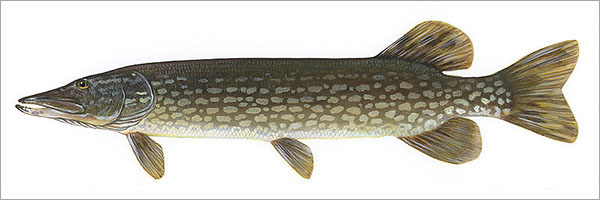 북부강꼬치고기의 묘사도. Illustration of Northern pike(Esox Lucius). Source/U.S. Fish & Wildlife Service National Image Library. Author/Timothy Knepp. (CC BY-NC)
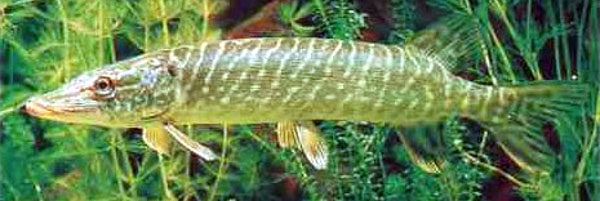 북부강꼬치고기. Northern pike(Esox Lucius). Author/MillaTom. (CC BY-NC)
 북부강꼬치고기. 장소/캐나다. Northern pike(Esox Lucius). Location/Fort Smith, Northwest Territories, Canada.Author/tatejack. (CC BY-NC)
 크로아티아의 핀줄라 호수에서 낚시에 걸린 북부강꼬치고기. Northern pike(Esox Lucius). Northern pike caught on a lure in lake Finzula, Croatia. Author/SpinfisherCRO. (CC BY-NC)
 전시회에 나와있는 북부강꼬치고기. 체코 공화국 프라하. Northern pike on exhibition Subaqueous Vltava, Prague 2011, Czech Republic. Author/Karelj
 Left/대물 북부강꼬치고기. 장소; 미국 유타 주의 유바 레이크. Kip is thrilled with his catch of this monster northern pike. Author/Mike Nielsen. Center/대물 북부강꼬치고기. 장소/네덜란드. Northern pike caught in Nederlands. Author/Hennie2005. Right/대물 노선 파이크. 장소/미상. Author/Terrance Lindall
 북부강꼬치고기 새끼와 소녀. 장소/캐나다. Northern pike cub and young girl. Location/Alberta, Canada. Author/cassieoddie. (CC BY-NC)
 얼음 낚시로 잡은 북부강꼬치고기와 소년. 장소/캐나다. Northern pike(Esox Lucius) caught by ice fishing and a boy. Location/Témiscamingue, Quebec, Canada. Author/Jonathan Fréchette. (CC BY-NC)
 Left/북부강꼬치고기를 잡아먹는 왜가리. 장소/스위스 칸톤주. Location/Basel-Landschaft, CHCanton. Author/rollier. (CC BY-NC). Right/북부강꼬치고기를 잡아먹는 왜가리. 장소/미국. Location/Kenosha County, Wisconsin, U.S. Author/sfitzgerald86. (CC BY-NC)
 Left/북부강꼬치고기. 장소/독일 작센주 라이프치히. Northern pike(Esox Lucius). Location/Leipzig, Sachsen, Deutschland. Author/w4l3nt1n. (CC BY-NC). Right/죽은 지 시간이 많이 지나서 건조된 것으로 보이는 북부강꼬치고기 입과 이빨. 장소/네덜란드. Mouth and teeth of Northern pike(Esox Lucius) that appears to have been desiccated long after death. Location/Nederland. Author/Bj.schoenmakers
 Left/북부강꼬치고기의 위턱 이빨. 장소/프랑스. Upper jaw teeth of Northern pike. Location/Doubs, Franche-Comté, France. Author/Heikel B. (CC BY-NC). Right/북부강꼬치고기의 아래턱 이빨(추정). 장소/노르웨이. Lower jaw(guessed) teeth of Northern pike. Location/ Oppland, Nordre Land, Norway. Author/Bjørnar. (CC BY-NC)
 Left/북부강꼬치고기의 머리. 장소/러시아. Head of Northern pike. Location/Nizhnevartovskiy rayon, Khanty-Mansiy, Russia. Author/usiaz. (CC BY-NC). Right/북부강꼬치고기 머리의 박제. 장소/북유럽(국가 불명). Esox lucius' head, taxidermy. Location/northern Europe(Country Unknown). Author/Lucyin. (CC BY-NC).
 Left/강꼬치고기의 무게를 저울로 재고 있는 여인의 그림. 1906년 작. 장소/핀란드. Drawing of a woman weighing a Pike on a scale. Date/1906. Location/Finland. Author/Eero Järnefelt(Finnish, 1863-1937). Left/북부강꼬치고기에 다리를 물려 부상당한 네덜란드의 12세 소년. 1974년 사진. 12-year-old boy bitten by an Esox Lucius fish in his leg in Amsterdam-Noord. Location/ Amsterdam-Noord. Date/1974. Author/Rob Croes, Anefo (CC BY-NC)
 Left/프랑스 요리 강꼬치고기 브로세트(brochet; 꼬치구이). Author/Varaine. Center/프랑스의 강꼬치고기 요리. Français : IGP vin des Allobroges blanc et filet de brochet. Author/JPS68. Right/강꼬치고기의 알로 만든 루마니아의 타라마(tarama/짠알젓 소스). Roumenian tarama from pike eggs Author/Prof.lumacorno


 검색
 참고 이미지/”강꼬치고기”와 이름에서 혼동을 일으킬 수 있는 “꼬치고기”의 묘사도. 한국에서 Pike와 barracuda는 각각 “River skewer fish(강꼬치고기)” 및 “Skewer fish(꼬치고기)”라고 불러서 혼동을 초래할 수 있다. 강꼬치고기는 담수어로 강꼬치고기목에 그리고 꼬치고기는 해수어로 농어목에 속하여 인연관계가 서로 크게 다른 물고기류이다.
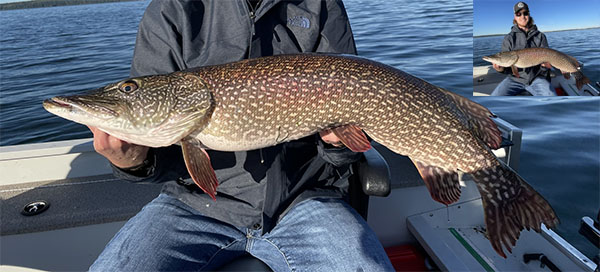 북부강꼬치고기. 장소/캐나다. Northern pike(Esox Lucius). Location/Alberta, Canada. Author/fishermantj17. (CC BY-NC)
