
사이트 로그인
사이트 로그인
|
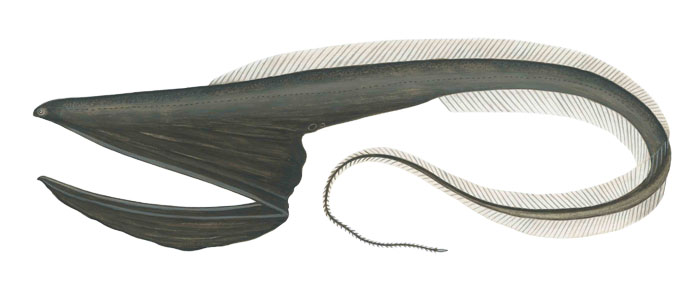
분류계보/경골상강→조기강→사코파린스목→걸퍼과→펠리칸장어(Pelican eel; Eurypharynx pelecanoides) Copyright by Kim In Young. 김인영 그림
|
 |
| text on preparation |
사코파린스목 걸퍼과 Oder Saccopharyngiformes Family Eurypharyngidae(Gulpers) 분포; 전 세계해양 열대와 온대 해역 대심도에 산다. 펠리칸 장어의 대표적인 특징은 몸보다 훨씬 큰 입이다. 자신보다 더 큰 먹이를 삼킬 수 있다. 아래 턱이 펠리칸 새처럼 자루 모양으로 생겨서 펠리칸 장어라는 이름이 나왔다. 아래턱이 머리 아래에 경첩 비슷한 방식으로 연결되어 있고 아래턱 뒤에 몸 부분이 연결되어 있지 않아서 머리가 비정상적으로 크게 보인다. 아래턱 뒤끝이 머리에 연결된 부분은 느슨하다. 펠리칸 장어는 검정 색이며 어떤 개체는 수평으로 가느다란 배색 선 한 개가 있을 수 있다. 외관은 뱀장어를 닮았지만 펠리칸 장어가 다른 물고기들과 다른 점은 다른 물고기에 없는 무엇을 더 가졌는가 보다 가지지 못한 것이 많다는 특징에 있다. 펠리칸 장어는 배지느러미, 부레, 비늘이 없고 꼬리지느러미가 없다. 근육절(筋肉節/muscle segments)이 다른 물고기들은 모두 W형(W-shaped)인데 반하여 펠리칸 장어는 V형(V-shape)이다. 다른 대심도 물고기들과는 다르게 눈이 작다. 이 작은 눈은 영상을 알아보는 기능을 가진 것이 아니라 미미한 빛만 감지하는 눈으로 여겨진다. 펠리칸 장어의 꼬리는 매우 길다. 어선 그물에 걸려 나온 것들 중에는 꼬리가 여러 개의 매듭이 지어져 있는 것도 있었다. 펠리칸 장어는 꼬리를 움직여 헤엄친다. 꼬리 끝에는 수많은 촉수들로 이루어진 복잡한 기관이 있고 여기에서 핑크 색을 발산하며 이따금 밝은 적색 빛을 점멸시킨다. 이것은 아마도 먹이를 유인하는 수단일 것이다. 미끼 기관이 입으로부터 먼 꼬리 끝에 있다는 것이 이상하지만 아마 실제 사용시에는 특이한 몸 자세가 있을 것으로 보인다. 펠리칸 장어의 측선에는 감각 구멍이 없고 그 대신 여러 개의 관 모양 구조가 열 지어 돌출되어 있다. 감지능력이 향상된 적응으로 보인다. 최대 1미터까지 자란다. 먹이 번식 생태 |
Oder Saccopharyngiformes Family Eurypharyngidae(Gulpers) Distribution; Circumglobal /In tropical to temperate waters in Pacific and Atlantic. The Pelican eel's most notable feature is its large mouth, which is much larger than its body. The mouth can be opened wide enough to swallow a fish much larger than the eel itself. The pouch-like lower jaw resembles that of a pelican bird, hence its name. The lower jaw is hinged at the base of the head, with no body mass behind it, making the head look disproportionately large. Pelican eels are black and some subspecies may have a thin lateral white stripe. They are ray-finned fish, and only resemble eels in appearance. What makes the Pelican eel so different from other fish, is not so much what it has, but what it doesn't have. They lack pelvic fins, swim bladders, and scales. Caudal fin absent. Their muscle segments have a “V-shape”, while other fish have “W-shaped” muscle segments. Unlike many other deep sea creatures, it has very small eyes. It is believed that the eyes evolved to detect faint traces of light rather than form images. The Pelican eel also has a very long, whip-like tail. Specimens that have been brought to the surface in fishing nets have been known to have their long tails tied into several knots. The Pelican eel uses a whip-like tail for movement. The end of the tail bears a complex organ with numerous tentacles, which glows pink and gives off occasional bright-red flashes. This is presumably a lure to attract prey, although its presence at the far end of the body from the mouth suggests the eel may have to adopt an unusual posture to use it effectively. Lateral line without pores, instead with groups of elevated tubules.; this may increase its sensitivity. The Pelican eel grows to about 1,0m in length. Diet Reproduction and life cycle |
 Left/펠리칸 장어 일러스트. Illustrated Pelican eel. Date/1886. Author/Author/Français : A. L. Clement. Right/펠리칸 장어 일러스트. Illustrated Pelican eel. Date/1896.Author/Author/G. Brown Goode |
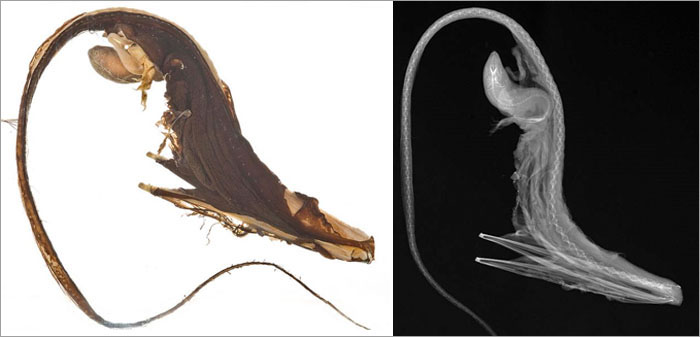 펠리칸 장어 표본 사진과 X-레이 사진. Image of preserved Eurypharynx pelecanoides(left) and it’s X-ray image(right). Author/Sandra Raredon(Smithsonian Institution). |


|
| Copyright ⓒ FISHILLUST.COM All rights reserved. All contents can not be used without permission of the copyright holder. |


 검색
