Order Beloniformes Family Exocoetidae(Flyingfishes)
Tropical two-wing flyingfish
Exocoetus volitans(Linnaeus, 1758) max length/30.0 cm TL, common length/20.0 cm TL
Korean name/sang-nal-chi(상날치)
Japanese name/ イダテントビウオ(Idaten-tobi-uo)
Chinese name/大頭飛魚(대두비어)
D/Soft ray 13-15. A/soft ray 13~14. P1/13~15. P2/6. Lateral line scales/43-48. Vert/43-44. Gill rakers/6-8 +23-27 = 30-34. Branchiostegal/9-11
Distribution; Distributed in subtropical and tropical waters of the Atlantic, Indian, and Pacific Oceans worldwide. It is distributed in South Sea of Korea and south of southernmost part of Japan(Okinawa Prefecture). Rest distribution area; refer to the distribution map.
General;
==Supplementary commentary; Tropical
two-wing flyingfish is also known by the common name "Tropical two-winged
flyingfish" or "blue flyingfish". The word "Tropical"
in the name is to distinguish it from “Oceanic two-winged
flyingfish(Exocoetus obtusirostris)”, which is a different species. Two-wing
flyingfish means "flying fish that has two wings". Flyingfish have
large pectoral fins and dorsal fins, and they glide by extending the pectoral
fins on the left and right and the pelvic fins also on the left and right,
giving them four wings. In some species, however, the pelvic fin is too small
to function as a wing, and only uses the pair of pectoral fin to glide, giving
them two wings. To distinguish this characteristic, the concepts of two-winged
and four-winged flying fish have been coined. Exocoetus volitans fall into the
category of flying fish with only two wings.==
Exocoetus volitans, commonly known as the tropical two-wing flyingfish or blue flyingfish. Body elongated, slightly compressed laterally. The head length is more than 1.5 times the head height, and the body length is 5.1-5.4 times the body height. The snout is blunt and short. Mouth open at front, lower jaw slightly longer than upper jaw; two jaws with weak teeth; palatine bone toothless. Two pairs of nostrils, large in shape, close to the eyes. Gill slit wide, gill membrane free in throat isthmus. The swim bladder is large and extends backward; the intestine is simple, without pylorus and caecum.
Body covered with round scales, large and thin, easy to fall off; head more or less scaled. Lateral line very low, near ventral margin, unbranched on thorax. 6 lines of scales between the dorsal fin and the lateral line. The number of scales on the dorsal midline from dorsal fin origin to the occiput is 18-21. The dorsal fin is located far to the back of the body and has no spinous ray and consists only of soft rays. Dorsal fin colourless without black or gray spots. Origin of the anal fin being at a location slight behind the origin of the dorsal fin, and no spinous rays, only soft rays.
The upper parts of the body are an iridescent dark blue colour while the belly is silvery white. The pectoral fins are remarkably long, reaching to caudal fin base. The upper 2/3 of the pectoral fin is dark(greyish) and the lower part is light. 1st ray of pectoral fin unbranched. The pelvic fin is very short, ends well before anal origin and colourless, , base is closer to the snout than to caudal fin base. Pelvic fin transparent and colorless. Anal fin origin under dorsal fin origin. Caudal fin, greyish, is well developed, deeply forked, lower lobe longer than upper lobe. Juvenile fish, the head is not significantly elevated, and the lower jaw without whiskers. Body of juvenile fish pale, sometimes with vertical dark bars or without, dorsal and anal fins black at rear, and pectoral and pelvics transparent
Exocoetus volitans is present in the tropical and subtropical zones of all the world's oceans. It is found in surface waters both in the open ocean and close to the coast. Form schools. E. volitans feeds in the open sea on crustaceans, such as copepods, and other planktonic fauna. Oviparous, with planktonic eggs and larvae. The female lays her clutches of 300 or 400 eggs in the open water. This fish sometimes launches itself into the air in an attempt to escape from predators such as tuna, dolphinfishes(Coryphaena), snake mackerel(Gempylus serpens) and the rainbow runner(Elagatis bipinnulata). However, in so doing, it exposes itself to a different set of predators in the form of gulls, cormorants and other aquatic birds. It often exits the water in shoals and sometimes lands on the decks of boats.
|

 상날치 분포도. Distribution map of Tropical two-wing flyingfish(Exocoetus volitans). Main ref. GBIF. Edited by fishillust.com
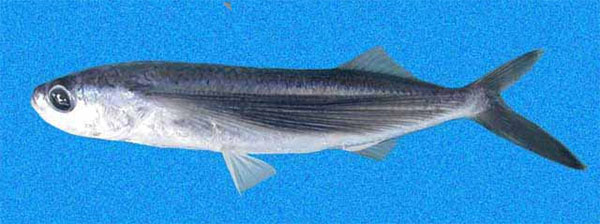 상날치 보존 개체. Preserved specimen of (Tropical two-wing flyingfish(Exocoetus volitans). Source/Smithsonian tropical research institute
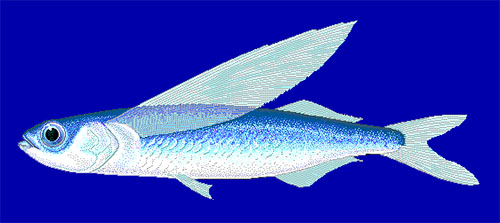 상날치 묘사도. Illustration of (Tropical two-wing flyingfish(Exocoetus volitans). Author/Robbie N. Cada(former FishBase staff).
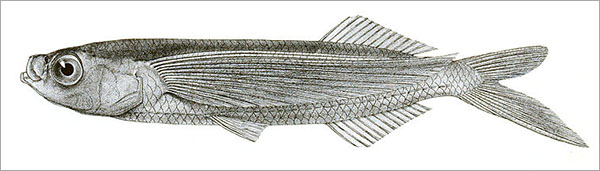
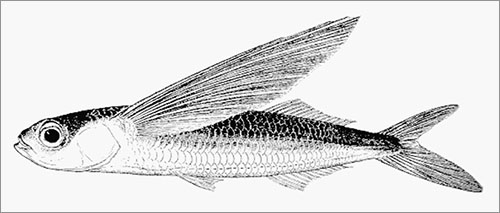 상날치 묘사도. Illustration of (Tropical two-wing flyingfish(Exocoetus volitans). Source/FAO
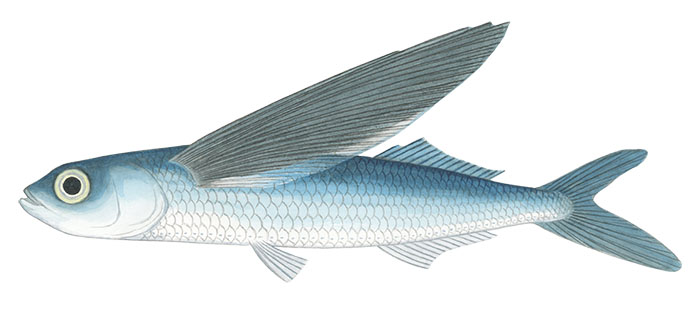
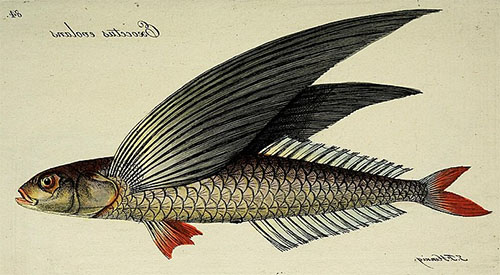 고전 문헌의 상날치 묘사도. Illustration of (Tropical two-wing flyingfish(Exocoetus volitans). From a classical literature. Date/1801. Author/Bloch, Marcus Elieser; Hennig, J. F.; Schneider, Johann Gottlob
 일본 고전 날치류 그림(아래는 조기류). 종이에 그려 나무 판에 붙임. Illustrations of a flying fish from classical Japanese literature(below/yellow corvina). Polychrome woodblock print; ink and color on paper. Date/1840s. Author/Utagawa Hiroshige (1797–1858). Collection/Metropolitan Museum of Art
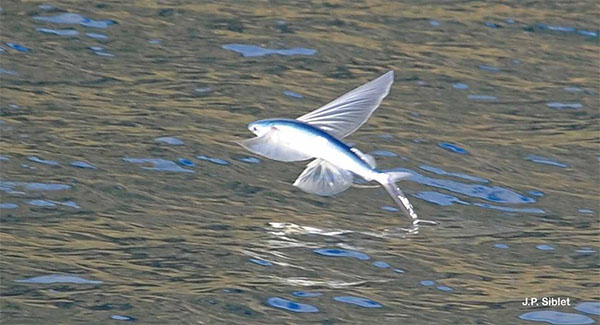 수면 위를 나는 상날치. 상날치라고 설명이 된 사진이지만 배지느러미가 큰 것으로 보아 다른 종일 가능성이 높다. A flyingfish flying over the water. Although the picture is captioned as a Exocoetus volitans, it is highly likely that it is a different species because of the large pelvic fins. Author/Creator J.P. Siblet
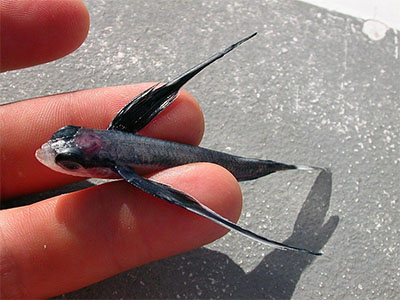 손가락 사이의 작은 상날치. Small Tropical two-wing flyingfish between the fingers. Author/Dr Jean Fortunet




 검색
