
사이트 로그인
사이트 로그인
경골상강/Superclass Osteichthyes(bony fishes)→조기강/Class Actinopterygii(ray-finned fishes)→철갑상어목 Order Acipenseriformes→Family Acipenseridae 철갑상어과 Family Acipenseridae(Sturgeons) Family 60 |
 숏노즈 스터전(Shortnose sturgeon; Acipenser brevirostrum). Author/George Brown Goode(1851–1896). |
 레이크 스터전(Lake sturgeon; Acipenser fulvescens). Author/H. L. Todd. Date/1884 |
 철갑상어의 복부와 머리 하부는 편평하다. Sturgeon’s head and body is with flat bottom. Derived from a picture of Sturgeon Cacophony by Author/Cacophony |
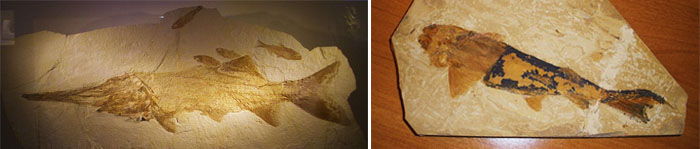 Left/5천 2백만년 전 시신세(始新世/lower Eocene) 후기의 철갑상어류 화석. 속명은 크로소폴리스(Crossopholis). 현생의 패들피시 방향으로 진화하는 과정 중에 있는 물고기. Fossil Crossopholis lived in the lower Eocene approximately 52 million years ago. It is an extinct relative of the contemporary paddlefish. Author/Ghedoghedo Right/약 1억 5천만년 전 백악기 전기의 철갑상어 선조 화석(종명/Peipiaosteus pani). 중국 랴오닝의 지우포탕 지층(Jiufotang Formation)에서 발견된다. Peipiaosteus closely related to living sturgeon and paddlefish. Its fossils are found in the Early Cretaceous(150 million years ago) Jiufotang Formation, Pani Lake, Liaoning Province, China. Author/Ghedoghedo |
 Left/백악기 초기의 철갑상어 화석. 종명/Yanosteus-longidorsalis. Fossil of Yanosteus-longidorsalis. Stage : Early Cretaceous 146 Ma to 100 Ma. Liaoning Province, China. Photographer/Didier Descouens. Right/화석어 야노스테우스 롱기도르살리스(Yanosteus-longidorsalis)의 복원도. Reconstruction of Yanosteus-longidorsalis. Author/Apokryltaros |
|
철갑상어과(Acipenseridae)는 4속 약 25종으로 구성되어 있고 이 중에서 1속 3종이 한국 분포 종으로 등록되어 있으나 지금은 한국에서 발견되지 않는다. 한국 분포 3종은 다음과 같다 철갑상어의 영어 이름 스터전(Sturgeon)의 어원은 독일어 네덜란드어 프랑스어 등 몇 가지 언어와 관계가 있으며 분명하지가 않다. 또한 철갑상어는 상어가 아니기 때문에 한국 말 “철갑상어”는 잘못된 이름이다. 굳어진 이름임으로 사용할 수 밖에 없으나 이 사실을 염두에 두고 철갑상어를 상대해야 한다. 철갑상어는 2억 8백만년~2억 4천 5백만년 전 트라이아스기(Triassic)에 나타난 물고기이다. 철갑상어는 철갑상어목(order Acipenseriformes)의 2개 과 중 한 과인 철갑상어과(family Acipenseridae)에 분류되는 물고기 무리로서 4속에 25종이 알려져 있다. 다른 한 과는 주걱철갑상어과(Family Polyodontidae)이며 영명으로 패들피시(Paddlefishes)라 하고 2속에 2종이 있다. 그러나 주걱철갑상어는 몸에 갑옷 같은 보호막이 없는데 “---철갑상어”라는 이름을 가져서 혼동을 일으킨다. 진정한 철갑상어류가 아니다. 패들피시(Paddlefish)의 Paddle은 “주걱”으로 번역해도 되기는 하지만 정확하게 말하면 작은 보트를 젓는 “노”의 뜻이다. “주걱고기” 또는 “노고기”라고 했으면 더 실제에 가까웠을 것이다. 철갑상어류와 주걱철갑상어류는 모두 그 형태가 초기 화석어로부터 크게 변하지 않은 원시 물고기라는 공통점이 있을 뿐이다. 철갑상어는 유라시아와 북아메리카의 아열대, 온대 및 아 북극 지방의 강, 호수, 그리고 연안에 산다. 태평양 지역에서는 러시아와 중국 경계에 있는 아무르 강과 사할린 섬, 중국 북부의 양자강에서 발견된다. 철갑상어는 수명이 길고 성어가 되는 나이가 길다. 꼬리지느러미는 상어 지느러미처럼 상엽이 크고 몸은 길고 방추형이며 피부는 밋밋하고 비늘이 없으며 5열의 골질 인갑판(鱗甲/scute) 줄이 수평 방향으로 배열되어 몸의 일정 부분에서만 갑옷 역할을 한다. 이 5열 인갑판 줄은 측면 중심 선과 배쪽에 1개씩, 양쪽에 4 줄이 있고 등 중심 선에 1개가 있어 도합 5개가 된다., 몇 종은 대형 종으로 길이가 2-3.5 m에 이른다. 최대어 기록은 1827년 볼가 강에서 잡힌 암컷 벨루가 철갑상어(Beluga/학명; Huso huso)로 길이가 7.2 m에 무게가 1,571 kg이었다. 대부분 철갑상어들은 강 하구와 기수에 살다가 알을 낳으러 강을 거슬러 올라가는 소하성(遡河性/anadromous)이다. 민물에서 평생을 사는 종들이 있고 해안 가까이 해수에 살며 먼 바다까지 나가는 종들도 있다. 진화 철갑상어는 경골어류에 속하지만 뼈대가 거의 모두 연골이라는 특징이 있다. 그렇다고 이 연골이 원시적인 것은 아니다. 철갑상어의 선조는 경골 뼈대를 갖고 있었으며 철갑상어의 연골은 이 경골이 연질로 진화된 것이기 때문이다. 철갑상어는 척추골(vertebral centra)이 없다. 입 앞에 4개의 수염이 있는데 이는 감지기관이다. 입은 옆으로 크고 이빨이 없다. 부리기 납작하다. 겉에 보이는 빛살 모양이 짝지느러미들을 지주하는 것처럼 보이지만 체벽 안에 있는 골격이 지주해 준다. 철갑상어는 대형어로 가스피해의 벨루가(beluga/Huso huso)는 5.5~7.2m 길이에 무게 2000 kg, 아무르 강의 칼루가(Kaluga/H. dauricus)는 비슷한 길이가 무게 1,000 kg을 기록했다. 철갑상어는 수명이 긴 물고기로 알려졌다. 100년 이상 살 수 있다. 성적으로 성숙되는 나이는 20년 이상 걸린다. 성장 속도가 느리고 성어가 되는 나이가 길어서 재생산율이 낮으며 알(캐비어)이 매우 고가품이어서 알 밴 암컷이 남획 됨으로 철갑상어는 멸종 위협을 받고 있다. 생태 철갑상어는 수염을 강 바닥에 대고 낮게 떠서 돌아다닌다. 철갑상어는 기본적으로 바닥 생물을 잡아먹는 저생동물섭이자(benthic feeders)이며 조개류, 갑각류, 작은 물고기를 먹는다. 흡입관 같은 입을 내밀어서 바닥에 있는 먹이를 빨아들인다. 이빨이 없어서 먹이를 물지는 못한다. 그러나 큰 철갑상어들은 연어 같은 큰 먹이를 통째로 흡입해 삼킨다. 철갑상어는 시각으로 먹이를 찾아먹지 못하고 감각 기관을 이용하여 먹이를 찾아먹는다. 후각, 촉각, 4개의 수염으로 탐지되는 화학 신호 그리고 로렌지니 팽대부(ampullae of Lorenzini)로 탐지된 전류감각을 종합하여 먹이를 찾는다. 철갑상어와 인간 유대교의 식사 계율에서는 비늘이 있는 물고기만 먹게 허락되어 있어서 정통 유대교인들은 철갑상어를 먹지 않는다. 철갑상어는 둥근비늘이든 빗비늘이든 비늘이 없고 비늘이라고 볼 수 없는 인판을 갖고 있다. 그러나 일부 보수적인 유대교인들은 철갑상어를 먹는다. 이는 19세기 헝가리의 유대교 종교 개혁가이며 랍비인 아론 코린(Aron Chorin)과 관계가 있는데 유럽의 유대인들은 이미 오래 전부터 철갑상어를 먹고 있었다는 것이다. |
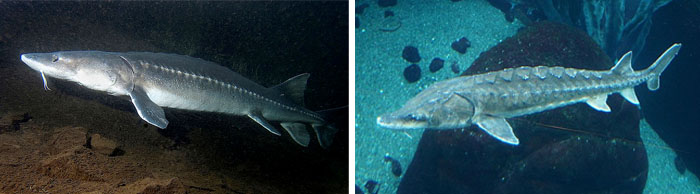 Left/화이트 철갑상어(White sturgeon/Acipenser transmontanus). 장소/미국 컬럼비아 주 본니빌 댐. White sturgeon(Acipenser transmontanus) at the Oregon Department of Fish and Wildlife's Sturgeon Center at Bonneville Dam on the Columbia River. Author/Oregon Department of Fish & Wildlife. Right/대형 해수 수족관의 철갑상어(종 미상). A sturgeon swimming in the large salt water pool. Author/Jiaqian AirplaneFan |
 Left/팰리드 스터전(Pallid sturgeon/학명; Scaphirhynchus albus). Pallid sturgeon(Scaphirhynchus albus) caught at Garrison Dam in North Dakota in the United States.Author/U.S. Fish and Wildlife Service. Right/과학자들에 의해 자연으로 방생되고 있는 팰리드 스터전(Pallid sturgeon/학명; Scaphirhynchus albus). A Pallid sturgeon(Scaphirynchus albus) is released into Yellowstone River by U.S. Fish and Wildlife Service personnel. Author/U.S. Fish and Wildlife Service |
 바다사자의 공격을 받고 있는 철갑상어. 바다사자가 철갑상어를 잡아먹으려고 하는지 단순히 괴롭히는 것인지 사진에 설명이 없다. Steller sea lion with a sturgeon. Author/Northwest Power and Conservation Council |
 중세 시대 초기 벨기에 지방에는 성인(여자) “성 아말베르가 오브 템스(Saint Amalberga of Temse)”가 있었다. 이 성인과 관련하여 여러 가지 기적 이야기가 있는데 그 중 하나는 큰 철갑상어가 나타나 그 녀를 등에 태워 강을 건너가게 해 주었다는 것이다. 이 전설은 덧옷에 그려지는 문장(紋章) 디자인으로 전해져 있고 그림 작품들로 표현되어 왔다. Amalberga of Temse Amalberga of Temse(born about 741, died 10 July 772) was a Lotharingian noblewoman from the Frankish royal house of the Pippinids who is celebrated as a saint in the Roman Catholic Church and the Eastern Orthodox Church. Many miracles, such as crossing the river Scheldt on a giant fish are attributed to her. In heraldry and art this is a sturgeon. |
|
철갑상어과 25종 명단. 25 Species in Family Acipenseridae(Sturgeons) |
|
|
철갑상어과 종 명세표 차트. Chart of species in Acipenseridae(Sturgeons)
|
|
Family Acipenseridae(Sturgeons) Family 60 Family Acipenseridae comprises 4 genera with 25 species and 1 genus, 3 species recorded in Korean peninsula but not found in this area. Korean species as follows; Sturgeon is the common name for the 27 species of fish belonging to the family Acipenseridae. Their evolution dates back to the Triassic some 245 to 208 million years ago. The family is grouped into four genera: Acipenser, Huso, Scaphirhynchus and Pseudoscaphirhynchus. Four species may now be extinct. Two closely related species, Polyodon spathula(paddlefish) and Psephurus gladius(Chinese paddlefish, possibly extinct) are of the same order, Acipenseriformes, but are in the family Polyodontidae and are not considered to be "true" sturgeons. Both sturgeons and paddlefish have been referred to as "primitive fishes" because their morphological characteristics have remained relatively unchanged since the earliest fossil record. Sturgeons are native to subtropical, temperate and sub-Arctic rivers, lakes and coastlines of Eurasia and North America. In the Pacific Ocean, they are found in the Amur River along the Russian-Chinese border, on Sakhalin Island, and in the Yangtze and other rivers in northeast China. Sturgeons are long-lived, late-maturing fishes with distinctive characteristics, such as a heterocercal caudal fin similar to that of sharks, and an elongated spindle-like body that is smooth-skinned, scaleless and armored with 5 lateral rows of bony plates called scutes. Several species can grow quite large, typically ranging 7–12 feet (2-3½ m) in length. The largest sturgeon on record was a Beluga female captured in the Volga estuary in 1827, weighing 1,571 kg and 7.2 m long. Most sturgeons are anadromous bottom-feeders which migrate upstream to spawn but spend most of their lives feeding in river deltas and estuaries. Some species inhabit freshwater environments exclusively while others primarily inhabit marine environments near coastal areas, and are known to venture into open ocean. Several species of sturgeon are harvested for their roe which is processed into caviar—a luxury food and the reason why caviar-producing sturgeons are among the most valuable of all wildlife resources. They are particularly vulnerable to overexploitation and other threats, including pollution and habitat fragmentation. Most species of sturgeon are considered to be at risk of extinction, making them more critically endangered than any other group of species. Evolution Physical characteristics Sturgeon have been referred to as both the Leviathans and Methuselahs of freshwater fish. They are among the largest fish: some beluga(Huso huso) in the Caspian Sea reportedly attain 5.5~7.2m and 2000 kg while for kaluga (H. dauricus) in the Amur River, similar lengths and over 1,000 kg weights have been reported. They are also among the longest-lived of the fishes, some living well over 100 years and attaining sexual maturity at 20 years or more. The combination of slow growth and reproductive rates and the extremely high value placed on mature, egg-bearing females make sturgeon particularly vulnerable to overfishing. Sturgeons are broadcast spawners, and do not spawn every year because they require specific conditions. The fertilized eggs become sticky and will adhere to the bottom substrate upon contact. It takes 8–15 days for the embryos to mature into larval fish. River currents carry the larvae downstream into backwater areas, such as oxbows and sloughs where the free-swimming fry will spend their first year feeding on insect larvae and crustacea. During their first year of growth, they will reach 18 to 20 cm (7.1 to 7.9 in) in length and migrate back into the swift-flowing currents in the main stem river. Behavior Use |
 Left/1921년 러시아 볼가강 테튜시(Tetyushi) 마을에서 잡힌 대형 철갑상어. Giant Beluga Sturgeon caught near the town of Tetyushi on the upper River Volga, 1921. Right/1924년 볼가강에서 잡힌 대형 벨루가 철갑상어(Beluga/학명; Huso huso). 큰 것은 무게가 1,571 kg 나갔다. Beluga sturgeon from the Volga River in 1924. weighed 1,571 kg! |
 Left/철갑상어(종명; Scaphirhynchus platorynchus)의 알로 만든 캐비어 상품. Domestic Hackleback caviar of Marky's product. Author/Stanislav Serbin. Center/송어 알로 만든 캐비어. 레드 캐비어(red caviar)라고 부른다. 철갑상어류 이외의 물고기 알로 만든 캐비어는 캐비어가 아니다. “대용 캐비어”라고 해야 옳다. Trout roe is one of the types of the so-called "red caviar". Author/Stanislav Serbin. According to the United Nations' Food and Agriculture Organization, roe from any fish not belonging to the Acipenseriformes species(including Acipenseridae, or sturgeon sensu stricto, and Polyodontidae or paddlefish) are not caviar, but "substitutes of caviar." Right/패들피시(주걱철갑상어)의 캐비어, 패들피시의 캐비어는 전통적인 오리지널 캐비어는 아니지만 캐비어로 취급해 준다. Tin of freshly processed paddlefish caviar. Paddlefish caviar is not traditional caviar, but included in regular caviar category defined by the United Nations' Food and Agriculture Organization. Author/Earthwave Society |
 Left/연어 살코기와 캐비어로 셋팅된 고급 아침 식사. Caviar a bit posh breakfast. Author/Sami Keinänen. Right/투르크메니스탄 서부 도시 투르크멘바시(Turkmenbashi) 생선 가게. 철갑상어만 전문으로 팔고 있다. Sturgeon at a fish market in Turkmenbashi, Turkmenistan. Author/Flydime |


|
| Copyright ⓒ FISHILLUST.COM All rights reserved. All contents can not be used without permission of the copyright holder. |


 검색
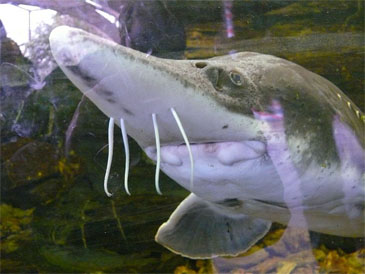 철갑상어의 수염과 입을 보여주는 사진. 수염을 바닥에 대고 헤엄치면서 먹이를 탐지하며 입을 앞으로 내밀고 흡입력을 만들어 끌어들여 먹는다. Barbels and mouth of sturgeon(Acipenser sinensis). They navigate just off the bottom with their barbels dragging along substrate, feed by extending their syphon-like mouths to suck food from the benthos. Author/Peter Potrowl.
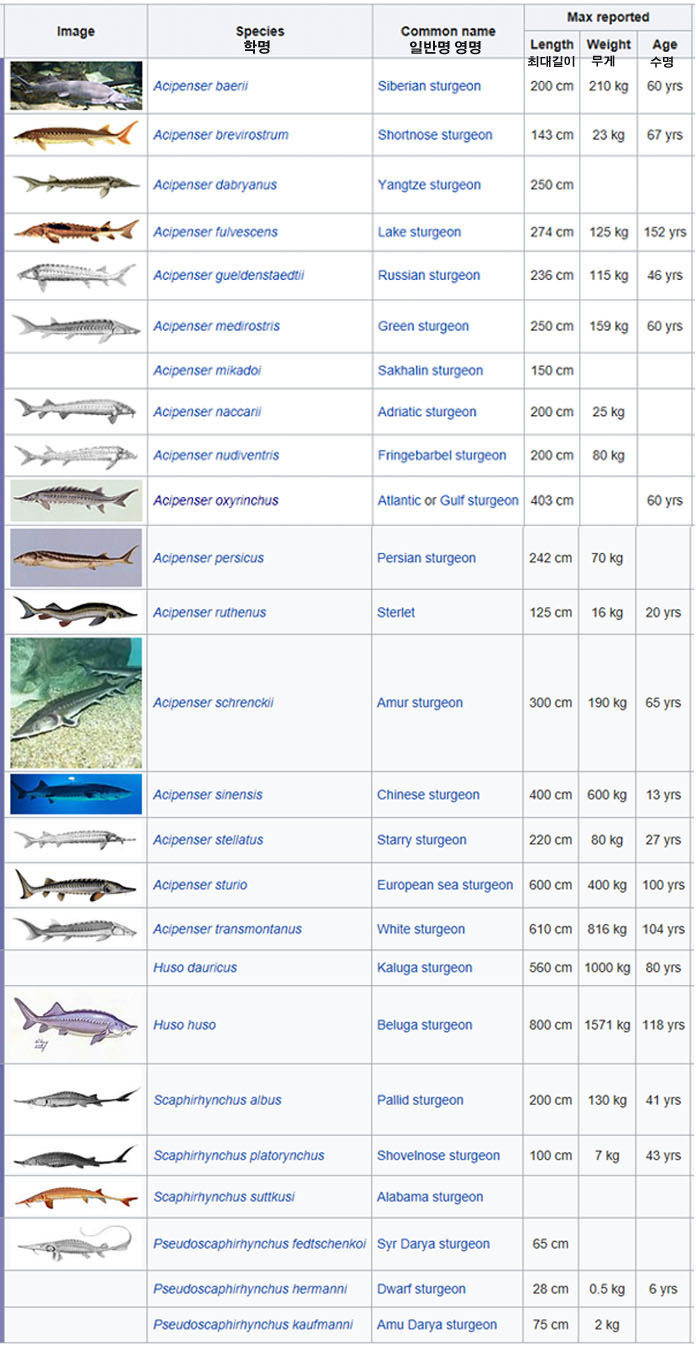 출처(source/wikipedia (last edited on 23 March 2018, at 12:27)
