
사이트 로그인
사이트 로그인
분류계통/경골상강→조기강→두꺼비고기목→두꺼비고기과 두꺼비고기과 Family Batrachoididae(Toadfishes) 두꺼비고기과는 3개 아과로 구성되어 있다; Batrachoidinae(18속, 47종), Porichthyinae(2속, 15종), and Thalassophryninae(2속, 11종). 두꺼비고기류는 연안의 얕은 수심에서부터 깊은 수심까지 바닥에서 생활하는 물고기들이며 몇 종은 강으로 들어간다. 일부는 얕은 수심과 깊은 수심 사이를 주기적으로 이동한다. 두꺼비고기류는 사냥감 동물이 알아차리기 어려운 위장 색을 가지고 있다. 바위틈, 해초 숲에 숨어있거나, 또는 흙은 파고 들어가 숨어있다가 먹이감을 기습공격 한다. 두꺼비고기들은 물 밖에서 24시간 살 수 있으며 간조 시에 노출된 펄 바닥을 지느러미를 사용하여 기어갈 수 있다. 물속의 이동 속도 굼뜨고 느리다. 무척추동물과 물고기를 잡아먹는다. 손으로 잡으면 입에 물릴 수 있다. 두꺼비고기는 대부분 비늘을 가지고 있지 않다. 머리는 크고 눈은 머리의 위쪽에 있다. 입이 크고 전상악골과 상악골이 있으며 수염과 피편으로 장식된 모양일 때가 자주 있다. 색상은 대개 칙칙하며 몸에 검은 점이나 안장무늬를 가졌다. 그러나 산호초에 사는 종은 밝은 색상을 가진다. 예를 들면 코랄 토드피시(Coral toadfish/Sanopus splendidus)가 있다. 크기는 7.5 cm인 것(Big-eyed toadfish/Thalassophryne megalops)에서부터 57cm로 큰 것(Pacuma toadfish/Batrachoides surinamensis))까지 있다. 아가미 구멍은 작으며 위치가 배쪽이 아닌 위쪽 몸 측면(가슴지느러미 기부 앞)에 제한되어 있다. 배지느러미는 가슴지느러미 앞쪽으로 멀게 목 부근에 위치에 있다. 배지느러미는 극조 1개 연조 2~3개로 구성되어 있다. 등지느러미는 2개이며 서로 분리되어 있다. 제1등지느러미는 작으며 극조로만 이루어져 있다. 제2등지느러미는 연조 15~25개로 구성되어 있다. 척추골 수는 25개에서 47개 사이이다. 측선은 머리와 몸에 1개에서부터 4개까지 가지고 있다. 두꺼비고기들 중에서 포리크디스 속(genus Porichthys/midshipman fishes;장교후보생)의 종들은 머리와 몸의 측선과 병행하여 발광기관들이 열 지어 있으며 측선은 4개를 가지고 있다. 모든 두꺼비고기들은 제1등지느러미와 아가미뚜껑에 날카로운 가시를 가지고 있는데 탈라스소프리니니 아과(subfamily Thalassophryninae)에 드는 속들은 가시의 속이 비어 있는 동시에 독샘과 연결되어 있어서 자신을 공격하는 자에게 심한 통증과 상처를 가할 수 있다. 탈라스소프리니니 아과에는 2속에 11종이 있다(Genus Daector 과 Genus Thalassophryne). 특징 있는 번식 방법; 수컷은 둥지를 만들어 놓고 “노래”를 부르며 암컷을 유인한다. 부레에 있는 근육을 수축하는 방법으로 공기를 내뿜어 소리를 낸다. 이 소리는 두꺼비고기의 웅웅소리(hum) 또는 휘파람소리(whistle)라고 일컬어지는데 수면에서도 분명하게 들린다. 알의 한쪽 면에는 점착성이 있으며 암컷은 알을 둥지의 측면에 붙인다. 수컷은 여러 암컷을 유인하며 따라서 한 둥지에 붙은 알들은 여러 마리의 어미를 가진 알 들이 된다. 그 다음 단계로 수컷은 포식자들로부터 알을 보호한다. 이 기간에는 잠시도 둥지를 떠날 수 없기 때문에 수컷은 거의 굶어야 한다. 알은 빠른 시일 내에 배아로 변한다. 그러나 부화되어도 3주, 4주일 간 둥지에 계속 붙어 있는다. 그 다음에는 스스로 독립할 수 있을 때까지 수컷의 몸 뒤에 모여 보호를 받는다. 이 생태는 물고기 세계에서 매우 강도가 높은 부성애에 들어간다. 두꺼비고기류의 어획량 통계는 나와 있지 않으나 크기가 큰 종들은 분포 지방의 생선 시장에서 흔히 볼 수 있으며 일부 종은 베네수엘라와 프렌치 기아나 지방에서 비싼 가격에 거래된다. 아마존 두꺼비고기(Amazon Toadfish/Thalassophryne amazonica)를 비롯해 일부 담수에 사는 작은 종들은 담수 수족관 관상용으로 거래되고 있다. 오이스터 토드피시 (Oyster toadfish/Opsanus tau)라고 알려진 종은 연구용으로 널리 이용된다. |
 울음두꺼비고기. 담수어. 수족관 사진. Freshwater toadfish. Grunting toadfish(Allenbatrachus grunniens). in aquarium. Max length/30.0 cm TL. Distribution/Ganges River delta in India and Bangladesh around the coastlines of Myanmar, Thailand, Malaysia, Cambodia, Vietnam, and the Philippines. Author/5snake5 |

| 두꺼비고기과 어류의 기본 체형도. Typical body form of Batrachoididae. Author/Kim in young(fishillust.com) |
Family Batrachoididae(Toadfishes) Toadfishes are bottom-dwellers ranging from shallow inshore areas to deep waters. Several species enter rivers, and some migrate regularly between shallow and deep waters. They often hide in rock crevices, among the bottom vegetation, or even dig dens in the bottom sediments, from which they ambush their prey. Toadfish can survive out of water for as long as 24 hours, and some can move across exposed mudflats at low tide using their fins. Toadfishes are ambush predators that favor sandy or muddy substrates where their cryptic coloration helps them avoid detection by their prey. They are rather sluggish in their movements. Feed on invertebrates and fishes. They may bite when handled. Toadfish are usually scaleless, with eyes set high on large heads. Their mouths are also large, with both a maxilla and premaxilla, and often decorated with barbels and skin flaps. They range in size from 7.5 cm length in Thlassophryne megalops, to 57 cm in the Pacuma toadfish. Gill openings restricted to sides, just in front of pectoral fin base. Pelvic fins jugular, inserted well in advance of pectoral fins, with 1 spine and 2 or 3 soft rays. For the two separate dorsal fins, the first is smaller with 2 or 3 strong, sharp spines, while the second has from 15 to 25 soft rays. The number of vertebrae range from 25 to 47. One to several lateral lines on head and body. Mostly drab brown with spots or saddles of black, although at least one coral reef species, Coral toadfish(Sanopus splendidus), is brightly coloured. Toadfishes of the genus Porichthys, the midshipman fishes, have rows of photophores along lateral lines on head and body. and four lateral lines. All toadfishes possess sharp spines on the first dorsal fin and on the opercle(gill cover). In fish of the subfamily Thalassophryninae, these are hollow and connect to venom glands capable of delivering a painful wound to predators. Subfamily Thalassophryninae includes 2genera with 11species(Genus Daector and Genus Thalassophryne). Reproduction; Males make nests, and then attract females by "singing", that is, by releasing air by contracting muscles on their swim bladders. The sound has been called a 'hum' or 'whistle', and can be loud enough to be clearly audible from the surface. The eggs are sticky on one side, so the female can attach them to the side of the nest. Each male attracts numerous females to his nest, so the eggs within have multiple mothers. The male then guards the nest against predators. During this period, the male must survive on a limited supply of food, as he is not able to leave the immediate vicinity to hunt. The eggs rapidly develop into embryos, but these remain attached to the side of the nest until the age of about three to four weeks. After this time, they continue to cluster around and hide behind the male, until they are large enough to fend for themselves. This degree of parental care is very unusual among fishes. Although no catch statistics are reported, larger species of toadfishes are commonly found in local markets. Some species are eaten and may fetch fairly high prices in Venezuela and French Guiana. A few smaller toadfishes from fresh water habitats, most notably Thalassophryne amazonica, are occasionally kept as aquarium fish. The western Atlantic species Opsanus tau, known as the oyster toadfish, is quite widely used as a research animal. |
 털북숭이 두꺼비고기 묘사도. illustrated Hairy toadfish(Batrachoides liberiensis). Max length.46.0 cm TL. Distribution/Senegal to Mangue Grande, Angola. Author/FAO. |
 Left/털북숭이 두꺼비고기의 등면 묘사도. Illustration of dorsal side of Hairy toadfish(Batrachoides liberiensis). Date/1867. Author/Steindachner. Right/물 담은 작은 용기 안에서 헤엄치는 두꺼비고기류의 아주 어린 새끼들. 묘사도 임. Illustration of free-swimming young toadfishes in a small container of water. Date/1910. Author/Eugene Willis Gudger(1866–1956) |
 보콘 두꺼비고기. 기본 체형도. Illustration of body shape. Bocon toadfish(Amphichthys cryptocentrus). Distribution/Western Atlantic: Panama to Brazil. Max length/40.0 cm TL. Author/FAO |
 보콘 두꺼비고기. 몸은 모래 속에 감추고 있다. Bocon toadfish(Amphichthys cryptocentrus). Body part hidden in the sand. Author/Wilfredor |
 이스턴 개구리고기. 묘사도. Illustrated Eastern frogfish(Batrachomoeus dubius). Distribution/Endemic to Australia. Max length/35.0 cm TL. Author/FAO |
 이스턴 개구리고기의 머리 윗면 묘사도. Illustratration of dorsal head view. Eastern frogfish(Batrachomoeus dubius). Distribution/Endemic to Australia. Date/between 1844 and 1875. The zoology of the voyage of the H.M.S. Erebus & Terror. Max length/35.0cm TL. Author/Gray, John Edward |
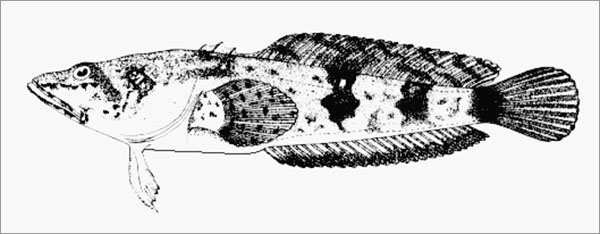 파쿠마 두꺼비고기 체형 묘사도. Body shape illustration. Pacuma toadfish(Batrachoides surinamensis). Max length/57.0cm TL. Distribution/Western Central Atlantic: Honduras to Salvador (Bahia) in Brazil. Author/FAO |
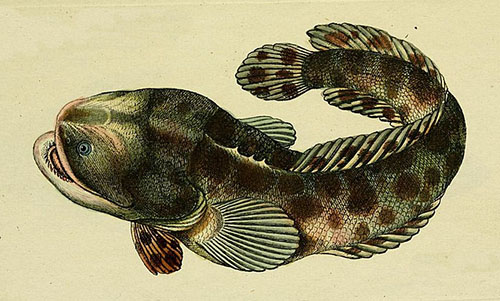 파쿠마 두꺼비고기 묘사도. Illustration of Pacuma toadfish(Batrachoides surinamensis). Author/Bloch, Marcus Elieser(1723-1799). |
 오이스터 두꺼비고기 묘사도. Oyster toadfish(Opsanus tau). Max length/43.2cm TL. Distribution/Western Atlantic: Cape Cod, Massachusetts to Florida in USA. Date/between 1795~1797 Author/Krüger |
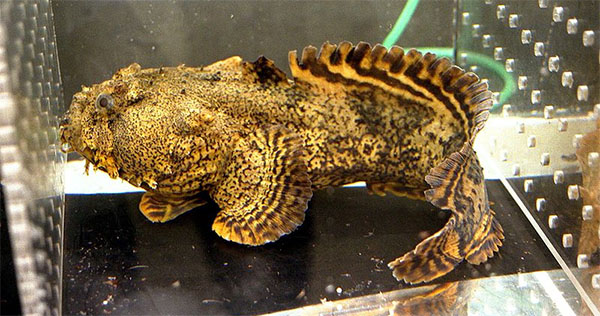
| 오이스터 두꺼비고기(Oyster toadfish/Opsanus tau)가 우주 왕복선(미션 STS-90)에 실려 행동분석시스템(Neurolab)에 들어가 있다. 실험의 목적은 미세한 중력의 변화가 신경계에 미치는 영향을 알아보는 것이다. 이 물고기는 내이와 중이의 구조가 포유동물과 매우 유사하여 전정(前庭) 신경(평형감을 뇌에 전달하는 청신경의 일부)의 기능을 관찰하는데 탁월한 모델이다. Oyster Toadfish(Opsanus tau) is loaded into the Space Shuttle(Mission STS-90) behavioral analysis system (Neurolab). The purpose of the experiment is to investigate the effect of minute changes in gravity on the nervous system. The structure of the inner and middle ears of this fish is very similar to that of mammals, making it an excellent model for observing the function of the vestibular nerve (the part of the auditory nerve that transmits a sense of balance to the brain). Author/NASA |
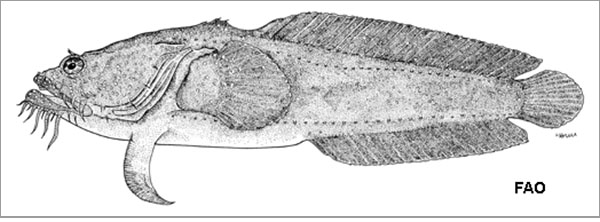 흰점무늬 두꺼비고기 묘사도. illustrated Whitespotted Toadfish(Sanopus astrifer). Distribution/Western Central Atlantic: Belize and Honduras. Author/FAO |
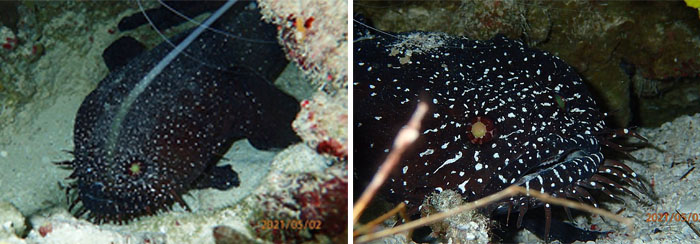 암초의 굴이나 틈 속에 사는 흰점무늬 두꺼비고기. Whitespotted Toadfish(Sanopus astrifer). Often found in burrows or crevices of reefs. Author/left and right; Kathleen Dobson. |
 산호두꺼비고기. Coral toadfish(Sanopus splendidus). Max length/29.0cm TL. Western Atlantic: known only from Cozumel Island in Mexico. Lives in caves under corals. Author/FAO |
 산호두꺼비고기. Coral toadfish(Sanopus splendidus). Lives in caves under corals. Author/Smithsonian Tropical Research Intitute. |
 산호두꺼비고기. Coral toadfish(Sanopus splendidus). Lives in caves under corals. Shot at Paradise Reef, Cozumel. Author/Laban712 at English Wikipedia |
|
 카노 두꺼비고기 묘사도. Illustrated Cano toadfish(Thalassophryne maculosa). Max length/20.0cm TL. Distribution/Western Central Atlantic: northern coast of South America. Author/FAO |
 카노 두꺼비고기의 등면 묘사도. Illustration of dorsal view. Cano toadfish(Thalassophryne maculosa). Date/1869. Author/Zoological Society of London. |
 가마우지의 두꺼비고기 사냥 장면. 촬영자의 설명/내가 강에 도착한 때는 이 가마우지가 오이스터 두꺼비고기(Oyster_toadfish/Opsanus tau)를 물고 수면으로 떠오르는 순간이었다. 가마우지는 한동안 물고기를 가지고 놀더니 물고기의 머리부터 삼켜버리고는 어디론가 날아가 버렸다. I got to the river just as this Cormorant surfaces with an oyster toadfish(Opsanus tau). It played it a while and swallowed it head fist and then flew away. Author/Tony Alter from Newport News, USA |
| text on preparation |


|
| Copyright ⓒ FISHILLUST.COM All rights reserved. All contents can not be used without permission of the copyright holder. |


 검색
 아마존두꺼비고기. 담수어. 수족관 사진. Aquarium pictures. Amazon toadfish(Thalassophryne amazonica). Max length/9.3cm SL. Distribution/South America: confined to the Amazon River and its tributaries. Author/left; 5snake5. Right; Gregoire Germeau.
