
사이트 로그인
사이트 로그인
분류계보/경골상강/Superclass Osteichthyes(bony fishes)→조기강/Class Actinopterygii(ray-finned fishes)→동갈치목 Order Beloniformes(needle fishes)→동갈치과 Family Belonidae(Needlefishes) 동갈치과 Family Belonidae(Needlefishes) 한국에 3속 4종, 세계에 10속 47종이 알려져 있고 그 중 약 3분의 1 이상이 담수어이다. 한국 분포종 명단 동갈치과 어류는 영명으로 바늘고기(Needlefishes)라고 한다. 아주 얕은 수심이나 먼 바다에서는 수면 층에 살면서 주로 물고기를 잡아먹고 산다. 어떤 속은 같은 속 안에 해수 종, 기수 종, 담수종이 혼재되어있다(예; genus Strongylura). 전체 10개 속 중 3속(Belonion, Potamorrhaphis, Xenentodon)은 모두 담수어로 구성되어 있다. 동갈치류를 영명으로 가르피시(gars, 또는 garfish)라고 부르는 일이 있는데 종류가 전혀 다른 북미의 담수어 중에 “gars” 또는 “garfish”라고 부르는 물고기가 있어 혼동이 일어난다. 이 물고기는 외관도 동갈치류와 비슷하지만 레피소스테우스목(Lepisosteiformes), 인골과(Lepisosteidae)의 물고 기이다. 유럽인들이 동갈치류를 “가르”라고 불렀는데 18세기에 미국에 이주한 유럽인들에 의해 두 종이 헷갈리는 이름이 되었다. 동갈치과 어류는 몸이 가는 물고기이며 3cm 길이에서부터 95cm 길이까지 있다. 등지느러미는 1개이며 등의 후방 쪽으로 멀리 위치하며 뒷지느러미와 거의 마주보고 있다. 이들의 대표적인 특징은 예리한 이빨이 여러 개 있는 길고 가는 부리이다. 대부분 종들은 성어가 되어야 위 턱이 길게 끝까지 자라며 어린 개체들은 위 부리가 다 자라지 않아서 하프비크(half-beak/반쪽부리고기)처럼 보인다. 하프비크는 학공치과(Hemiramphidae; halfbeaks)의 영명이다. 하프비크는 성어가 되어도 위턱이 아주 짧고 아래 턱이 긴 모양을 가지고 있다. 동갈치과 어류는 부리가 덜 자란 어린 시기에는 플랑크톤을 먹으며 다 자라면 물고기를 사냥한다. 번식은 짝짓기와 산란을 통해서 이루어진다. 짝짓기 때는 수컷이 암컷을 수면 위 파도 위로 몬다. 지느러미에는 극조가 없다. 가슴지느러미가 짧다. 등지느러미는 11-43 연조, 뒷지느러미는 12-39 연조, 가슴지느러미는 5-15 연조, 배지느러미는 복강 아래에 있고 6 연조로 이루어져있다. 측선은 복부 가장자리에 가깝게 직선으로 몸 전체에 그어져있으며 몸의 앞쪽 시작점에서는 가슴지느러미 기부까지 분기되어 있다. 그러나 예외적으로 물동갈치(Flat needlefish; Ablennes hians)는 측선이 분기되지 않았다. 비늘은 작고 둥근비늘이며 잘 떨어지는 성질이다. 척추골 수는 52-97 개이다. 수면에 살기 때문에 이 환경에서 은폐가 잘 되는 색상을 갖고 있다. 등은 녹색이거나 청색이며 측면과 배는 은백색이다. 측면에 검푸른 횡선 줄무늬가 있는 것들이 많다. 아래턱에 끝의 살점은 적색이거나 오렌지색이다. 담수어들 중 작은 것은 6~7 cm 밖에 안되며 해수 종은 최대 2m에 이르는 것도 있을 수 있다. 동갈치류는 작은 물고기를 주식하는데 머리를 위로 들어올리는 동작으로 물고기를 잡는다. 어떤 종은 새우와 유영하는 갑각류, 두족류를 잡아먹는다. 인도양에 사는 어떤 종은 전적으로 큰 갑각류만 먹는다. 동갈치류는 아열대 해역에 가장 흔하게 살고 있으나 어떤 종은 추운 겨울에 온대해역에서 발견된다. 북대서양에 흔히 있는 동갈치류는 다랑어 떼 옆에서 무리 지어 헤엄치는 것이 자주 발견된다. 동갈치과 물고기는 동갈치목의 다른 물고기들과 마찬가지로 60 km/h 속도로 수면 위로 점프할 수 있다. 이 물고기들은 수면에 살기 때문에 턱이 낮은 작은 보트 위로 점프하는 일이 많다. 이 점프는 야간에 인공적인 불빛이 있으면 광폭하게 일어난다. 야간에 불을 켜고 낚시질을 하거나 다이빙을 하면 불빛을 향해 점프하는 동갈치들이 사람을 찔러 중상을 입히거나 사망시킬 수 있으며 실제로 사고가 자주 일어 난다. 암초에서 작은 보트로 물고기를 잡는 태평양 일부 섬 사람들은 상어의 위험보다 동갈치류의 위험이 더 큰 것으로 인식하고 있다. 역사적으로 유명한 동갈치 사고가 2건 알려져 있다. 1977년 하와이에서 아버지와 야간 낚시를 하던 10세 소년이 1미터가 넘는 동갈치의 공격을 받고 사망했는데 점프한 동갈치의 부리가 아이의 눈을 찌르고 두뇌까지 박혀 들어갔다. 2007년 사건은 베트남에서 일어났는데 야간에 자맥질로 해삼을 잡던 16세 소년이 15cm 길이의 동갈치 부리가 심장을 찔러 사망하였다. 이 기록 이후에도 동갈치 상해나 사망 사건은 몇 건이 더 리포트되어 있다. |
 동갈치류는 수면에 아주 가깝게 붙어서 산다. 수중 촬영자의 머리가 수면에 거의 닿을 정도의 깊이에서 카메라를 수평 방향으로 향해 촬영한 사진이다. Needle fishes just below the surface level, Author/Paul Brown(U.S. National Park Service) |
 대서양 동갈차(Atlantic needlefish; Strongylura marina). Author/Kobac(NOAA) |
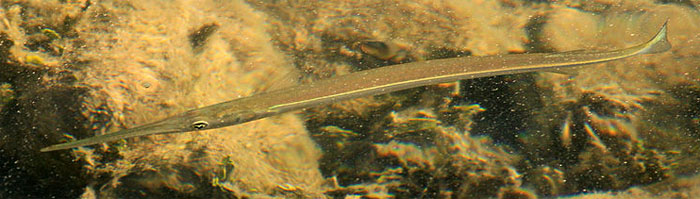 얕은 수심에서 헤엄쳐가는 동갈치(학명 미상). Needlefish swimming on the shallows. Author/Yinan Chen |
Family Belonidae(Needlefishes) Needlefish closely resemble North American freshwater gars(family Lepisosteidae) in being elongated and having long, narrow jaws filled with sharp teeth, and some species of needlefishes are referred to as gars or garfish despite being only distantly related to the true gars. In fact, the name "garfish" was originally used for the needlefish Belone belone in Europe and only later applied to the North American fishes by European settlers during the 18th century. Needlefish are slender fish, ranging from 3 to 95cm in length. They have a single dorsal fin, placed far back on the body, almost opposite to the anal fin. Their most distinctive feature is their long, narrow beak, which bears multiple sharp teeth. In most species, the upper jaw only reaches its full length in adulthood, so the juveniles have a half-beak appearance, with an elongated lower jaw, but a much smaller upper one. During this stage of their lifecycle, they eat plankton, switching to fish once the beak fully develops. Needlefish reproduce through mating and lay eggs. The male usually rides the female on the waves as they mate. No spines in fins; pectoral fins short. Dorsal fin with 11-43 rays; anal fin with 12-39 rays, pelvic fins, with 6 soft rays, are located in an abdominal position; and pectoral fins with 5-15 rays. The lateral line runs straight across the body laterally, close to the edge of the abdomen, and diverged at the anterior start point to the base of the pectoral fin. The exception is the flat needlefish(Ablennes hians), which does not have bifurcated lateral line. Scales small, cycloid, easily detached. Precaudal vertebrae 33-65, caudal vertebrae 19-41 and total vertebrae 52-97. Colour: These fishes live at the surface and are protectively colored for this mode of life by being green or blue on the back and silvery white on the lower sides and belly. Usually, a dusky or dark blue stripe along sides; fleshy tip of lower jaw frequently red or orange. Some fresh water needlefishes reach only 6 or 7 cm in total length while some marine species may attain 2 m. All needlefish feed primarily on smaller fishes, which they catch with an upward sweep of the head. In addition, some species also take krill, swimming crustaceans, and small cephalopods. Saltwater species are also predatory, with the Indian species at least feeding exclusively on large crustaceans. Needlefish, like all ray-finned beloniforms, are capable of making short jumps out of the water at up to 60 km/h. Since needlefish swim near the surface, they often leap over the decks of shallow boats rather than going around. This jumping activity is greatly excited by artificial light at night; night fisherman and divers in areas across the Pacific Ocean have been "attacked" by schools of suddenly excited needlefish diving across the water towards the light source at high speed. Their sharp beaks are capable of inflicting deep puncture wounds, often breaking off inside the victim in the process. For many traditional Pacific Islander communities, who primarily fish on reefs from low boats, needlefish represent an even greater risk of injury than sharks. Two historical deaths have been attributed to needlefish. The first was in 1977 when a 10-year-old Hawaiian boy, night fishing with his father at Hanamaulu Bay, Kaua'i, was killed when a 1.0-to-1.2-metre-long needlefish jumped from the water and pierced his eye and brain. The second was a 16-year-old Vietnamese boy, stabbed through the heart by the 15cm beak of a needlefish in 2007 while night diving for sea cucumbers near Halong Bay. Injury and/or death by needlefish have also been documented in more recent years. |
 Left/유럽 동갈치(Garfish;Belone belone). Author/Eskrol. Right/동갈치류의 엑스레이 사진. 분류학의 중요 기준인 척추골 수를 확인하기에 좋은 사진으로 보인다. xray fineart photography. Author/Dazeley |
 Left/낚시로 큼직한 동갈치(종명 미상)를 잡은 여인이 기뻐하고 있다. Author/Clinton & Charles Robertson. Right/한국명이 꽁치아재비인 동갈치과 물고기. 학명; Tylosurus crocodilus. 영명; Hound needlefish. Author/NOAA, Haplochromis |
 Left/터키 생선가게의 동갈치류. Belonidae fishes in fishmonger. Location/Samsun, Turkey. Author/Kurt Kulac. Right/그리스 생선가게의 유럽 동갈치. Belone belone for sale at fishmonger, Varkiza, Athens, Greece. Author/Vouliagmeni |


|
| Copyright ⓒ FISHILLUST.COM All rights reserved. All contents can not be used without permission of the copyright holder. |


 검색
