
사이트 로그인
사이트 로그인
|
read more link---
|
| 잉어과 Family Cyprinidae(Minnows or carps). |
“잉어”는 순 우리말인가 한자 말인가? -현상어도보를 찾아서(이태원 지음) 제1권 118쪽에서 인용- |
|
잉어과(Family Cyprinidae)의 아과(亞科; subfamily) 명단 잉어과 종은 너무 많아서 종들을 아과별 족보로 분류(계통발생 분류)하기가 매우 어려우며 족보 분류는 항상 지금까지도 임시적이고 불안정적이다. The massive diversity of cyprinids has so far made it difficult to resolve their phylogeny in sufficient detail to make assignment to subfamilies more than tentative in many cases. (A) J.S 넬슨의 분류 (B)에시마이어의 분류 |
잉어과 어류는 북아메리카(캐나다에서 멕시코 까지), 아프리카, 유럽, 아시아의 담수에 살며 대황어(Tribolodon brandtii)와 사할린 황어(Tribolodon sachalinensis) 2종은 해수어이다. 잉어과(Cyprinidae)는 일반적으로 알려진 잉어류(잉어아과)외에 납자루아과. 강준치아과. 모래무지아과. 피라미아과 등 10여 개의 아과(subfamily)들을 포함한 분류 그룹이다. 국제적으로는 잉어과 전체를 “잉어류/carp family”라 부르기도 하고 “민노우 류(minnow family)”라고도 부르는데 “민노우 minnow”는 사전적으로는 “피라미”로 번역되는 단어이다. 이 정의에 따르면 민노우는 피라미라는 특정된 일부 종을 의미하지 않는 것이 된다. 결국 민노우는 잉어과 어류 전체의 통칭이기도 하고 좁게는 피라미류(피라미 아과)에 제한적으로 적용되는 이름이다. 또한 잉어아과에는 보통 잉어라고 생각되지 않는 붕어(Genus Carassius)도 포함되어 있어서 혼란스럽다. 잉어과는 약 370속에 3,000종 이상을 포함하고 있는 어류 중에서뿐만 아니라 척추동물 중에서 가장 규모가 큰 분류 군이다. 종 수가 너무 많아서 족보(계통발생 phylogeny)를 정리하기가 매우 어려워 아과 분류가 항상 임시적이고 유동적이며 불안정적이었다. 현재도 그렇다. 한국에는 6아과 36속 66종이 알려져 있다. 형태와 생태. 크기가 7.9mm로 아주 작은 것(파에도키프리스 프로게네티카; 학명/Paedocypris progenetica)에서부터 2.5m를 초과하는 크기(시아미스 자이언트 잉어/Siamese giant carp/Catlocarpio siamensis)까지 다양하다. 어미가 알이나 새끼를 보호하지 않는 것이 원칙이며 일부 종의 수컷은 둥지를 만들고 알을 보호하기도 한다. 잉어류는 위장이 없고 턱에 이빨도 없다. 인두에 1-3개의 치열이 있고 각 열에는 최대 8개의 인두치가 있다. 이 인두치를 두개골 벽에 난 돌출 뼈판에 대고 음식을 씹는다. 인두치는 종 마다 달라서 종을 구별하는 기준의 하나로 이용된다. 잉어(표준 잉어)는 강한 인두치로 단단한 달팽이와 조개류를 으깨 먹을 수 있다. 잉어류는 베버기관(Weberian apparatus)이라는 특수한 기관이 있어 청각이 발달되어있다. 베버기관은 부레와 청각 시스템(내이)을 연결하고 있는 뼈의 구조를 말한다. 맨 앞쪽에 있는 4 개의 척추골로부터 발달해 나온 작은 뼈들로 이루어져 있다. 내이로 직접 전해지는 음파는 작게 감지되지만 부레가 음파 공명을 일으켜 더 큰 소리로 내이에 전달되게 한다. 또한 이 기관을 통해 부레에 들어있는 기체의 움직임이나 수심의 변화를 감지할 수 있다. 물고기가 성어로 성장했을 때 나타나는 기관이다. 잉어류는 부레와 장관(腸管)이 연결되어 있어서 입으로 공기를 마셔 부레에 보낼 수 있고 부레에 기체량이 많으면 장관을 통해 배출시킬 수 있다. 잉어류는 대부분 무척추동물과 식물을 먹는다. 이빨과 위장이 없기 때문일 것이다. 그러나 황어아과의 아스프(asp; 학명/Leuciscus aspius) 같은 종은 전적으로 물고기를 잡아먹는 포식자이며 황어아과의 아이드(Ide; 학명/Leuciscus idus)와 러드(Rudd; 학명/Scardinius erythrophthalmus)는 크게 자란 후에는 작은 물고기를 포식한다. 역시 황어아과인 벨리카(Belica=moderlieschen; 학명/ Leucaspius delineates)는 작은 종이지만 수족관 환경에서 기회가 주어지면 개구리 애벌레도 먹는다. 잉어류의 하나인 초어(grass carp)는 전적으로 초식성이다. 황어 아과의 커먼 내이즈(Common nase; 학명/Chondrostoma nasus)는 해조류와 생물막(biofilms )을 긁어먹는다. 검은잉어(black carp; 학명/Mylopharyngodon piceus)는 주로 달팽이를 먹으며 백련어(silver carp; 학명/Hypophthalmichthys molitrix)는 부유먹이를 여과섭식을 한다. 이러한 잉어류의 특징적인 섭식 습관은 수계 환경의 여러 가지 결점을 치유하는 목적으로 이용된다. 예를 들면 수초 과잉 번식을 억제시킨다든가 달팽이에 의한 전염병을 예방한다든가 하는 것들이다. 일반적인 물고기들과 달리 잉어류는 부영양상태(富營養狀態)인 저수지에서 잘 번성한다. 부영양상태에서는 해조류를 먹는 동물플랑크톤이 과다해 지는데 잉어류가 동물플랑크톤을 먹어 줌으로서 해조류의 쇠퇴를 예방해 준다. 그러나 아시아에서 미국 미시시피강 수계에 도입된 전형적인 잉어는 토종 물고기들과 먹이 경쟁을 하거나 환경을 파괴시켜 심각한 침입 종이 되었다. 잉어는 바닥의 개펄을 후벼 파서 먼지를 일으켜 식물 위에 덮이게 함으로 식물의 성장을 방해하고 있다. 잉어류와 인간의 관계 잉어과 어류들 중 여러 종이 수조 관상어와 연못의 애완 물고기로 사랑을 받아왔다. 가장 유명한 것이 금붕어이다. 금붕어는 프러시안 잉어(=프로이센 잉어/Prussian carp)의 변형 종이며 학명은 두 가지가 혼동을 일으킨다(Carassius auratus와 Carassius gibelio). 처음에 중국인들이 프러시안 잉어를 금붕어로 개조시키기 시작했으며 1150년경에 중국의 귀족들이 즐겼고 1728년에 유럽으로 수입되었다. 1502년에는 일본에 전파되었다. 일본에서는 18세기에 일반 잉어를 비단잉어로 개조시켰다. 일본의 비단잉어는 세계적으로 유명하며 일본 말로 코이(koi)라고 부른다. 그러나 정확히는 니쉬키고이(nishikigoi/錦鯉)이며 코이는 일반 잉어(鯉/잉어 리)를 뜻한다 |
|
Cladogram=Superclass Osteichthyes→Class Actinopterygii→Subclass Neopterygii→Division Teleostei→Subdivision Ostarioclupeomorpha→Superorder Ostariophysi→Order Cypriniformes→Family Cyprinidae(Minnows or carps). Family Cyprinidae(Minnows or carps). Distribution: Freshwaters of North America(northern Canada to southern Mexico), Africa, and Eurasia. Only two species occur in true marine waters(Tribolodon brandtii(Dybowski, 1872), Tribolodon sachalinensis(Nikolskii, 1889)). The Cyprinidae are the family of freshwater fishes, collectively called cyprinids, that includes the carps, the true minnows, and their relatives(for example, the barbs and barbels). Also commonly called the "carp family", or "minnow family", Cyprinidae is the largest and most diverse known fish family and the largest vertebrate animal family in general, with about 3,000 living species In about 370 genera. 6 subfamilies, 36 genera, and 66 species distribute in Korea. The massive diversity of cyprinids has so far made it difficult to resolve their phylogeny in sufficient detail to make assignment to subfamilies more than tentative in many cases. Usually thin lips, plicae or papillae absent; mouth sometimes suckerlike(Garra and Labeo). With or without barbels. Premaxilla usually borders the upper jaw making the maxilla entirely or almost entirely excluded from the gape. Usually protrusible upper jaw. Dorsal fin with spinelike rays in some. They range from about 7.9mm(Paedocypris progenetica) to 2.5 meters(Catlocarpio siamensis). Mainly non-guarders, but in some species males build nests and/or protect the eggs. Biology and ecology Hearing is a well-developed sense in the cyprinids since they have the Weberian organ, three specialized vertebral processes that transfer motion of the gas bladder to the inner ear. The vertebral processes of the Weberian organ also permit a cyprinid to detect changes in motion of the gas bladder due to atmospheric conditions or depth changes. The cyprinids are considered physostomes because the pneumatic duct is retained in adult stages and the fish are able to gulp air to fill the gas bladder, or they can dispose excess gas to the gut. Most cyprinids feed mainly on invertebrates and vegetation, probably due to the lack of teeth and stomach; however, some species, like the asp(Leuciscus aspius), are predators that specialize in fish. Many species, such as the ide and the common rudd, prey on small fish when individuals become large enough. Even small species, such as the moderlieschen, are opportunistic predators that will eat larvae of the common frog in artificial circumstances. Some cyprinids, such as the grass carp, are specialized herbivores; others, such as the common nase, eat algae and biofilms, while others, such as the black carp, specialize in snails, and some, such as the silver carp, are specialized filter feeders. For this reason, cyprinids are often introduced as a management tool to control various factors in the aquatic environment, such as aquatic vegetation and diseases transmitted by snails. Unlike most fish species, cyprinids generally increase in abundance in eutrophic lakes. Here, they contribute towards positive feedback as they are efficient at eating the zooplankton that would otherwise graze on the algae, reducing its abundance. In some cases, such as the Asian carp in the Mississippi Basin, they have become invasive species that compete with native fishes or disrupt the environment. Carp in particular can stir up sediment, reducing the clarity of the water and making it difficult for plants to grow. Relationship with humans Numerous cyprinids have become important in the aquarium and fishpond hobbies, most famously the goldfish, which was bred in China from the Prussian carp(Carassius (auratus) gibelio). First imported into Europe around 1728, it was much fancied by Chinese nobility as early as 1150 AD and after it arrived there in 1502, also in Japan. In the latter country, from the 18th century onwards, the common carp was bred into the ornamental variety known as koi – or more accurately nishikigoi (錦鯉), as koi (鯉) simply means "common carp" in Japanese. |
 Left/메콩강에 사는 세계에서 가장 큰 잉어. 사이어미즈 자이언트 카프(Siamese giant carp). 3m까지 자란다. The largest carp; Siamese giant carp(or giant barb). 학명/Catlocarpio siamensis. Author/Lerdsuwa Right/사람의 손톱과 비교시킨 가장 작은 잉어과 물고기 파에도키프리스 프로게네티카(학명/Paedocypris progenetica). 잉어류 중에서만이 아니라 전 세계 물고기 중에서 가장 작다. 손톱 위의 물고기는 그림이다. 7.9mm 크기이며 인도네시아 담수에 산다. 이 물고기 이전에는 8mm짜리 필리핀 망둑어가 가장 작은 물고기로 기록되어 있었다. 그림/김인영. The smallest carp Paedocypris progenetica, compared to nail size, this fish also the smllest fish of the world. Distrtbute in Indonesia. The fish on the nail is illustrated by Kim In Young. |
|
잉어과의 아과별 물고기 이미지 앨범 |
| 1. Subfamily Acheilognathinae 납자루아과 |
 납자루아과/흰줄납줄개(Rhodeus ocellatus). 5.8 cm. Author/Seotaro |
 납자루아과/납자루(Tanakia lanceolata). 9.0 cm. Author/OpenCage |
 납자루아과/Oily bitterling(Tanakia limbata). 6.0 cm. Author/OpenCage |
| 2. Subfamily Cultrinae 강준치아과 |
 강준치아과/백조어(Hemiculter leucisculus). 23.0cm. Author/A. C. Tatarinov |
 강준치아과/Mongolian redfin(Chanodichthys mongolicus). 100cm. Author/A. C. Tatarinov |
 강준치아과/Predatory carp(Chanodichthys erythropterus). 102cm. Author/Unknown |
| 3. Subfamily Cyprinae 잉어아과 |
 학명/Cyprinus carpio. 체코 산. Author/Dezidor |

학명/Cyprinus carpio. 네덜란드 산. Author/Franky44 |
 학명/Cyprinus carpio. 오스트리아 산. Author/xxrevsxx |
| 4. Subfamily Gobioninae 모래무지아과 |
 모래무지아과/모래무지(Pseudogobio esocinus), 25cm. Author/Seotaro |
 모래무지아과/모샘치(Gobio gobio 또는 Gobio cynocephalus). 21.0cm. Author/Gilles San Martin |
 모래무지아과/버들매치(Abbottina rivularis). 18.9cm. Author/OpenCage |
| 5. Subfamily Rasborinae(=Danioninae) 피라미아과 |
 피라미아과/피라미(Zacco platypus). 15cm. author/opencage |
 피라미아과/끄리(Opsariichthys uncirostris). 40cm.
저자/Benel |
 피라미아과/Zebra danio(Danio rerio). 3.8 cm SL. Author/Azul |
| 6. Subfamily Leuciscinae 황어아과 |
 황어아과/황어(tribolodon hakonensis). 20 cm 저자/小宮山広明 |

황어아과/연준모치(Phoxinus phoxinus). 8 cm. Author/Adrien Pinot |
 황어아과/버들치(rhynchocypris oxycephalus). 10 cm TL. Author/KENPEI |
| 7. Subfamily Squaliobarbinae 눈불개아과 |
| ■눈불개아과는 넬슨 2006년 분류에 있으며 에시마이어의 분류에는 없다 현재의 한국 분류에도 없다. 어떤 것이 맞느냐 틀리느냐의 문제라기 보다는 키프리니드 식구들이 너무 많아서 분류가 어렵고 불안정적이라고 생각해야 한다. |
 눈불개아과(현재 한국분류; 피라미아과)/눈불개(Squaliobarbus curriculus). 20∼30㎝. 출처/생물자원정보,한국과학기술정보연구원 |
 눈불개아과/검은잉어<>북한;강청어(Mylopharyngodon piceus). 180 cm. Author/ CAFS |
 눈불개아과(현재 한국분류; 잉어아과)/초어(Ctenopharyngodon idella). 150 cm. Author/Dezidor |
| 8. Subfamily Barbinae 바르비니아과 |
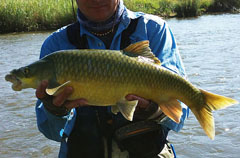 바르비니 아과/Smallmouth Yellowfish(Labeobarbus aeneus). 50.0 cm. Author/Toxicsox |
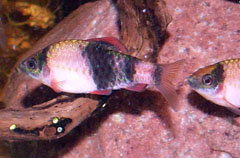 바르비니 아과/Melon barb(Haludaria fasciata ). ? cm. Author/Haplochromis |
 바르비니 아과/Tricolor sharkminnow(Balantiocheilos melanopterus). 35cm SL. Author/Lerdsuwa |
| 9. Subfamily Labeoninae 라베오니니 아과 |
 라베오니니 아과/Siamese flying fox(Crossocheilus oblongus). 16cm SL. 저자미상 |
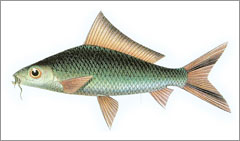 라베오니니 아과/Signal barb(Labiobarbus festivus). 24cm. Published by Zoologische Mededelingen, |
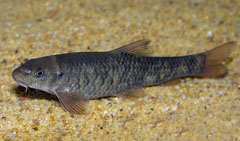 라베오니니 아과/Red garra(Garra rufa). 13.4 cm SL. Author/Dances. |
| 10. Subfamily Tincinae 틴키니 아과 |
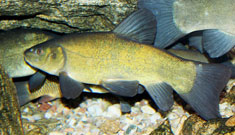
  틴키니 아과/위 3사진은 모두 틴키니 아과(Subfamily Tincinae)의 텐치(Tench)라는 물고기이다. 틴키니 아과에는 본종 1종만 있다. 학명/Tinca tinca. 황어아과(Leuciscinae)에 분류되기도 한다. 보통 20cm, 최대 70cm. 아일랜드를 제외한 유럽 전역과 예니세이 강(시베리아 중부에서 발원하여 북극해로 흘러든다)에 서식한다. 첫사진/Author; Karelj, 중간 사진/Author;Piet Spaans, 마지막 사진은 유럽에서 애용되고 있는 텐치 음식이다(Author/ Benreis). |
| 11. Subfamily Xenocyprinae 제노시프리니 아과 |
 제노시프리니 아과/백련어(Silver carp; Hypophthalmichthys molitrix. 105 cm. Author/Harka Akos. 2016년 현재 한국 분류는 황어아과. |
 제노시프리니 아과/영명 없음, Distoechodon tumirostris. 11cm. Picture by CAFS. 중국, 대만 분포. |
 제노시프리니 아과/영명 없음. Xenocypris davidi. 35.7cm SL. picture by CAFS. 중국에 분포. |
| 12. 무소속. 아과가 결정되지 않은 잉어과 물고기. Subfamily undesignated species. |
| ■잉어과에는 아과를 배정 받지 못한 무소속 아과 종들이 많다. 다음은 몇 예이다. |
 무소속 아과/giant barb or Siamese giant carp(Catlocarpio siamensis). 3m. 메콩강 수계에 서식. Dreamstime photo. |
 무소속 아과/Somalian cavefish(Phreatichthys andruzzii). 6.2cm. 장님고기임. 아프리카 소말리아에 서식. Author/Hectonichus |
 무소속 아과/소우브와 바브(Sawbwa barb; Sawbwa resplendens). 3.0cm. 미얀마 고유종. Author/The Man On The Street. |


|
| Copyright ⓒ FISHILLUST.COM All rights reserved. All contents can not be used without permission of the copyright holder. |


 검색
