
사이트 로그인
사이트 로그인
|
분류계보/경골상강/Superclass Osteichthyes(bony fishes)→조기강/Class Actinopterygii(ray-finned fishes)→청어목 Order Clupeiformes→멸치과(Family Engraulidae/Anchovies) 멸치과 Family Engraulidae(Anchovies) 전 세계 해양에 분산 분포하지만 온수 해역에 집중되어 있으며 더운 해역과 찬 해역에는 드물다. 수온과 염도 내성 폭이 큰 편이다. 얕은 수심과 바닥이 펄인 기수나 내만에서 대형 무리로 발견된다. 유럽 멸치류는 지중해에 많으며 특히 알보란 해(Alboran Sea), 에게 해, 흑해에 풍부하다. 대부분 동물플랑크톤을 먹으며 몇 종은 부화된 지 얼마 안 되는 작은 물고기 새끼를 잡아먹는다. 청어목의 다른 물고기들과 마찬가지로 입을 크게 벌리고 헤엄친다. 물이 아가미 밖으로 빠져나가면서 아가미 갈퀴에 걸린 플랑크톤은 식도로 이동되며 이를 삼킨다. 멸치류는 모든 포식 물고기들의 중요한 식량 자원이다. 인간 식용으로도 중요한 어족 자원이며 어분fish meal, 魚粉)과 미끼용으로도 사용된다. 멸치과에는 17속이 있다. 한국의 멸치과 5속 9종 명단
Colia mystus (Osbeck's grenadier anchovy/싱어/웅어속) |
 멸치(한국-일본-아시아 멸치). Japanese anchovy(Engraulis japonicus). Author/CAFS(Chinese Academy of Fishery Sciences). |
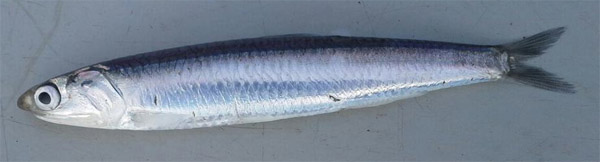 유럽 멸치. European anchovy(Engraulis encrasicolus). Location; Nederlands. Author/Jschop |
|
Anchovies(Family Engraulidae) Mouth inferior. Upper jaw produced. Jaw teeth well developed to absent. Gill rakers on lower limb o f first arch 10-50 or more. Branchiostegal rays 7-19. A silvery stripe down flanks. Body translucent. Abdominal scutes present in most Old World anchovies; absent in New World anchovies, except for one pelvic scute. Luminescent organs noted in one species. They range from 2 to 50 cm in adult length, most species below 15 cm, and their body shapes are variable with more slender fish in northern populations. Anchovies are found in scattered areas throughout the world's oceans, but are concentrated in temperate waters, and are rare or absent in very cold or very warm seas. They are generally very accepting of a wide range of temperatures and salinity. Large schools can be found in shallow, brackish areas with muddy bottoms, as in estuaries and bays. The European anchovy is abundant in the Mediterranean, particularly in the Alboran Sea, Aegean Sea and the Black Sea. Mostly filter feeding on zooplankton and recently hatched fish. Anchovies, like most clupeoids(herrings, sardines and anchovies), are filter-feeders that open their mouths as they swim. As water passes through the mouth and out the gills, food particles are sieved by gill rakers and transferred into the esophagus. The anchovy is a significant food source for almost every predatory fish in its environment. Commercially important for food and fish meal; also used as bait. |
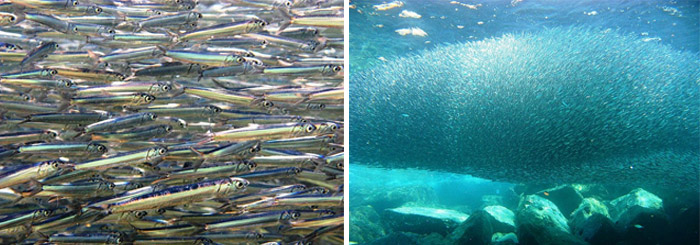 Left/유럽 멸치 무리. Shoal of European anchovy(Engraulis encrasicolus). Photo taken in Liguria, Italy. Author/Etrusko25. Right/유럽 멸치 대형 무리. Big school of European anchovy(Engraulis encrasicolus). Photo taken in Liguria, Italy. Author/Etrusko25 |
 Left/한국의 멸치볶음. Korean dish; panboiled dried anchovies in soy source and malt. Author/brappy!(a flickr user). Right/일본의 멸치 새끼(치어) 회 무침 백반(시라수돈). Shirasu-don or whitebait rice bowl at Enoshima, Fujisawa, Kanagawa, Japan. Author/Miyuki Meinaka. |
 Left/스페인 멸치 요리. 보케로네스 엔 비나레(Boquerones en vinagre). 멸치를 식초와 올리브 오일 혼합물에 절여서 마늘과 파슬리로 맛을 낸 요리이다. 스페인의 전채 요리로 특히 여름철에 가장 많이 먹으며 레스토랑과 바에서 제공되는 타파스로 매우 유명하다. 맥주나 청량 음료와 함께 먹는다. Boquerones en vinagre are a type of appetizer or tapa found in Spain.[1] The central ingredient of the dish is the boquerones, fresh anchovies. The fillets are marinated in vinegar or a mixture of vinegar and olive oil, and seasoned with garlic and parsley. It is commonly served with beer or soft drinks, and rarely with wine. Author/Tamorlan. Right/스페인의 간편식 핀쵸스(Pinchos 또는 Pintxos), 오른 쪽 빵 조각 위에 멸치가 얹혀져 있다. 스페인 북부 바스크 지방의 전통 서민 음식이다. Pintxos are small finger foods served at bars and taverns throughout the Basque Country. They are quintessential Basque and form the backbone of the local food culture. Author/Ardo Beltz |
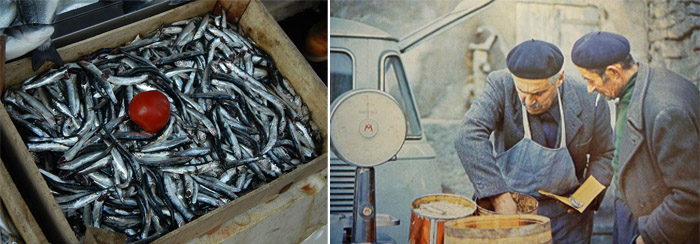 Left/터키 시장의 멸치(유럽 멸치). Anchovy(Engraulis encrasicolus) in a market of Turkey. Author/Kurt Kulac. Right/이탈리아의 멸치 상인. Seller of anchovies in Piedmont – Italy. Author/Ivo Chiappello. |
 Left/경상남도 거제시 유교마을 유교항의 노천 멸치 건조장. Drying of anchovy in a fisherman’s cove of Korea. Author/Asfreeas. Right/필리핀의 멸치 건조장 장면. Drying of anchovy in Philippines. Author/Judgefloro. |


|
| Copyright ⓒ FISHILLUST.COM All rights reserved. All contents can not be used without permission of the copyright holder. |


 검색
