
사이트 로그인
사이트 로그인
 명화 속의 날치. 포세이돈의 승리를 축하하는 퍼레이드이다. 그의 아내 암피트리테와 많은 그의 백성과 하위 신들이 행렬에 참여하고 있다. 하늘에 날치 4마리가 떠있는데 이들도 퍼레이드에 참여한 것일까 죽임을 당하지 않으려고 하늘로 도망친 것일까? 작살에 꽂혀 죽은 수많은 물고기들이 보이지 않는가? 화가/프란스 프란켄(Frans Francken the younger;1581~1642). Dutch: Triomftocht van Neptunus en Amphitrite. Triumph parade of Poseidon. Many fishes are stuck on harpoons, whereas the flyingfishes are alive in the air. Are the flyingfishes participating the parade or escaping from the demoniac fish hunting?. |
분류계통/경골상강→조기강→동갈치목→날치과 날치과 Family Exocoetidae(Flyingfishes) 세계에 7속 71종, 한국에는 5속 11종이 알려져 있다. |
|
날치류는 전세계 해양에 븐포하며 특히 열대와 아열대 해역에 많이 산다. 세계에 7속 71종, 한국에는 5속 11종이 알려져 있다. 수심 200m 이내의 표해수대(表海水帶, epipelagic zone)에서 주로 발견된다. 아래와 위턱이 길이가 같고 짧다. 가슴지느러미가 크고 수면 위로 날 수 있다. 어떤 종은 배지느러미가 커서 마치 또 한 벌의 가슴지느러미인 것처럼 보인다. 꼬리지느러미는 안으로 깊게 패였으며 위쪽 엽이 아래 엽보다 작다. 날치류의 꼬리지느러미 하엽이 상엽보다 훨씬 더 큰 이유는 수면 위로 글라이딩을 시도할 때 꼬리지느러미의 하엽을 이용하여 물을 좌우로 휘저어 속도를 얻기 때문이다. 척추골 수는 39-51이다. 여러 종들이 어렸을 때 덥수룩한 수염을 달고 있다. 최대 45 cm, 보통 30 cm 이하이다. 날치류는 주로 플랑크톤을 먹는다. 돌고래, 다랑어, 새치, 바다새, 오징어들에게 잡아 먹힌다. 날치의 빠른 속도 비행 능력은 다른 종들에 비해서 살아남는데 유리한 고지를 차지하고 있다. 날치는 위협을 느끼면 큰 가슴지느러미를 날개처럼 이용하여 물 밖으로 튀어나와 비행을 하며 달아남으로 '날치'란 이름이 붙었다. 수면을 전속력으로 헤엄치다가 상체를 일으켜 꼬리로 수면을 타듯이 달리면서 뛰어 오르고 잘 발달된 양쪽 가슴지느러미와 배지느러미를 활짝 편 채 글라이더처럼 활강한다. 수면 위로 나오기 직전에는 가슴지느러미를 몸에 바짝 붙여 몸을 유선형으로 갖춘 다음 수면을 벗어나는 순간 가슴지느러미를 활짝 펴서 글라이딩한다. 물 위로 나오는 순간 속력은 시속 50~60km 정도이며 나는 동안 꼬리지느러미를 조작하여 방향을 약간은 바꿀 수 있지만 미미한 정도이다. 그래서 보트 같은 장애물을 만나면 충돌하여 죽거나 갑판 위에 떨어져 사람의 횟감이 된다. 1947년 인류학자 토르 헤이에르달(Thor Heyerdahl)은 6명과 함께 뗏목으로 태평양을 건넜는데 뗏목 이름이 콘티키(Kontiki) 호였다. “콘티키호의 탐험(Kon-Tiki expedition)”이란 제목의 책에서는 날치들이 뗏목 위로 떨어졌다는 이야기가 나온다. 보통은 해면에 닿을 정도로 비행하지만 2~3m 정도로 높게 비상하기도 하며 고도 최고 높이는 6m 이다. 최장 비행거리는 3백~4백m, 최장 비행시간은 30~40초로 알려져 있다. 날치의 비행은 새처럼 날개 짓을 하는 것은 아니며 글라이딩하는 것이다. 반대로 물 밖의 천적인 새에게 잡아 먹힐 위험이 생긴다. 멀리 날기 위하여 몸을 가볍게 해야 하므로 먹이는 소화가 잘 되는 작은 플랑크톤 갑각류를 먹는다. 장이 짧아 먹이를 빨리 소화시켜 체외로 배출시킨다. 천적이 나타나면 비행 전에 똥을 싸서 몸을 가볍게 하면서 이수(離水)한다. 날치뼈를 현미경으로 보면 조류의 뼈처럼 골밀도가 낮아서 구멍이 숭숭 뚫려 있어서 뼈가 가볍다. 글라이디의 마감 시점에서는 가슴지느러미를 몸으로 접어 붙이는데 이는 물로 다시 들어가기 위함이거나 꼬리로 수면을 차서 다시 솟구쳐 글라이딩하려고 하기 위함이다. 방향을 바꾸기 위해서일 때도 있다. 꼬리지느러미는 착수 시 랜딩기어의 역할도 한다. 1900년부터 1930년대 기간에는 비행기의 모델로 날치류가 이용되기도 하였다. 날치류가 수면 위로 솟아올라 날 수 있는 데는 여러 가지 체형상의 특징을 가지고 있기 때문이다. 그 특징 중 하나는 매우 넓은 신경궁(神經弓; neural arches)이다. 신경궁의 사전적 정의는 “수용체와 반응체를 이어 주는 구심성신경과 원심성신경의 연결부”라고 되어 있다. 물고기 뼈대에 있는 인대와 연결조직 간에 삽입부로 작용하는데 매우 넓은 신경궁은 연결을 안정적으로 튼튼하게 해줌으로 척추와 두개골 사이의 연결이 강해진다. 이 특징은 몸 전체의 척추를 단단하게 함으로 비행에 도움이 된다. 몸이 늘어지지 않고 단단하게 굳는다는 것은 속도와 비행 목표를 개선시키는 기체역학적 이점이 있는 것이다. 이에 더하여 날치류는 “척추와 꼬리의 경직화 콤플렉스(complexes; 복잡함)”라는 특징을 발달시켰다. 이 특징은 날치의 모든 힘이 몸을 물 위로 들어올리는 데 집중되어 멀리 글라이딩할 수 있게 한다. 날치류는 상업적으로 어획되며 일본, 베트남, 중국에서는 자망으로 잡고 인도네시아에서는 반두그물로 잡는다. 솔로몬 섬에서는 날아오르는 날치를 잡는다. 그들의 전통적이 보트인 아우트리거 카누(outrigger canoe) 위에 그물을 쳐놓고 잡는다. 횃불에 유인되는 날치를 잡기 때문에 달빛이 없을 때 고기잡이를 한다, 일본에서는 고급 식용어가 되며 건조시키는 경우가 많다. 날치(한국 종명의 날치/Cheilopogon agoo)의 알은 일식당에서 초밥으로 흔히 먹으며 “알밥”에 사용되는 알도 날치 알이다. 날치는 대만의 란위 섬 사람들에게도 중요한 음식이며 바베이도스(Barbados;카리브해에 있는 섬나라)에서는 국가 대표 음식이다. |
Family Exocoetidae(Flyingfishes) Flying fish live in all of the oceans, particularly in tropical and warm subtropical waters. They are commonly found in the epipelagic zone, the top layer of the ocean to a depth of about 200 m. 7 genera with 71species worldwide, 5 genera with 11 species in Korea. Both jaws are in same length and relatively short. Pectoral fins unusually large and can be used for gliding flights. Moreover, some species have unusually large pelvic fins giving them a four-winged appearance. Caudal fin deeply forked; the upper lobe shorter than the lower. The reason why the lower lobe of the caudal fin of flying fish is longer than the upper lobe is that it strikes the water surface efficiently left and right in order to gain speed for gliding when jumping out of the water surface. 39-51 vertebrae. A pair of long, flaplike whiskers in the juveniles of many species. Attains 45 cm maximum length; usually below 30 cm. Exocoetidae feed mainly on plankton. Predators include dolphins, tuna, marlin, birds, squids, and porpoises. The flying fish's ability to fly at high speed occupies an advantage in survival compared to other species. When feels threatened, flying fish uses its large pectoral fins like wings to jump out of the water and fly away, hence the name 'flying fish'. After swimming at full speed on the surface, raise the upper body, run as if riding the surface with the tail, jump, and glide like a glider with well-developed both pectoral and pelvic fins wide open. Just before coming out of water, pectoral and pelvic fins attach close to body to form perfect streamlined body, and then, as soon as they come out of water, the fins open wide like wings. The speed at the moment it comes out of water is about 50 to 60 km per hour, and it can slightly change the direction by manipulating the tail fin while flying, but it is insignificant. So, when it encounters obstacle such as boat, it crashes and dies or falls on the deck and becomes sashimi for persons on board. In 1947, anthropologist Thor Heyerdahl and six other people crossed the Pacific Ocean on a raft called the Kontiki. A book titled “Kon-Tiki expedition” tells the story of flying fish falling onto the raft. It usually flies enough to touch the sea surface, but it sometimes soars as high as 2 to 3 m, maximum height is 6m. The longest flight distance is 300 to 400 m, and the longest flight time is known to be 30 to 40 seconds. Not flapping its wings like bird, in true sense of the word, it's not flying, it's gliding. On the contrary, there is risk of being eaten by the natural bird outside the water. It needs to be light to fly far, so it eats small planktonic crustaceans that are easily digested. The short intestine digests food quickly and discharges it out of the body. Flying fish poop before flying to lighten their bodies. Microscopic images of flying fish bones show that they are light in weight because they have low bone density like bird bones. At the end of a glide, they fold their pectoral fins to re-enter the sea, or drop their tails into the water to push against the water to lift for another glide, possibly changing direction. The caudal fin also serves as landing gear when landing. From 1900 to the 1930s, flying fish were studied as possible models used to develop airplanes. Numerous morphological features give flying fish the ability to leap above the surface of the ocean. One such feature is fully broadened neural arches, which act as insertion sites for connective tissues and ligaments in a fish's skeleton. Fully broadened neural arches act as more stable and sturdier sites for these connections, creating a strong link between the vertebral column and cranium. This ultimately allows a rigid and sturdy vertebral column(body) that is beneficial in flight. Having a rigid body during glided flight gives the flying fish aerodynamic advantages, increasing its speed and improving its aim. Furthermore, flying fish have developed vertebral columns and ossified caudal complexes. These features provide the majority of strength to the flying fish, allowing them to physically lift their bodies out of water and glide remarkable distances. Flying fish are commercially fished in Japan, Vietnam, and China by gillnetting, and in Indonesia and India by dipnetting. In the Solomon Islands, the fish are caught while they are flying, using nets held from outrigger canoes. They are attracted to the light of torches. Fishing is done only when there is no moonlight. Often in Japanese cuisine, the fish is preserved by drying. The roe of Cheilopogon agoo, or Japanese flying fish, is used to make some types of sushi, and is known as tobiko. It is also a staple in the diet of the Tao people of Orchid Island, Taiwan. Flying fish is part of the national dish of Barbados, cou-cou and flying fish. |
 날치(Cheilopogon pinnatibarbatus)가 허공을 글라이딩할 때의 지느러미를 활짝 편 모습(왼쪽). 날치(종명 미상)가 수면을 벗어나 떠오르는 순간(오른쪽). Left/a flying fish(Cheilopogon pinnatibarbatus) with its fins outstretched as it glides through the air. Location; off the northern tip of New Zealand. Author/Bert Filemyr. Right/moment a flying fish(unidentified species) take off from the surface. Author/noaa |
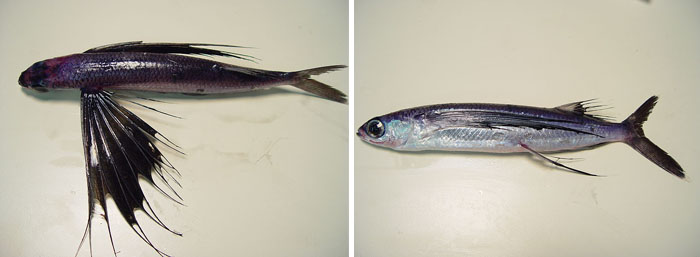 Left/가슴지느러미가 늘어져 있는 상태의 죽은 매날치(Black wing flyingfish; Hirundichthys rondeletii). Author/Collection of Brandi Noble, NOAA. Right/가슴지느러미가 체측에 붙어있는 상태의 죽은 매날치(Black wing flyingfish; Hirundichthys rondeletii). Pectoral fin sticked to body side. Author/Brandi Noble. |
 Left/황날치(Sailfin flyingfish; Parexocoetus brachypterus). Author/David Starr Jordan(1851–1931). Right/새날치(Yellowing flyingfish; Cypselurus poecilopterus). Author/Robert Mintern(1840–1908) |
 Left/밴드윙 날치(Bandwing flyingfish; Cheilopogon exsiliens). Date/1868. Author/Charles Bevalet. Right/Common Flying Fish. Author/John Stevenson Bushnan(1807–1884). |
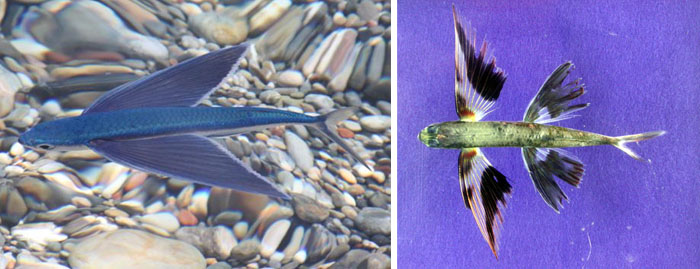 Left/날개(가슴지느러미)가 큰 것이 특징인 상날치의 배행 순간. 상날치(Tropical two-wing flyingfish; Exocoetus volitans). This species has particularly large pectoral fins. Author/Kolisberg. Right/비행 중인 밴드윙 날치(Bandwing flyingfish; Cheilopogon exsiliens). 큰 배지느러미까지 날개로 사용 중이다. Author/Tara Casazza(NOAA) |
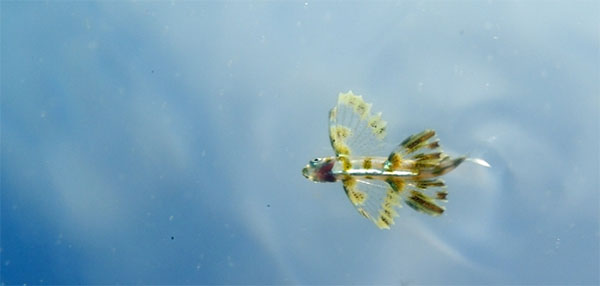 지중해 날치의 매우 어린 유어. Very young juvenile of Mediterranean flyingfish(Cheilopogon heterurus). Author/Izuzuki |
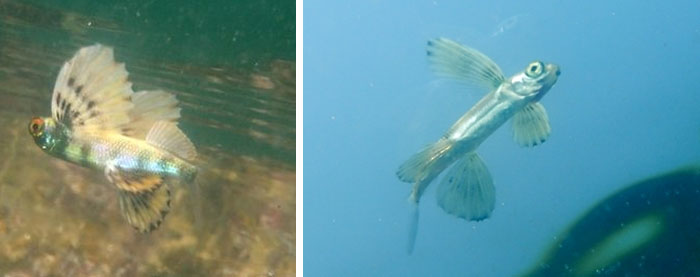 Left/수중에서 날개를 펼친 새날치(Yellowing flyingfish; Cypselurus poecilopterus). Spreaded out it’s wings underwater. Author/Izuzuki. Right/수중에서 날개를 펼친 새날치 속(genus Cypselurus)의 한 종. 종명 미확인. Underwater picture of a unidentified Cypselurus. Author/Izuzuki |
 Left/낚시꾼 위치 물 속에 날치 떼가 있었을 것이다. 갑자기 다랑어들이 날치를 공격하자 날치들이 공중으로 도망쳤고 뒤따라 점프하던 다랑어들이 보트와 낚시꾼을 뛰어넘자 낚시꾼이 혼란에 빠졌다. Probably many flying fishes were below the boat, then, tunas attacked the flying fishes, this small fishes escaped into air, and followed by jumping out tunas. The angler is embarrassed with the unexpected shower of fishes. Author/Charles Frederick Holder(1851–1915). Date/1909. Right/인어가 날치를 잡으려고 하자 날치가 도망가 버렸다. Mermaid and Flying Fish. 화가/허버트 제임스 드레이퍼(Herbert James Draper/1864~1920). 인어 신화에 관한 여러 명작들을 남겼다. |
 Left/날아가는 날치의 원형을 살린 튀김 요리. 일본 야쿠시마 섬(Yakushima)의 한 여관에서 제공된 음식. Fried flying fish offered by a japanese-style lodge in Yakushima. Author/Josh Berglund. Right/손가락 사이로 쥔 어린 상날치(Tropical two-wing flyingfish; Exocoetus volitans). 상날치는 최대 30cm까지 자란다. Juvenile; max length of this fish; 30cm. Author/Jean Fortunet |
 Left/날치 알 초밥. Sushi of flying fish eggs. Author/Till Krech. Right/알밥. Korean dish; “albap”, boiled rice topped with flying fish eggs. Author/rose garden |
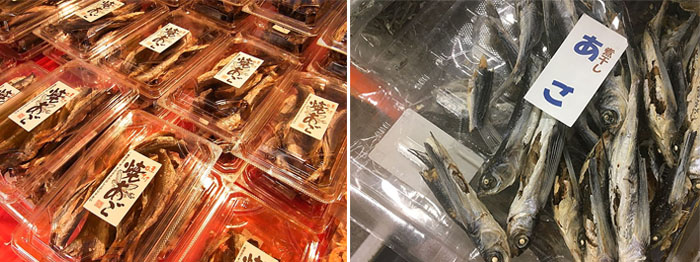
| 일본의 날치 구이 포장 음식(좌)과 건조시킨 날치(우). Japanese grilled flying fish packaged food (left) and dried flying fish(right). Author/left; 江戸村のとくぞう, right/Nesnad |
 필리핀의 날치 구이 음식. Philippine dish of flyingfish. 종명(species name; Exocoetus volitans). Author/Judgefloro |
 회화. 제목/날치의 메아리. 좌측 아래에 날치 2마리가 있는데 여인이 입김으로 불어낸 듯하다. 어떤 뜻인지 모르겠음. Painting title/The echo of the flying fish). 48x80, 2011. Author/Alexandre Evgrafov(Sasha), from Canada. There are two flying fish on the lower left, and it seems that the woman blew them out with her breath, the meaning not found. Creative Commons 3.0 |


|
| Copyright ⓒ FISHILLUST.COM All rights reserved. All contents can not be used without permission of the copyright holder. |


 검색
