
사이트 로그인
사이트 로그인
경골상강/Superclass Osteichthyes(bony fishes)→조기강/Class Actinopterygii(ray-finned fishes)→밑보리멸목 Order Notacanthiformes(halosaurs and deep-sea spiny eels)→발광멸과(Family Halosauridae(Halosaurs) 발광멸과(Family Halosauridae(Halosaurs/할로사우르). Family 72 "halosaur"는 기준 종의 속명 Halosaurus(할로사우루스)에서 나온 용어이며 그리스어 hals(sea)와 sauros(lizard)의 합성어로 즉 “바다 도마뱀”이란 뜻이다. 꼬리가 잘려나가면 도마뱀처럼 재생된다. 화석은 선명한 모양이 나타나지 않은 것들이 발견되어 있다. 가장 오래전 화석 종 할로사우르는 독일의 후백악기 지층에서 발견된 Echidnocephalus(속명)이며 그 다음 오래 전 것은 캘리포니아에서 발견된 Laytonia(속명)이다. 화석 종들은 현생 할로사우르와 닮은 점이 아주 많다. 할로사우르는 몸이 매우 길고 꼬리는 회초리모양으로 끝난다. 비늘은 크다. 등지느러미는 1개로 크기는 작으며 머리 쪽에 가깝게 있다. 머리는 앞으로 뾰족하고 비늘이 거의 없다. 꼬리지느러미는 거의 퇴화되었고 뒷지느러미 기부가 아주 길다. 입은 큰 편이며 아래턱이 위턱보다 짧다. 부레는 없다. 가장 큰 종은 어비살 할로사우르(abyssal halosaur, 학명; Halosauropsis macrochir)로 전장이 90cm이다. 이 종은 3,300m 수심에서 발견되었다. 할로사우르들은 빛이 없는 환경에 적응된 물고기이다. 측선이 매우 발달하였다. 체측 전체에 걸쳐있는 측선의 감각공들은 주변의 파동을 예민하게 감지한다. 어떤 종은 긴 가슴지느러미를 앞쪽으로 일으켜 세워서 감지 범위를 확장시킨다. 할로사우르는 저서형 물고기로 수온이 2-4 °C로 해저 바닥을 돌아다니거나 바닥에서 쉬면서 시간을 보낸다. 바다뱀처럼 몸을 좌우로 율동시키며 헤엄친다. 갯지렁이, 극피동물, 갑각류 같은 저서 무척추동물을 주로 먹는다. 살아있는 할로사우르는 대개 회색 내지 암청색이다. 노타칸투스과 종들과 마찬가지로 꼬리가 잘려나가면 도마뱀처럼 재생된다. |
 Left/발광멸과 물고기. 한국명 발광멸(Aldrovandia affinis)의 기본 도형. Based on a specimen collected at depth of 1400m. Gilbert's halosaur(Aldrovandia affinis). Date1896. Author/H. L. Todd. Right/발광멸과 물고기. 학명/Aldrovandia gracilis. Based on a specimen collected off Guadalupe at depth of 1400m. Date/1896. Author/Sherman Foote Denton(1856–1937) |
 Left/발광멸과 물고기. 학명/Halosaurus johnsonianus. Author/Bideault. Right/발광멸과 물고기. 학명/Halosaurus ovenii. Author/Bideault |
발광멸과(할로사우르과) 16종 명단 . 16 Species in Family Halosauridae Aldrovandia affinis(Günther, 1877). Gilbert's halosaurid fish |
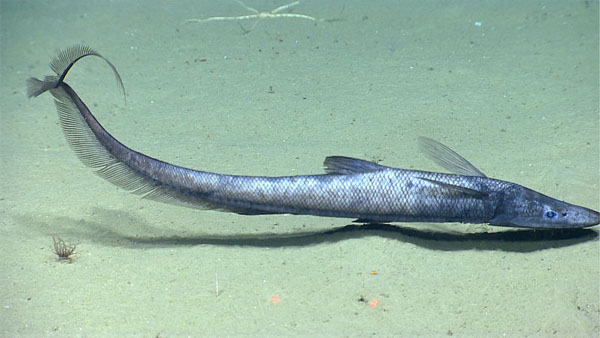 수심 2000m 심해저 모래 바닥에서 이동중인 할로사우르(발광멸류). 바닥에 말미잘(왼쪽 아래)과 흰 불가사리류(중앙 꼭대기)가 보인다. A halosaur cruising over a sandy bottom with a white brittle star and a small anemone. Depth; 2000 m. Author/NOAA Photo Library |
 수심 1800m 해저의 화이트 할로사우루스. A white halosaurus. At depth of 1870-1621m. Author/NOAA Photo Library |
Family Halosauridae(Halosaurs). Family 72 The term "halosaur" refers to the type genus, Halosaurus, which is a Greek compound word, hals meaning "sea" and sauros meaning "lizard". Halosaurs have a spotty fossil record, the oldest known genus being Echidnocephalus from the Late Cretaceous strata of Westphalia, Germany, and the second-oldest known genus, Laytonia, from Miocene strata of California and Oregon. The fossil specimens already bear strong resemblance to the modern genera. The halosaurs' greatly elongated bodies end in whip-like tails; their scales are large. One small dorsal fin is close to the sharply pointed, mostly scaleless head. The tail fin is greatly reduced, with the anal fin being the largest fin. Their mouths are somewhat large, with the lower jaw shorter than the upper jaw. The gas bladder is absent. The largest species, the 90-cm long abyssal halosaur(Halosauropsis macrochir) is also one of the most deep-living fish, recorded at depths of 3,300m. Halosaurs have developed certain adaptations to life at these extreme depths, where no light penetrates. Their lateral line system is highly developed; the pores run the length of the fish's body, lending it a sort of "sixth sense" by detecting nearby vibrations. Some species are also known to hold their elongated pectorals erect and forward, possibly providing a further means of detection. Halosaurs are benthic fish, spending their time cruising over or resting on the sea floor, where temperatures may be just 2-4 °C. They propel themselves with rhythmic, lateral undulations of their bodies, not unlike sea snakes. Halosaurs are thought to prey mainly on benthic invertebrates, such as polychaete worms, echinoderms, and crustaceans such as copepods. In life, most halosaurs are grey to bluish-black in colour. Like other notacanthiform fish, halosaurs are able to regenerate their tails easily if lost. This adaptation can be likened to certain terrestrial reptiles, such as the glass lizard, which sacrifices its tail to evade predators. |
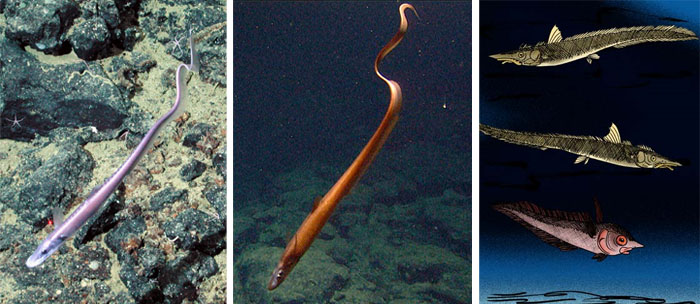 Left/1736m 수심에서 촬영된 발광멸과 물고기. 종명 미상. Aldrovandia sp Halosaur(Aldrovandia sp.) at 1736 meters water depth, Davidson Seamount, California. Author/NOAA Photo Library. Center/할로사우르가 보통 회색이나 암청색으로 알려져 있으나 오렌지 색인 것도 발견되었다. 심해저 바위 지대에서 움직이고 있는 할로사우르. A surpisingly orange-colored halosaur over a black rock outcrop. Author/NOAA Photo Library. Right/그림으로 복원 시킨 화석 종들. 맨 위가 할로사우르 종이며 학명은 Laytonia californica이다. 아래 2 물고기는 목이 다른 물고기이다. Reconstruction of the extinct halosaur Laytonia californica(top), loswer 2 fishes are species of other group |
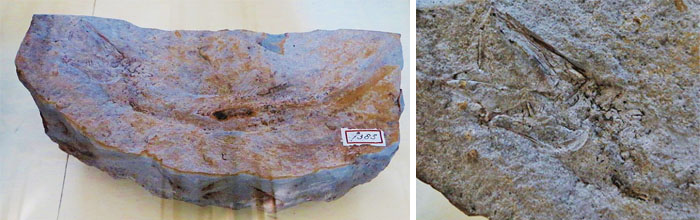 Left and right/멸종 할로사우르의 화석. 학명/Echidnocephalus. 할로사우르의 화석은 판독하기가 쉽지 않은 불분명한 화석들만 있다. Halosaurs have a spotty fossil record. Fossil of Echidnocephalus, an extinct fish. Author/Ghedoghedo. |


|
| Copyright ⓒ FISHILLUST.COM All rights reserved. All contents can not be used without permission of the copyright holder. |


 검색
