
사이트 로그인
사이트 로그인
분류계보/경골상강/Superclass Osteichthyes(bony fishes)→조기강/Class Actinopterygii(ray-finned fishes)→ 동갈치목 Order Beloniformes(needle fishes) 학공치과(=학꽁치과) Family Hemiramphidae(Halfbeaks) 학공치과는 동갈치목의 5개과중 한 과이며 나머지 4개과는 송사리과 날치과 동갈치과 꽁치과이다. 학공치과는 전 세계에 8속 약 62종이 알려져 있고 한국에는 2속 4종이 알려져 있다. 대부분 해수어이며 담수에 사는 것도 일부 있다. ※2016년판 넬슨 분류에서는 태생성학공치과(Family Zenarchopteridae; 제나르콥테루스)가 추가되어 모두 6개과가 되어있다. 영명으로 하프비크(Halfbeaks)라고 부르며 아래턱만 아주 길게 앞으로 뻗어서 반(half) 부리(beak)라는 뜻을 가진 이름이다. 위턱의 끝 뼈는 뾰족하게 주둥이 앞으로 짧게 튀어나가 있다. 가슴지느러미와 배지느러미는 짧다. 척추골 수는 38-75개이다(아람푸스 속은 예외로 18-25개)이다. 최대 길이는 약 45 cm이다. 학공치류는 대부분 아래턱이 매우 긴 것이 특징인데 이에 비해 날치류는 양턱이 일반 물고기와 비슷하고 위턱보다 아래턱이 더 짧으며 동갈치류와 꽁치류는 양턱이 모두 길다. 학공치류는 지느러미에 가시 기조가 없다. 등지느러미는 한 개며 등지느러미와 뒷지느러미는 몸의 후방에 대칭으로 위치한다. 배지느러미는 6개의 기조로 되어 있고 복부에 위치해있다. 측선은 가슴지느러미 기부에서 시작하여 몸의 복부 가장자리를 따라 이어져있다. 비늘은 약간 큰 편이며 원형비늘이며 잘 떨어지는 성질이다. 학공치류는 물 표면에 떠서 살기 때문에 이에 맞게 은폐색을 가지고 있다. 등쪽은 녹색 내지 청색이며 측면과 배쪽은 은백색이다. 하늘 쪽에서 내려다 보거나 물속에서 올려다보면 실체가 거의 보이지 않는다. 대부분 종들이 살아 있을 때 아래턱의 끝은 밝은 적색이거나 오렌지색이다. 잡식성이며 부유 해조류, 수면 층의 갑각류, 동물플랑크톤 및 작은 물고기를 잡아먹는다. 알은 얕은 수심의 해조류에 붙여 낳는다. 수면 위로 뛰어오르거나 수면에서 재빠르게 도망갈 수 있으며 어떤 종(Euleptorhamphus velox)은 날치처럼 공중을 나를 수 있다. 큰 개체는 세계 여러 지방에 음식으로 인기가 있다. Family Hemiramphidae(Halfbeaks) The Hemiramphidae, the halfbeaks, are one of five families of the order Beloniformes. 8 genera with about 62 species worldwide, 2 genera with 4 species in Korea. Most species are marine, but some inhabit freshwaters. ※ Family Zenarchopteridae has been added in recent classification “Nelson 2016”, thus 6 families in total. Halfbeaks are known from the Atlantic, Indian and Pacific Oceans. The lower jaw much longer than upper jaw; premaxillae pointed anteriorly; short pectoral and pelvic fins. Vertebrae 38-75 (except 18-25 in Arrhamphus). About 45 cm maximum length. Most halfbeaks have an elongate lower jaw that distinguishes them from flying fishes which have lost the elongate lower jaw and from needlefishes(Belonidae) and sauries(Scomberesocidae) which have both jaws elongate. No spines in fins. With single dorsal fin. Dorsal and anal fins symmetrical and posterior in position. Pelvic fins in abdominal position, with 6 soft rays. Lateral line running down from pectoral fin origin and then backward along ventral margin of body. Scales moderately large, cycloid, easily detached. These fishes live at the surface and are protectively colored for this mode of life being green or blue on the back and silvery white on the sides and ventrally. Tip of the lower jaw bright red or orange in life in most species. Omnivorous, feeding on floating sea grasses, crustaceans ,zooplankton and small fishes. Eggs are attached to algae in shallow waters. They are prone to leap and skitter at the surface and one offshore species, Euleptorhamphus velox can leap out of the water and glide like a flying fish. The flesh is excellent and larger species of halfbeaks are utilized as food in many parts of the world. |
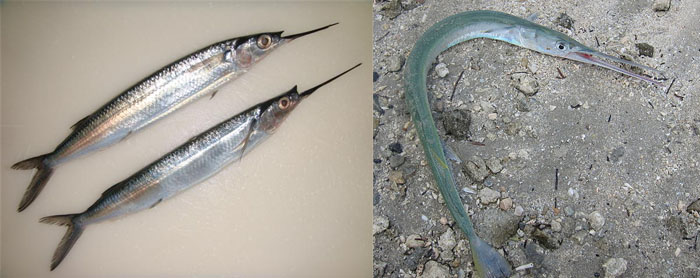 Left/블랙바 하프비크. Black-barred halfbeak(Hemiramphus far). Author/Shankaragouda. Distribution(분포)/Indo-West Pacific: Red Sea and East Africa to Samoa, north to the Ryukyu Islands, south to northern Australia and New Caledonia. Migrated to the eastern part of the Mediterranean Sea via the Suez Canal. Right/롱빌드 하프비크. Long billed half beak(Rhynchorhamphus georgii). Author/കാക്കര. Distribution(분포)/Indo-West Pacific: the most widespread of the four species of Rhynchorhamphus, found from Persian Gulf through Arabian Sea and Bay of Bengal through the Western Central Pacific north to Taiwan and Hong Kong and east to New Guinea and northern Australia. |
 줄공치(Asian pencil halfbeak). Hyporhamphus intermedius(Cantor, 1842) |
 학공치. Japanese halfbeak(Hyporhamphus sajori). Author/Kawahara Keiga(1786–). Country/Japan. |
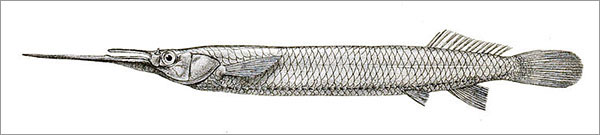 학명(scientific name)/Zenarchopterus ectuntio. Author/R. Mintern. Date/1878. Viviparous. Raised at family rank (Family Zenarchopteridae) in 2016 Nelson 5th classification. 2016년도 넬슨 제5판에서 과로 승격됨. 태생성이다. |


|
| Copyright ⓒ FISHILLUST.COM All rights reserved. All contents can not be used without permission of the copyright holder. |


 검색
