
사이트 로그인
사이트 로그인
경골상강/조기강→이악어목→붉평치과 붉평치과 Family Lampridae(Opahs) ① Lampris australensis(Southern spotted opah)/Southern hemisphere, in the Pacific and Indian oceans. 남반구의 인도양과 태평양에 분포. 붉평치류는 전 세계 해양의 열대와 온대에 걸쳐 널리 분포하며 한 종(Lampris megalopsis)은 남반구 해양에만 분포한다. 붉평치과 물고기는 영명으로 오파(Opah)라고 하는데 납작하고 둥근 모양 때문에 달고기(moonfish) 또는 해고기(sunfish)라고도 부르며 킹피시(kingfish; 크기가 커서), 빨간바다냄비(redfin ocean pan), 예루살렘 해덕 같은 별칭을 갖고 있다. 해고기(sunfish)는 원래 개복치를 말하는데 붉평치의 별칭에 sunfish가 있다 보니 개복치류의 하나인 것으로 오인된 정보들이 있다. 예를 들어 인터넷에서 Opah의 번역을 보면 “빨간개복치”라고 나오는데 붉평치는 개복치(복어류)와 완전히 다른 물고기이다. 붉평치류는 매우 둥글고 옆으로 납작하며 튀는 색상을 가진 물고기들이다. 몸 바탕 색이 진한 황적색에서부터 배쪽으로 내려오면서 장미 빛으로 변하며 체측 전체에 많은 백색 점들이 분포하고 있다. 지느러미들은 모두 밝은 주홍색(vermilion)이다. 눈은 크고 튀어나온 눈이며 황금색 테두리를 가지고 있다. 몸을 덮고 있는 비늘은 아주 작은 원형비늘이며 무지개 빛깔을 내는 은빛의 구아닌 코팅아 되어 있는데 이 코팅은 쉽게 벗겨진다. 붉평치류는 암수의 외형이 차이가 있는 것으로 알려져 있는데 수컷의 배가 아래쪽으로 더 확장되어 있다. 붉평치류는 체형이 근친 관계가 없는 병어과의 병어(butterfish/family Stromateidae)와 아주 닮았다. 가슴지느러미가 휘어진 모양이며 꼬리지느러미가 안으로 깊이 패인 것도 닮았다. 붉평치류는 병어보다 크기가 비교할 수도 없을 만큼 크며 병어는 배지느러미가 없으나 붉평치류는 배지느러미도 길게 휘어졌고 기조 수도 14-17개로 많다. 붉평치류는 외관이 전갱이류(특히 어린 성어들)와도 닮았다. 그러나 붉평치류는 가슴지느러미가 수평으로 놓이지 않고 수직으로 서있는 점에서도 유사 종과 다르다. 붉평치류는 등지느러미가 1개이며 앞부분이 매우 길게 연장되어 있고 배지느러미와 함께 길게 휘어진 모양을 가지고 있다. 뒷지느러미는 등지느러미의 짧은 부분과 같은 길이로 높으며 등지느러미와 뒷지느러미를 기저부에 있는 홈으로 접어넣 을 수 있다. 주둥이는 뾰족하고 입은 작으며 턱에 이빨이 없고 입은 전방을 향해 열리는 터미널 형이다. 측선은 가슴지느러미 위에서 크게 곡선을 그렸다가 미병부로 이어진다. 붉평치류 중 붉평치는 최대 2 m 길이에 270 kg까지 나갈 수 있다. 붉평치의 생태학에 관해서는 알려진 것이 거의 없다. 전 생애를 외해 50-500m 수심의 중심해(中深海)에서 회유해 다니며 사는 것으로 믿어지며 점심해(漸深海) 층으로 더 내려갈 수도 있다. 단독 생활을 하는 것으로 믿어지며 다랑어나 고등어류의 무리에 섞여 회유해 다니는 것으로도 알려져 있다. 가슴지느러미를 위아래로 진동시키는 방법과 추진력이 강한 가랑이 형의 꼬리지느러미를 이용하여 헤엄치는데 등 및 뒷지느러미를 몸에 있는 홈에 수납시켜서 몸을 더 매끈하게 만든다. 이는 다랑어처럼 빠른 속도를 유지하면서 장시간 헤엄칠 수 있음을 나타내는 것이다. 주로 오징어와 크릴 새우, 그리고 작은 물고기도 잡아먹는다. [유일한 온혈 물고기로 판명 되다]. 2018년 붉평치과의 붉평치(Lampris guttatus)가 5종으로 세분 되기 전인 2015년 연구에 의하면 붉평치(Lampris guttatus)는 몸 전체가 온혈동물인 것이 발견되었다. 몸 전체의 중심부가 주변의 수온보다 약 5 °C가 높았다는 것이다. 물고기는 몸 전체가 냉혈이거나 몸의 일부분만 따뜻하게 만들 수 있는데 반하여 붉평치는 몸 전체의 체온을 올릴 수 있다는 점에서 유일한 물고기가 되었다. |
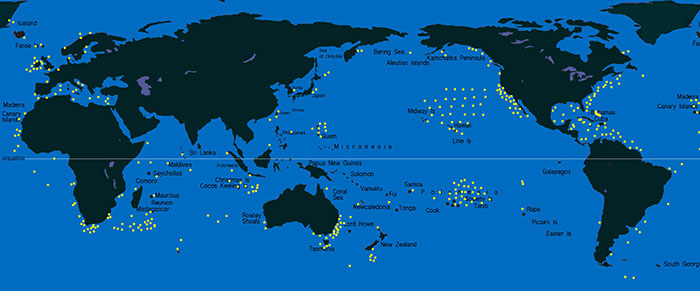 붉평치과 6종의 종합 분포도. Distribution map of all 6 species in Family Lampridae(opah). Derived work. Author/Kim in young(fishillust.com) |
|
Family Lampridae(Opahs) Opahs also commonly known as moonfish, sunfish(not to be confused with Molidae), kingfish, redfin ocean pan, and Jerusalem haddock, are large, colorful, deep-bodied pelagic lampriform fishes comprising the small family Lampridae(also spelled Lamprididae). Two living species were traditionally recognized, but a taxonomic review in 2018 found that more should be recognized(the result of splitting L. guttatus into 5 species, each with a more restricted geographic range), bringing the total to six species. The six species of Lampris have mostly non-overlapping geographical ranges, and can be recognized based on body shape and coloration pattern. ① Lampris australensis(Southern spotted opah)/Southern hemisphere, in the Pacific and Indian oceans.. A study of a specimen(standard length 705mm) collected by a stationary net set in water of central east coast of Korea in November 2014, confirmed that the specimen is “Lampris guttatus”, and an unrecorded species in Korea. This is the first species even in Family Lampridae(Opahs) in Korea. However the species name “Lampris guttatus” that given to Korean specimen came invalid because after the Korean taxonomic study, a new taxonomic review in 2018 found that more should be recognized(the result of splitting L. guttatus into 5 species), Opahs are deeply keeled, compressed, discoid fish with conspicuous coloration: the body is a deep red-orange grading to rosy on the belly, with white spots covering the flanks. Both the median and paired fins are a bright vermilion. The large eyes stand out, as well, ringed with golden yellow. The body is covered in minute cycloid scales and its silvery, iridescent guanine coating is easily abraded. Opahs are known to have a sexually dimorphic characteristic of an enlarged abdomen in males. Opahs closely resemble in shape the unrelated butterfish(family Stromateidae). Both have falcated (curved) pectoral fins and forked, emarginated(notched) caudal fins. Aside from being significantly larger than butterfish, opahs have enlarged, falcated pelvic fins with about 14 to 17 rays, where as the butterfish absent in pelvic fin. Opahs also superficially similar to carangids(especially young adults), but pelvic fins positioned thoracically rather than mid body like the Opahs. The pectorals of opahs are also inserted(more or less) horizontally rather than vertically. The anterior portion of an opah's single dorsal fin(with about 50–55 rays) is greatly elongated, also in a falcated profile similar to the pelvic fins. The anal fin (around 34 to 41 rays) is about as high and as long as the shorter portion of the dorsal fin, and both fins have corresponding grooves into which they can be depressed. The snout is pointed and the mouth small, toothless, and terminal. The lateral line forms a high arch over the pectoral fins before sweeping down to the caudal peduncle. The larger species, Lampris guttatus, may reach a total length of 2 m and a weight of 270 kg. The lesser-known Lampris immaculatus reaches a recorded total length of just 1.1 m. Almost nothing is known of opah biology and ecology. They are presumed to live out their entire lives in the open ocean, at mesopelagic depths of 50 to 500 m, with possible forays into the bathypelagic zone. They are apparently solitary, but are known to school with tuna and other scombrids. The fish propel themselves by a lift-based labriform mode of swimming, that is, by flapping their pectoral fins. This, together with their forked caudal fins and depressible median fins, indicates they swim at constantly high speeds like tuna. Squid and euphausiids(krill) make up the bulk of the opah diet; small fish are also taken. [Endothermy]. According to a 2015 study, before the 2018 when the Lampris guttatus was subdivided into 5 species, lampris guttatus was discovered to have near-whole-body endothermy in which the entire core of the body is maintained at around 5 °C above the surrounding water. This is unique among fish as most fish are entirely cold blooded or are capable of warming only some parts of their bodies. ※기사 작성 날자(date of editing)/December 2021 |
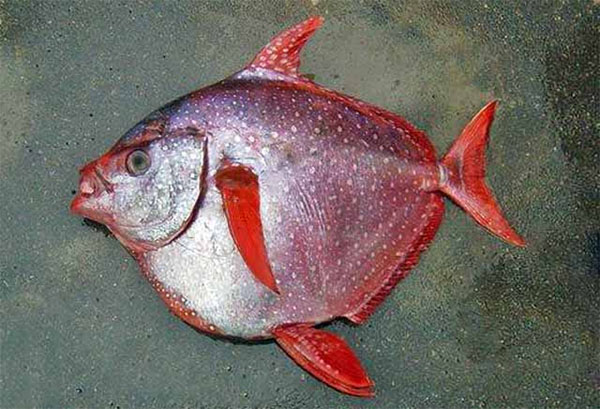 붉평치. Bigeye Pacific opah(Lampris megalopsis). Author/BOL, source/Smithsonian Institute. |
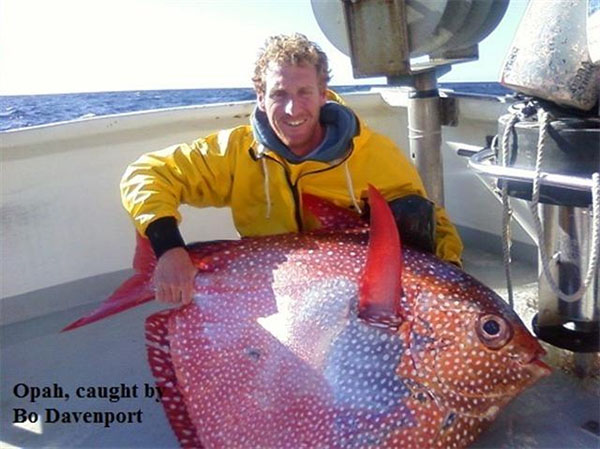 붉평치류. 종전의 학명 Lampris guttatus로 소개된 사진이며 종이 세분화되었으므로 재확인이 필요함. Opah. Country/USA. Author/David H. A picture captioned as former name “Lampris guttatus”, reconfirmation of scientific name required according to new split species of “Lampris guttatus”. |
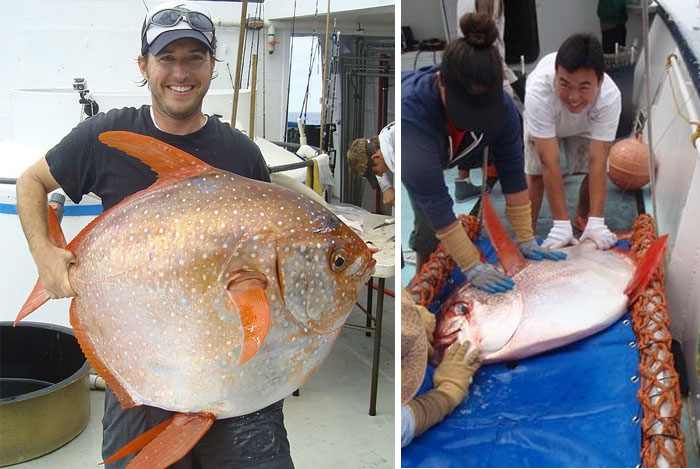 두 사진은 붉평치류. 종전의 학명 Lampris guttatus로 소개된 사진이며 종이 세분화되었으므로 재확인이 필요함. Opahs. Author of both pictures/NOAA. Both pictures captioned as “Lampris guttatus”, reconfirmation of scientific name required because Lampris guttatus split into several species. Left/NMFS(noaa) biologist, Nick Wegner, holding a recently captured Opah fish. Right/ Researchers examine an opah, Lampris guttatus, caught off California (and later released). |
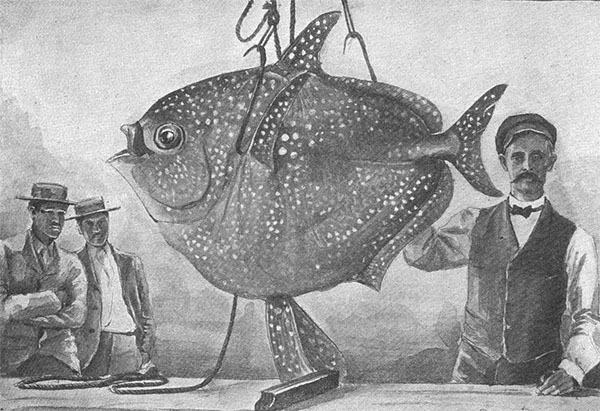 144kg 무게의 붉평치류. Date/1907, 하와이 호놀룰루의 생선 시장. 종전의 학명 Lampris guttatus로 소개된 사진이며 종이 세분화되었으므로 재확인이 필요함. Opah. Specimen in Honolulu market weighing 144kg. Date/1907. Author/E. L. Berndt. Reconfirmation of scientific name required because Lampris guttatus split into several species. |
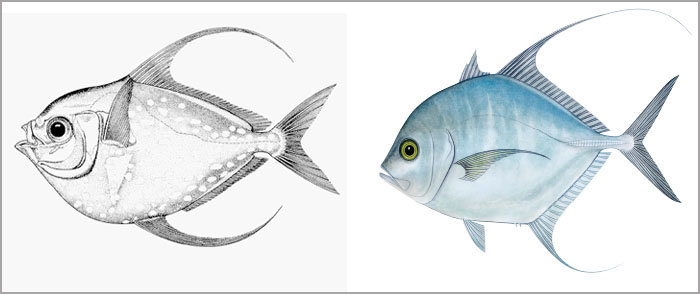 왼쪽은 붉평치(Lampris megalopsis)의 어린 개체이며 오른쪽은 전갱이류(Carangoides coeruleopinnatus)의 유어이다. 붉평치와 전갱이는 성어가 되기 전 모습이 서로 유사하다. Both pictures are young specimens of Opah(Lampris megalopsis) and Trevally(Carangoides coeruleopinnatus) respectively. Both species resemble each other in young stage. Author/left; FAO, right; Kim in young(fishillust.com) |
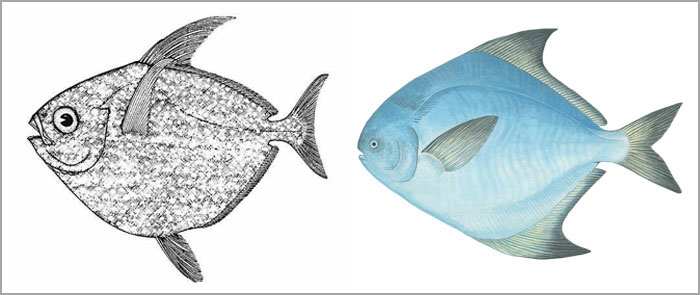 왼쪽은 붉평치(Lampris megalopsis)의 묘사도이며 오른쪽은 병어Pampus argenteus)의 묘사도이다. 서로 외형이 닮았지만 병어는 농어목의 물고기이며 서로 크기와 색샹에 큰 차이가 있다. Both pictures are illustrations of Opah(Lampris megalopsis) and Silver pomfret(Pampus argenteus) respectively. Similar each other in shape, but quite different in taxon, size and color pattern; Silver pomfret is contained in Oder Perciformes. Author/left; FAO, right; Kim in young(fishillust.com) |
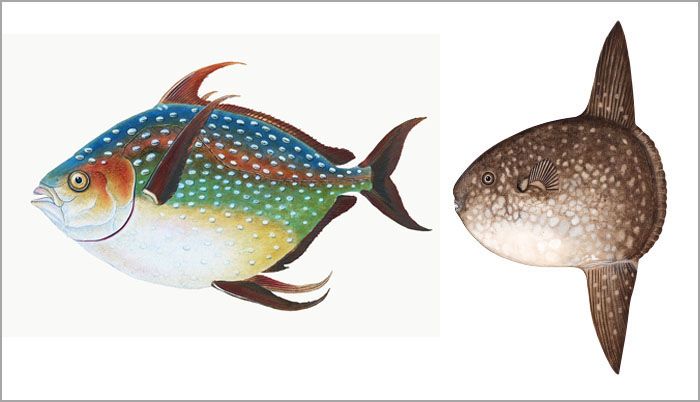
| 위 그림에서 왼쪽은 붉평치 묘사도이며 오른쪽은 개복치 묘사도이다. 붉평치류는 영명이 Opah 인데 이를 사전에서 찾아보면 “빨간개복치”라고 나온다. 붉평치의 별칭 영명 중 하나에 썬피시(sunfish)가 있고 개복치(Mola mola)도 영명으로 Ocean sunfish라고 한다. 붉평치의 별칭 중 하나인 sunfish는 이 물고기의 모양이 크고 둥글기 때문에 나온 이름일 것이다. 그러나 개복치와 붉평치는 전혀 다른 물고기이다. 개복치는 복어목 물고기이다. “빨간개복치”는 엉뚱한 번역이다. In the figures above, the left is depiction of Opah, and the right is depiction of Mola mola(Ocean sunfish). In English-Korean dictionary, Opah comes out as “Red Mola mola or Red Ocean sunfish”. This confusion may be come out from the name “sunfish” which is one of the English common names of Opah. The Ocean sunfish and Opah are completely different fish. Ocean sunfish belong to Order Tetraodontiformes(Puffers and Filefishes). “Red Sunfish” is perfectly incorrect translation |


|
| Copyright ⓒ FISHILLUST.COM All rights reserved. All contents can not be used without permission of the copyright holder. |


 검색
