
사이트 로그인
사이트 로그인
경골상강/Superclass Osteichthyes(bony fishes)→조기강/Class Actinopterygii(ray-finned fishes)→샛비늘치목/Order Myctophiformes(lanternfishes)→ 샛비늘치과 Family Myctophidae(Lanternfishes) 샛비늘치과류는 랜턴피시(Lanternfishes)라는 영명으로 널리 알려진 물고기이며 발광 물고기라는 특징 때문에 랜턴피시라고 해야 국제적 차원에서 인지가 빠르다. 그러나 아귀목 물고기 중에도 이마에서 자라난 낚시 줄 미끼 끝에 발광하는 부분인 “랜턴” 기관을 가진 것이 있어 서로 혼동될 수 있는 점에 유의해야 한다. 샛비늘치과의 학명 믹토피디(Myctophidae)의 어원은 머리가 큰 뱀이란 뜻의 그리스어에서 유래한 것이다. 샛비늘치류는 크기가 작은 물고기 군으로 중심해층에 살며 본과에는 33속에 약 248 종이라는 많은 종들이 포함되어 있다. 반면에 샛비늘치목에 함께 포함되어 있는 또 다른 자매 과인 미올비늘치과(Neoscopelidae)에는 3속 6종 밖에 없으며 이들 중에도 랜턴피시라고 부르는 종이 섞여 있다. 샛비늘치류(랜턴피시)는 세계 모든 해양에 가장 널리 분포하며 다양성에서도 폭이 넓은 어류이다. 세계의 모든 심해어 생물체량(fish biomass)의 65%를 차지하며 부존량으로 치면 전세계 어획고의 여러 곱절이나 된다. 샛비늘치류(랜턴피시)는 먹이사슬에서 매우 중요한 위치에 있으며 해역에 따라 수많은 해양동물들이 주로 먹어야 되는 중요한 식략원이다. 고래, 돌고래, 연어 다랑어 상어 또는 민태(대구류) 같은 큰 물고기들과 물개 바다사자 바닷새 펭귄 대왕오징어 같은 큰 바다동물들이 이 식량에 의존하는 해역이 여러 곳에 있다. 또한 랜턴피시들끼리도 잡아 먹는다. 지구 남쪽 해양에서는 오징어와 킹펭귄 같은 큰 동물이 크릴 새우 대신에 배를 채울 수 있는 물고기이다. 풍부하지만 아직 인간의 상업적 어업 대상은 아니며 남아프리카와 아남극 지방, 오만 걸프 등에서 제한적인 어획작업이 있는 정도이다. 샛비늘치류(랜턴피시)는 바다에 누적된 미세 플라스틱을 많이 먹는 것으로 나타났다. 어떤 연구 개체는 80개의 플라스틱 조각이 내장에 들어 있었다. 외형적 특징; 샛비늘치류(랜턴피시)는 몸이 길고 좌우로 측편되었고 비늘은 작고 잘 떨어지는 성질이며 대부분 원형 비늘(4종만 빗비늘을 가짐)이며 머리는 뭉툭하게 둥글고 눈은 크고 타원형이거나 둥근 눈이며 몸의 중심축에 위치한다(Protomyctophum 속의 종들은 눈이 머리 등쪽에 치우쳐 있음). 입은 크고 주둥이 앞에서 열리는 터미널 마우스(terminal mouth)이며 턱에는 촘촘하게 난 작은 이빨들이 열을 지어 있다. 지느러미들은 대개 작으며 한 개인 등지느러미는 높이가 높다. 기름지느러미가 있으며 꼬리지느러미는 안으로 깊게 패였다. 가슴지느러미는 큰 것도 있고 작은 것도 있지만 퇴화된 것, 아예 없는 종도 있다. 거의 모든 종이 부레는 갖고 있다. 측선은 끊어짐 없이 완전하다. 발광기관; 아주 예외적인 1종(Taaningichthys paurolychnus)만 제외하고 모든 종이 여러 개의 발광포(發光胞/ photophore; 발광기관)를 갖고 있다. 발광포들은 체측 아래에 열을 지어 있고 머리에도 있다. 어떤 종은 꼬리자루(미병부), 눈 근처(해드라이트), 지느러미들의 기부에도 특별한 발광포가 있다. 발광포의 빛의 종류는 연한 청색, 녹색, 또는 노란색이며 종 마다 색이 다른 것으로 알려져 있다. 어떤 종은 암수의 발광 패턴이 다르다. 예를 들어 꼬리지느러미에 발광기가 있는 경우 수컷은 지느러미 위쪽에 있고 암컷은 아래 쪽에 있는 식으로 다르다. 샛비늘치류(랜턴피시)의 발광포 구성이 종마다 다르다는 것은 그들이 내는 빛이 동족간의 의사소통 역할을 한다는 것을 의미한다. 예를 들어 떼를 지어 모이거나 짝짓기 행위를 할 때 신호 수단이 된다. 또한 발광포들이 복부 쪽에 몰려 있는 것은 자신을 감추는 위장술로 빛을 이용한다는 것을 알 수 있다. 이 전략을 반대조명(counterillumination)이라고 부른다. 수면 쪽에서 빛이 들어오면 아래 쪽에 있는 포식자는 위에 있는 먹이감의 실루엣으로 사냥감을 쉽게 발견할 수 있다. 샛비늘치류는 복부에 몰려있는 발광포의 빛을 아래로 비추어 자기 몸이 실루엣 이미지가 되는 것을 방지하는 것이다. 위에서 내려오는 빛의 양에 따라 거기에 맞추어 발광량을 조절한다.
랜턴피시과(샛비늘치과) 어류의 발광기관 약어 풀이
Ant/눈전(前) 발광기관. AO/뒷지느러미 발광기관. AOa/뒷지느러미 전(前) 발광기관. AOp/뒷지느러미 후(後) 발광기관. Cp/뺨 발광기관. Dn/콧등 발광기관. INGL/꼬리하(下) 발광샘. Op/아가미뚜껑 발광기관. PLO/가슴지느러미상(上) 발광기관. PO/가슴 발광기관. Pol/측선후(後) 발광기관. Prc/꼬리지느러미 앞 발광기관. PVO/가슴지느러미하(下) 발광기관. SAO/항문상(上) 발광기관. So/안하(眼下) 발광기관. SUGL/꼬리상(上) 발광샘. Suo/안상(眼上) 발광기관. VLO/복부상(上) 발광기관. Vn/콧등하(下) 발관기관. VO/복부 발광기관. 주야간 수직이동 생태; 샛비늘치류(랜턴피시)는 주야간 수심이동하는 물고기로 유명하다. 낮에는 300~1,500 m 어두운 깊은 수심에 있다가 야간에 해가 지는 시간에 10~100 m 수심 표해수층(表海水層)으로 상승하기 시작한다. 먹이인 플랑크톤이 수심 이동하는데 따라 이동하는 것이기도 하고 그들의 포식자들로부터 피하기 위해서 이동하는 것으로 알려져 있다. 밤새도록 얕은 수심에서 먹이를 먹고 나서 동이 트기 시작하면 하강을 한다. 대부분 종들이 연안의 대륙붕 사면 위에서 무리를 지어 모여있다. 여러 종들은 서로의 경쟁을 피하기 위해 각 종마다 다른 수심에 모여있는 습성이 있다. 샛비늘치류(랜턴피시)가 밀집해 모여있는 층은 기체가 들어있는 그들의 부레 때문에 소나 스캔에서 해저 바닥인 것처럼 나타난다. 이 “가짜 바닥(false bottom)”은 과거 해양학자들이 혼란을 당한 현상으로 “대심도 산란층(scattering, 散亂層)”이란 해양학 용어를 만들어 냈다.` 심해 산란층(深海散亂層 Deep scattering layer)이란 무엇인가? 이 현상은 수백만 마리의 해양동물 떼에 의해 발생하며 대부분 부레를 가진 작은 대심도 물고기들이 원인인데 공기가 들어가 있는 부레가 음파를 반사시키기 때문에 일어난다. 이 물고기들은 어두워지면 얕은 수심에 많은 플랑크톤을 먹으려고 얕은 수심으로 이동한다. 달이 지면 깊은 수심으로 내려가고 또한 구름에 달이 가려져도 얕은 수심으로 이동한다. 이 물고기들은 낮에는 어둡고 차며 산소가 부족한 깊은 수심으로 내려가는데 이는 포식자들로부터 좀 더 안전해 지기 위해서이다. 대심도 바다 속에서 큰 무리를 이루어 사는 물고기들 중에서 약 65 퍼센트가 랜턴피시류(샛비늘치류)이다. 따라서 심해 산란층은 대부분 랜턴피시에 의한 것이다. 이 물고기들이 수직 이동하는 방법은 부레를 이용하는 것이다. 위로 상승하고자 할 때는 부레를 부풀리는데 엄청난 수압 하에서 부레를 부풀리는 데는 에너지가 크게 소요된다. 물고기가 위로 뜨면 부레가 터지지 않도록 부레의 부피를 조절해야 한다. 그리고 하강 할 때는 부피를 줄인다. |
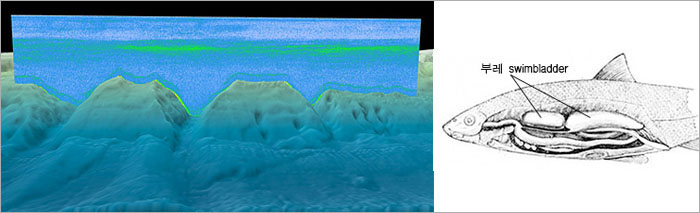 Left/소나 스캔의 정지 화면. 녹색으로 나타난 부분이 심해 산란층이다. 사진은 미국의 해양대기청이 심해 탐사에서 촬영한 것이다. Right/크기가 큰 샛비늘치류의 부레(그림의 종명은 Alburnoides bipunctatus). 이 물고기가 큰 무리로 있으면 부레가 소나의 음파를 반사하여 해저 바닥처럼 보이는 층으로 나타난다. 저자 불명. |
Family Myctophidae(Lanternfishes) Lanternfishes (or myctophids, from the Greek μυκτήρ myktḗr, "nose" and ophis, "serpent") are small mesopelagic fish of the large family Myctophidae. One of two families in the order Myctophiformes, the Myctophidae are represented by 246 species in 33 genera, and are found in oceans worldwide. They are aptly named after their conspicuous use of bioluminescence. Their sister family, the Neoscopelidae, are much fewer in number but superficially very similar; at least one neoscopelid shares the common name 'lanternfish'. Sampling via deep trawling indicates lanternfish account for as much as 65% of all deep-sea fish biomass. Indeed, lanternfish are among the most widely distributed, populous, and diverse of all vertebrates, playing an important ecological role as prey for larger organisms. With an estimated global biomass of 550–660 million metric tonnes, several times the entire world fisheries catch, lanternfish also account for much of the biomass responsible for the deep scattering layer of the world's oceans. A major source of food for many marine animals, lanternfish are an important link in the food chain of many local ecosystems, being heavily preyed upon by whales and dolphins, large pelagic fish such as salmon, tuna and sharks, grenadiers and other deep-sea fish(including other lanternfish), pinnipeds, sea birds, notably penguins, and large squid such as the jumbo squid, Dosidicus gigas. In the Southern Ocean, myctophids provide an alternative food resource to krill for predators such as squid and the king penguin. Although plentiful and prolific, currently only a few commercial lanternfish fisheries exist: limited operations off South Africa, in the sub-Antarctic, and in the Gulf of Oman. Lanternfish themselves have been found to feed on bits of plastic debris accumulating in the oceans. At least one lantern fish was found with over 80 pieces of plastic chips in its gut, according to scientists monitoring ocean plastic in the Pacific Ocean's eastern garbage patch. External characteristics; Lantern fish are generally small fish, ranging from about 2 to 30 cm in length, with most being under 15 cm. Lanternfish typically have a slender, compressed body covered in small, silvery deciduous cycloid scales(ctenoid in four species), a large bluntly rounded head, large elliptical to round lateral eyes (dorsolateral in Protomyctophum species), and a large terminal mouth with jaws closely set with rows of small teeth. The fins are generally small, with a single high dorsal fin, a forked caudal fin, and an adipose fin. The pectoral fins may be large and well-developed to small and degenerate, or completely absent in a few species. Most lanternfish have a gas bladder. The lateral line is uninterrupted. In life, shallow-living species are an iridescent blue to green or silver, while deeper-living species are dark brown to black. Luminous organ; In all but one species, Taaningichthys paurolychnus, a number of photophores(light-producing organs) are present; these are paired and concentrated in ventrolateral rows on the body and head. Some may also possess specialised photophores on the caudal peduncle, in proximity to the eyes(e.g., the "headlights" of Diaphus species), and luminous patches at the base of the fins. The photophores emit a weak blue, green, or yellow light, and are known to be arranged in species-specific patterns. In some species, the pattern varies between males and females. This is true for the luminous caudal patches, with the males' being typically above the tail and the females' being below the tail. The arrangements of lanternfish photophores are different for each species, so their bioluminescence is thought to play a role in communication, specifically in shoaling and courtship behaviour. The concentration of the photophores on the flanks of the fish also indicate the light's use as camouflage; in a strategy termed counterillumination, the lanternfish regulate the brightness of the bluish light emitted by their photophores to match the ambient light level above, effectively masking the lanternfishes' silhouette when viewed from below. Diel vertical migrations; Lanternfish are well known for their diel vertical migrations: during daylight hours, most species remain within the gloomy bathypelagic zone, between 300 and 1,500 m deep, but towards sundown, the fish begin to rise into the epipelagic zone, between 10 and 100 m deep. The lanternfish are thought to do this to avoid predation, and because they are following the diel vertical migrations of zooplankton, upon which they feed. After a night spent feeding in the surface layers of the water column, the lanternfish begin to descend back into the lightless depths and are gone by daybreak. Most species remain near the coast, schooling over the continental slope. Different species are known to segregate themselves by depth, forming dense, discrete conspecific layers, probably to avoid competition between different species. Due to their gas bladders, these layers are visible on sonar scans and give the impression of a "false bottom"; this is the so-called deep-scattering layer that so perplexed early oceanographers. Deep scattering layer; The deep scattering layer, sometimes referred to as the sound scattering layer, is a layer in the ocean consisting of a variety of marine animals. It was discovered through the use of sonar, as ships found a layer that scattered the sound and was thus sometimes mistaken for the seabed. For this reason it is sometimes called the false bottom or phantom bottom. It can be seen to rise and fall each day in keeping with diel vertical migration. Sonar operators, using the newly developed sonar technology during World War II, were puzzled by what appeared to be a false sea floor 300–500 metres(980–1,640 ft) deep at day, and less deep at night. Initially, this mysterious phenomenon was called the ECR layer using the initials of its discoverers. The first people to see these measurements erroneously reported that they had discovered sunken islands. It turned out to be due to millions of marine organisms, most particularly small mesopelagic fish, with swim bladders that reflected the sonar. These organisms migrate up into shallower water at dusk to feed on plankton. The layer is deeper when the moon is out, and can become shallower when clouds pass over the moon. During the day, they return to the dark, cold, oxygen deficient waters of the mesopelagic where they are relatively safe from predators. Lanternfish account for as much as 65 percent of all deep sea fish biomass and are largely responsible for the deep scattering layer of the world's oceans Fish undertake these migrations with the assistance of a swimbladder. The swimbladder is inflated when the fish wants to move up, and, given the high pressures in the messoplegic zone, this requires significant energy. As the fish ascends, the pressure in the swimbladder must adjust to prevent it from bursting. When the fish wants to return to the depths, the swimbladder is deflated. |
|
Left/Static image of a sonar scan conducted by the NOAA Okeanos Explorer in the North Atlantic Ocean. The backscattered signal(green) above the bottom is likely the deep scattering layer. Right/The swim bladder of Alburnoides bipunctatus. The swim bladders of large numbers of mesopelagic fishes cause sonar waves to be reflected in a recognisable layer. Author/Unknown
|
 샛비늘치과(Myctophidae/lanternfishes). 영명/글레이시어 랜턴피시/Glacier lantern 학명/ Benthosema glaciale Left/Author; H. L. Todd. Date/1884. Right/Author; G. Brown Goode. Date/1896 |
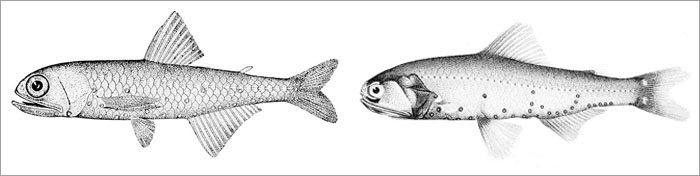 Left/샛비늘치과(Myctophidae/lanternfishes). 한국명/깃비늘치. 영명/Skinnycheek lanternfish 학명/. Benthosema pterotum. Author/Barton Warren Evermann. Date/1907. Right/영명; 길버트 라지 랜턴피시(Gilbert's large lantern fish). 학명/Diaphus adenomas. Author/Barton Warren Evermann. Author/Gilbert, Charles Henry. Date/1905. |
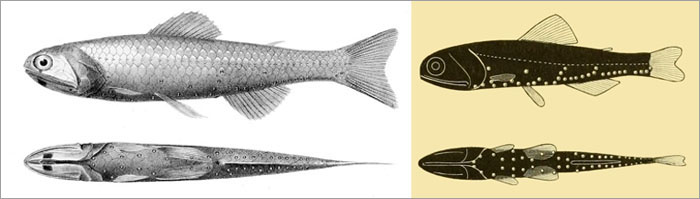 샛비늘치과(Myctophidae/lanternfishes). 영명/블루랜턴피시(Blue lantern fish). 아래 그림은 복부. Lower illustration/ventral view. 학명/Diaphus coeruleus. Left/Author/R. Mintern. Date/1887. Right/ Author/Christian Frederik Lütken. Date/1892 |
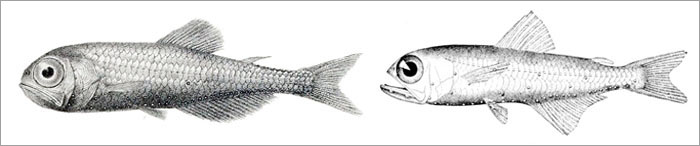 샛비늘치과(Myctophidae/lanternfishes). Left/영명; 남극 랜턴피시(Antarctic lanternfish). 학명/Electrona antarctica. Author/R. Mintern. Date/1887. Right/영명; 버뮤다 랜턴피시(Bermuda lantern fish). 학명/Hygophum hygomii. Author/G. Brown Goode. Date/1896. |
 샛비늘치과(Myctophidae/lanternfishes). Left/한국명; 얼비늘치. 영명/Prickly lanternfish. 학명/Myctophum asperum. Author/G. Brown Goode. Date/1896. Right/한국명; 샛비늘치. 영명/Pearly lanternfish. 학명/Myctophum nitidulum. Author/G. Brown Goode. Date/1896. |
 샛비늘치과(Myctophidae/lanternfishes). 영명/스폿티드 랜턴피시(Spotted lanternfish). 학명/Myctophum punctatum. Left/Author/Emma Kissling. Date/1911. Right/Author/Francesco Costa |


|
| Copyright ⓒ FISHILLUST.COM All rights reserved. All contents can not be used without permission of the copyright holder. |


 검색
 랜턴피시과(샛비늘치과) 어류의 발광기관 배치도와 약칭어. Layout diagram and abbreviations of the luminescent organs of the Lanternfishes(Myctophidae). Derived work from Fishes of Japan, Nakabo, Tokai University Press. Illustrated by Kim in young(fishillust.com)
