
사이트 로그인
사이트 로그인
경골상강→조기강→샛멸목→통안어과 통안어과(또는 귀신고기과) 통안어의 눈은 바렐통 모양의 튜브형으로 생겼고 자신 보다 위에 있는 먹이감의 실루엣을 발견하기 위해 대개 위를 향하고 있다. 그러나 눈을 전방을 향해 돌릴 수도 있다. 과 학명 오피스토프록다이(Opisthoproctidae)의 어원은 그리스어의 opisthe='behind/뒤'와 proktos='anus/항문'이다. 통안어과 물고기들의 체형은 크게 3가지가 있다. 몸이 통통하고 체고가 높은 형(예; Opisthoproctus속과 Macropinna속), 몸이 매우 가늘고 긴 형(예; Dolichopteryx속과 Bathylychnops속), 그리고 이 두 형의 중간형이 있다(예; Rhynchohyalus속과 Winteria속). 통안어과의 모든 종들은 쌍안경 형의 눈을 가졌고 눈이 머리의 큰 부분을 차지 하면서 머리에서 튀어나와 있지만 큰 투명 막의 돔 안에 들어 있다. 투명 막은 부드럽고 유연한 조직이다. 눈의 렌즈와 망막이 크며 간상세포(桿狀細胞, rod cell; 망막에 있는 가늘고 긴 모양의 시세포)와 로돕신rhodopsin;눈의 망막에서 붉은색의 빛을 감지하는 단백질)이 매우 발달해 있다. 추상체Cone Cells, 錐狀體)는 없다. (※추상체; 눈의 망막에 있는 세포의 일종으로, 주로 밝은 곳에서 작용하며 색각 및 시력에 관계한다). 통안어의 머리는 투명한 큰 돔이다. 이 투명 돔 머리는 미약한 빛을 눈으로 모아주는 효과가 있는 동시에 쏘는 자포동물로부터 눈을 보호하는 기능이 있다. 통안어는 해파리 같은 쏘는 자포동물 촉수에 걸려든 먹이를 훔쳐먹는 것으로 알려져 있다. 이 투명 창은 주변부의 근육이나 그 자체에 있는 근육을 조절하여 추가적인 렌즈(수정체) 기능을 가졌을 수도 있다. 또는 해수의 굴절율과 거의 동급으로 빛을 굴절시켜 주는지도 모른다. 통안어과 중의 한 종인 브라운스노우트 귀신고기(Brownsnout spookfish; Dolichopteryx longipes)는 수정체 외에 눈에 별도의 거울이 있어서 이미지의 초점을 맞추는데 이는 모든 척추동물에서 브라운스노우트 귀신고기 (Brownsnout spookfish) 만이 가지고 있는 유일한 특징이다. 입은 정면 앞으로 열리는 터미널 형 입이다. 입에 이빨이 없으며 입은 뾰족한 주둥이 끝에서 마감된다. 살아있을 때 색은 대부분 암갈색이며 기와 모양의 크고 은빛이 나는 비늘이 덮여있다. 그러나 Dolichoptery 속들은 비늘이 없으며 투명한 백색이다. 모든 종들이 검은 멜라닌색소포를 주둥이 부분, 복부 또는 몸 가운데 부분에 가지고 있는데 그 위치와 범위는 종에 따라 다르다. 발광기관은 돌리콥터릭스 속(genus Dolichopteryx), 오피스토프록투스 속(genus Opisthoproctus), 및 윈터리아 속(genus Winteria)이 가지고 있다. 돌리콥터릭스 속은 복부 전체 길이에 걸쳐 여러 개의 발광 기관이 있는 반면에 오피스토프록투스 속은 4각형 파우치 모양으로 1개가 있다. 발광기관은 몸에 있는 공생 발광 박테리아를 통해서 약한 빛을 낸다. 오피스토프록투스 속(genus Opisthoproctus) 종들(예; Opisthoproctus grimaldii 와 Opisthoproctus soleatus)은 복부에서 튀어나온 납작한 판(sole; 신발창)을 가지고 있는데 발산된 빛을 몸 아래쪽으로 반사시킨다. 모든 종의 지느러미들은 아주 작고 가시 기조를 가지고 있지 않다. 그러나 돌리콥터릭스 속은 가슴지느러미가 날개 모양으로 매우 길고 체장의 약 1/2 길이가 된다. 이 가슴지느러미는 물 중간에서 제자리를 유지하는 역할(호버링;hovering)을 하는 것으로 보인다. 가슴지느러미는 몸의 밑 쪽에 달려 있다. 몇 종은 복부나 등에 기름지느러미가 있으며 꼬리지느러미가 상엽과 하엽으로 나뉘어져 있거나 안으로 깊이 패인 형이다. 뒷지느러미는 있거나 또는 심하게 퇴화하여 겉으로 보이지 않는다. 등지느러미는 1개이며 기점은 뒷지느러미 기점에서 약간 앞에 있거나 바로 위에 있다. 대부분 부레가 없으며 측선은 끊겨있는 형이다. 새조골 수는 2개 내지 4개이다. 현재까지 알려진 가장 큰 종은 자벨린 귀신고기(javelin spookfish; 학명/Bathylychnops exilis)이며 50cm(SL) 길이이다. 나머지들은 20cm 이하이다. 통안어들은 수심 400–2,500m 범위에서 산다. 단독 생활을 하며 주야간 수직 이동은 하지 않는다. 태양광이 미치지 못하는 범위에 머물러 있으며 위로 향해있는 예민한 튜브형 눈으로 위쪽을 감시한다. 눈은 망원경 기능이 추가되어 있고 평행 방향을 보기보다는 위를 보는 쪽으로 적응되었다. 눈 망막의 수많은 간상체는 매우 미미한 주변광 속에서 머리 위쪽에 있는 먹이감의 실루엣을 찾아내도록 해준다. 생체발광에서 나오는 빛과 주변광을 정확하게 구별한다. 그리고 망원 시각은 아주 작은 풀랑크톤 동물도 정확하게 찾아서 추적해 갈 수 있다. 번식에 관해 알려진 정보는 별로 없다. 이들은 수 공간에 알을 낳는다. 수정된 알은 플랑크톤으로 부유하며 치자어들은 해류를 따라 흘러 다닌다. 아마도 성어들보다는 얕은 수심에서 부유생활을 하다가 탈바꿈을 하여 성체 모양이 되면 깊은 수심으로 되돌아간다. 돌리콥터릭스 속(Dolichopteryx)의 생체발광과 오피스오프록투스 속(Opisthoproctus)의 신발창(sole) 빛 반사 기능은 자신을 은폐하는 카운터쉐이딩(countershading)을 만들어내는 것으로 믿어진다. 카운터쉐이딩은 몸의 아래 쪽을 밝게 하여 포식자가 올려다볼 때 자신의 실루엣이 수면 쪽의 밝은 빛과 혼합되게 하는 역그늘 은폐술이다. 역그늘 은폐술은 구사하는 물고기들에는 다른 여러 가지 물고기들이 있다. Family Opisthoproctidae(Barreleyes or spookfishes) Description; The morphology of the Opisthoproctidae varies between three main forms: the stout, deep-bodied barreleyes of the genera Opisthoproctus and Macropinna, the extremely slender and elongated spookfishes of the genera Dolichopteryx and Bathylychnops, and the intermediate fusiform spookyfishes of the genera Rhynchohyalus and Winteria. All species have large, telescoping eyes, which dominate and protrude from the head, but are enclosed within a large transparent dome of soft tissue. The opisthoproctid eye has a large lens and a retina with an exceptionally high complement of rod cells and a high density of rhodopsin(the "visual purple" pigment); no cone cells are present. To better serve their vision, barreleyes have large, dome-shaped, transparent heads; this presumably allows the eyes to collect even more incident light and likely protects the sensitive eyes from the nematocysts(stinging cells) of the siphonophores, from which the barreleye is believed to steal food. It may also serve as an accessory lens(modulated by intrinsic or peripheral muscles), or refract light with an index very close to seawater. Dolichopteryx longipes is the only vertebrate known to use a mirror(as well as a lens) in its eyes for focusing images.The toothless mouth is small and terminal, ending in a pointed snout. The living body of most species is a dark brown, covered in large, silvery imbricate scales, but these are absent in Dolichopteryx, leaving the body itself a transparent white. In all species, a variable number of dark melanophores colour the muzzle, ventral surface, and midline. Also present in Dolichopteryx, Opisthoproctus, and Winteria species are a number of luminous organs; Dolichopteryx has several along the length of its belly, and Opisthoproctus has a single organ in the form of a rectal pouch. These organs glow with a weak light due to the presence of symbiotic bioluminescent bacteria, specifically, Photobacterium phosphoreum(family Vibrionaceae). The ventral surfaces of Opisthoproctus species are characterised by a flattened and projecting 'sole'; in the mirrorbelly(Opisthoproctus grimaldii) and Opisthoproctus soleatus, this sole may act as a reflector, by directing the emitted light downwards. In all species, the fins are spineless and fairly small; in Dolichopteryx however, the pectoral fins are greatly elongated and wing-like, extending about half the body's length, and are apparently used for stationkeeping in the water column. The pectoral fins are inserted low on the body. Several species also possess either a ventral or dorsal adipose fin, and the caudal fin is forked to emarginated. The anal fin is either present or greatly reduced, and may not be externally visible. A single dorsal fin originates slightly before or directly over the anal fin. The gas bladder is absent in most species, and the lateral line is uninterrupted. The branchiostegal rays (bony rays supporting the gill membranes behind the lower jaw) number two to four. The javelin spookfish (Bathylychnops exilis) is by far the largest species at 50 centimetres standard length; most other species are under 20 centimetres. Barreleyes inhabit moderate depths, from the mesopelagic to bathypelagic zone, circa 400–2,500 m deep. They are presumably solitary and do not undergo diel vertical migrations; instead, barreleyes remain just below the limit of light penetration and use their sensitive, upward-pointing tubular eyes—adapted for enhanced binocular vision at the expense of lateral vision—to survey the waters above. The high number of rods in their eyes' retinae allows barreleyes to resolve the silhouettes of objects overhead in the faintest of ambient light(and to accurately distinguish bioluminescent light from ambient light), and their binocular vision allows the fish to accurately track and home in on small zooplankton such as hydroids, copepods, and other pelagic crustaceans. What little is known of barreleye reproduction indicates they are pelagic spawners; that is, eggs and sperm are released en masse directly into the water. The fertilized eggs are buoyant and planktonic; the larvae and juveniles drift with the currents—likely at much shallower depths than the adults—and upon metamorphosis into adult form, they descend to deeper waters. The bioluminescent organs of Dolichopteryx and Opisthoproctus, together with the reflective sole(or sandals) of the latter, may serve as camouflage in the form of counterillumination(or countershading). This predator avoidance strategy involves the use of ventral light to break up the fishes' silhouettes, so that (when viewed from below) they blend in with the ambient light from above. Counterillumination is also seen in many other unrelated deep-sea fishes. 통안어과 21종 명단 |
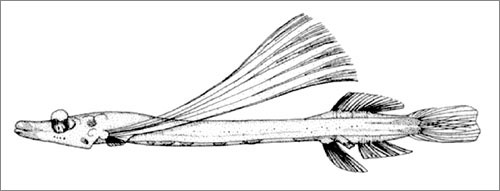 날개쌍안경통안어 묘사도. Illustration of Winged binocular fish(Dolichopteroides binocularis). Illustrator/Susan Laurie Bourque |
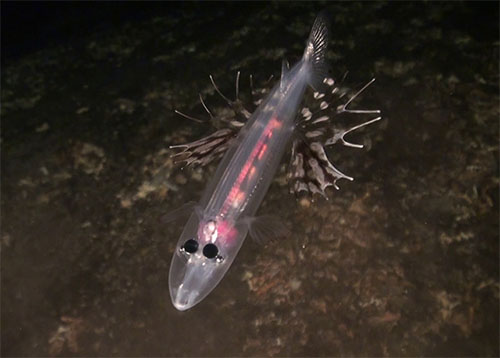 브라운스노우트 귀신고기 Brownsnout spookfish(Dolichopteryx longipes). Locality(촬영 장소 바다)/Canary Islands, Punta de las Cañas, El Hierro. Author/OCEANA. Remark: Oceana allows the use of this image exclusively for educational and/or outreach purposes. |
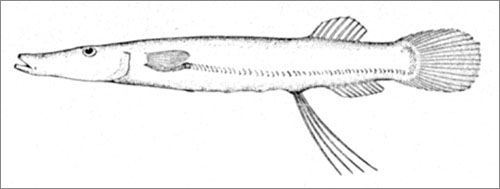 브라운스노우트 귀신고기 묘사도. Illustrated Brownsnout spookfish(Dolichopteryx longipes). Oceanic Ichthyology by G. Brown Goode and Tarleton H. Bean, published 1896. |
 태평양통안어. Pacific barreleye(Macropinna microstoma). Author/Ezra Weller |
 태평양통안어 Pacific barreleye(Macropinna microstoma). Source/Encyclopedia of Canadian fishes. Illustrator/Susan Laurie Bourque |
 샌들 통안어 묘사도. Illustration of Sandalled barreleye (Opisthoproctus soleatus). Date/1906. Author/Brauer, A. |
 샌들 통안어의 모형. 복부에서 튀어나온 납작한 판(sole or sandal 신발창)을 가지고 있는데 생체발광 빛을 몸 아래 물 쪽으로 반사시킨다. Model of Sandalled barreleye(Opisthoproctus soleatus). Location/Natural History Museum in London. Author/Lusanaherandraton. A flattened and projected 'sole or sandal' developed at ventral surfaces, this sole may act as a reflector, by directing the emitted light downwards. |
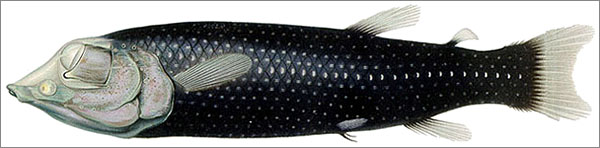 쌍안경통안어 묘사도. Illustrated Binocular fish(Winteria telescopa). From Brauer, A., 1906. |
|
Copyright ⓒ FISHILLUST.COM All rights reserved. All contents can not be used without permission of the copyright holder. |


 검색


