분류계보/경골상강(Superclass Osteichthyes)→조기강(Class Actinopterygii)→열대송사리목(Order Cyprinodontiformes)→태생열대송사리과(Family Poeciliidae)
태생열대송사리과(포에킬리아과) Family Poeciliidae(Poeciliids, Livebearers)
태생열대송사리과(포에킬리아과)는 담수어 군이며 구피(guppy), 몰리(molly), 플라티(platy), 스워드테일(swordtail) 같은 잘 알려진 태생 관상어들을 포함하고 있는 과이다. 총 29속에 273종이 알려져 있다. 모두 담수어이지만 유일하게 로우랜드 리브베어러(Lowland livebearer; Poeciliopsis latidens)는 해수어이다.
원래 분포지는 동남부 미국에서 아르헨티나 동북부까지, 그리고 마다가스카르를 포함한 아프리카였다. 관상어 개체들이 방류되고 모기 퇴치를 위해 포에킬리아 속(Poecilia)과 감부시아 속(Gambusia) 종들이 널리 사용되면서 오늘날 이들은 전세계 열대와 아열대 지방에서 발견된다. 또한 이 두 속의 물고기들은 캐나다 앨버타주 밴프시 북부 지방의 온천수 웅덩이에서도 발견된다.
태생열대송사리과 명칭의 “태생”은 알을 낳지 않고 새끼를 바로 낳는다는 뜻이다. 그러나 태생열대송사리과의 모든 종이 태생은 아니며 일부 속(Aplocheilichthys 속과 Hylopanchax 속)은 정상적으로 알을 낳는다. 엄밀히 말하면 새끼를 바로 낳는 방식은 태생과 난태생으로 구분되며 순 태생은 모체에 알이 형성되지 않고 포유동물처럼 출산하는 것이며 난태생은 모체에 알이 형성되고 수컷의 정자가 모체에 투입되어 체내 수정을 일으킨 다음에 모체 안에서 알이 부화한 다음 체외로 새끼를 내보내는 방식이다. 태생열대송사리과에서 의미하는 태생(livebearers)은 난태생인 것으로 보인다. 또 하나의 특이한 예외는 남아메리카의 한 종(Tomeurus gracilis)인데 이 물고기는 수컷이 암컷의 몸에 정자를 투입하여 알을 수정(체내수정)시킨 다음에 체내 부화를 하지 않고 수정된 알을 수초에 붙여 낳는다. 그러나 또한 이들은 경우에 따라 새끼를 바로 낳을 수도 있다. 어떤 종은 모든 개체가 암컷이며 수컷이 없는데 이들의 알은 다른 종의 수컷이 살포한 정액에 의해 자극을 받아 실제 수정 없이 알이 부화된다. 이를 전문용어로 처녀생식(處女生殖/parthenogenesis)이라고 한다.
종명이 혼란스러운 여러 변형 몰리(molly)
태생열대송사리과(Family Poeciliidae)에는 영명으로 몰리(molly), 학명 “포에실리아 스페놉스; Poecilia sphenops)”라는 물고기가 있다. 몰리는 짧은지느러미 몰리(short-finned molly) 또는 “보통 몰리(common molly)”라고도 부른다. 멕시코에서부터 콜롬비아까지 하천, 기수 및 해수에서 사는 물고기이다. 야생 개체들은 색상이 별로 아름답지 않은 은빛이다. 그러나 몰리는 같은 속의 다른 종들과 잡종교배가 잘되어 아름다운 변형 품종이 만들어진다. 잡종 교배는 야생에서도 일어난다. 특히 세일핀 몰리((Sailfin molly; Poecilia latipinna)와의 잡종 교배가 흔하다. 수족관 어류 연구자들은 여러 가지 변형 색상의 몰리 품종들을 만들어 냈으며 약 6 가지 아름다운 변형 품종들이 관상어로 널리 유통되고 있다.
그런데 이들 변형 몰리들의 학명에 혼선이 일어나 있어서 관심을 가진 사람들이 불편을 겪고 있다. 몰리의 다양한 품종(strains)에 대하여 서술한 글은 어류학적으로 전문적인 사이트에서는 발견되지 않는다. 관상어 업계의 수많은 업체들이 그들의 상품을 홍보하는 과정에서 학명이 표기되고 있는데 이들이 발표하는 학명에 일관성이 없다.그래서 혼란이 일어나 있는 것이다. 주로 몰리(Poecilia sphenops)와 세일핀 몰리(Poecilia latipinna) 2 종 사이에서 혼선이 나타나 있다. 잡종을 몰리 쪽에서 보는가 또는 세일핀 몰리 쪽에서 보는가에 따라 학명에 혼선이 일어나고 있는 것이 아닌가 추측되지만 문외한인 필자는 사실을 알 수가 없다.
이 페이지에 소개된 여러 사진은 모두 학명이 표시되어 있는데 Poecilia sphenops나 Poecilia latipinna로 표기된 것들은 사진의 제공자들이 표기한 것이며 따라서 독자들은 옳고 그름의 확실성이 없음을 감안하고 보아야 한다. 필자는 이 분야의 정보를 자세히 알아볼 만큼 시간 여유가 없기 때문에 관상어 몰리의 변형에 대해 두리뭉실한 소개를 해놓을 수 밖에 없다.
여러 잡스러운 정보들 중 그런대로 잘 정리된 편인 글에서 몰리(Poecilia sphenops)에는 약 6가지 변형 품종이 있다고 하였다(오리지널 야생 타입 제외). 이 글의 흐름으로 보면 6가지 변형 품종들의 학명은 모두 Poecilia sphenops로 상정된다. 잡종과 선발육종이 혼재되어 있을 수 있다(2023년 3월 정보 기준)..
1. 블랙 몰리(Black molly); 몸 전체가 검정색을 띠도록 선별 육족을 한 품종이다. 관상어로 잘 알려진 품종이며 사육이 쉽고 구피(guppy)처럼 다산한다.
2. 화이트 몰리(White molly); 백색 품종이다.
3. 금빛 몰리(Golden molly); “24 캐럿(karat)”이라는 별명을 가지고 있다.
4. 풍선 몰리(Balloon molly); 유전자 결함으로 척추가 변형되어 풍선 모양이 되었다. 선별 육종을 통해 널리 보급되고 있다. 풍선 몰리는 자체 번식을 할 수 있으며 다른 몰리 품종들과 마찬가지로 정상적인 생활을 할 수 있다. 그러나 유전자 결함 때문에 수명이 짧고 건강 문제가 있다는 설이 있다.
5. 리라테일 몰리(Lyretail): 꼬리지느러미 모양을 변형시킨 종이다. 리라(Lyre)는 서양의 고대 현악기 이름이다.
6. 달마시안 몰리(Dalmatian molly); 은빛 바탕에 검은색 점들이 산재한다. 달마시안의 원 뜻은 개량한 개의 한 품종이며, 흰 바탕에 검은색 점무늬를 가졌다.
Family Poeciliidae(Poeciliids, Livebearers)
The Poeciliidae are a family of freshwater fishes of the order Cyprinodontiformes, the tooth-carps, and include well-known live-bearing aquarium fish, such as the guppy, molly, platy, and swordtail. Known 29 genera with 273 species worldwide. All species are fresh water fishes but the only one species, Poeciliopsis latidens, lives in true marine waters.
The original distribution of the family was the Southeastern United States to northeastern Argentina, and Africa, including Madagascar. Due to release of aquarium specimens and the ㅋwidespread use of species of the genera Poecilia and Gambusia for mosquito control, though, poeciliids can today be found in all tropical and subtropical areas of the world. In addition, Poecilia and Gambusia specimens have been identified in hot springs pools as far north as Banff, Alberta.
The English name “Livebearers” of family Poeciliidae means that they give birth right away without laying eggs. However, not all species of Poeciliidae are livebearers, and some genera (Aplocheilichthys and Hylopanchax) lay eggs normally. Strictly speaking, the method of giving birth right away is divided into viviparous and ovoviviparous. In pure viviparous, eggs are not formed in the mother's body and give birth like mammals. In ovoviviparous, eggs are formed in the mother's body, male sperm are injected into the mother's body to cause internal fertilization, and then the eggs hatch in the mother's body and are then released outside the body. The name “Livebearers”, appear to be ovoviviparous. Another unusual exception is a South American species “Tomeurus gracilis”, in which the male injects sperm into the female's body to fertilize the eggs(internal fertilization), then mother attaches the fertilized eggs onto aquatic plants. They can also be facultively ovoviviparous. Some species with all-female individuals, their eggs capable of developing when stimulated by the sperm of another species without fertilization(Parthenogenesis).
Confusion of species name in Molly variants
In the family Poeciliidae, there is a fish called “Molly” of which scientific name is Poecilia sphenops, also called as short-finned molly or "common molly". They inhabit fresh water streams and coastal brackish and marine waters from Mexico to Colombia. The wild-type fishes are dull, silvery in color.
However, molly does well to hybridize with other species of the same genus, resulting in beautiful strains. Hybridization also occurs in the wild. Crossbreeding with the sailfin molly(Poecilia latipinna) is particularly common. Aquarium fish researchers(aquarists) have created molly varieties in several color variations, and about half a dozen beautiful variations are widely distributed as ornamental fish.
However, there is confusion in the scientific names of these modified mollies, causing inconvenience to those who are interested. Articles describing the various strains of molly are not found on ichthyologically specialized sites. Numerous companies in the ornamental fish industry are displaying scientific names in the process of promoting their products, but the scientific names they announce are inconsistent. This is why confusion occurs. Cross-talk appears mainly between two species, the molly (Poecilia sphenops) and the sailpin molly (Poecilia latipinna). It is presumed that there is confusion in the scientific name depending on whether the hybrid is viewed from the Molly side or the Sailfin Molly side, but I, as an outsider, cannot know the facts.
The various photos introduced on this page are all labeled with scientific names, but those labeled as Poecilia sphenops or Poecilia latipinna are notated by the contributors of the photos, so readers should take into account that there is no certainty of right or wrong. Since I don't have enough time to dig into the information in this area, I can't help but give a vague introduction to the variations of the ornamental fish molly.
In an article that is reasonably well organized among the miscellaneous informations, it is said that there are about 6 variants of molly(Poecilia sphenops), except the original wild type. According to the flow of this article, the scientific names of all six modified varieties are assumed to be Poecilia sphenops. Hybrids and selective breeding may be mixed(based on information as of March 2023).
1. Black molly: It is a melanistic breed which are black all over. It is one of the most well-known aquarium fishes and nearly as easy to keep and prolific as guppies.
2. White molly: A white colored molly.
3. Golden molly: Nicknamed the "24 karat".
4. Balloon molly: This fish has a deformed spine due to a genetic defect that gives it its appearance. Through selective breeding it is now widely available. Balloon mollies can still reproduce and live a normal life comparable to that of other mollies, but it has garnered controversy due to the belief that its defect gives it a shortened lifespan and a susceptibility to health problems.
5. Lyretail: A breed with an altered caudal fin structure.
6. Dalmatian molly: A silver colored breed with black speckles.
|

 나이프 태생송사리(Knife Livebearer; Alfaro cultratus). 중앙아메리카 산. 관상어로 거래됨. Distribution/Central America: Costa Rica, Panama and Nicaragua. Often kept in home aquaria. Max length/7.5 cm TL. Author/Haplochromis
 톱 송사리(Top minnow; Belonesox belizanus). 중앙아메리카 산. 관상어로 거래됨. Distribution/North and Central America Often kept in home aquaria. Max length/9.7 cm TL. Author/Vassil
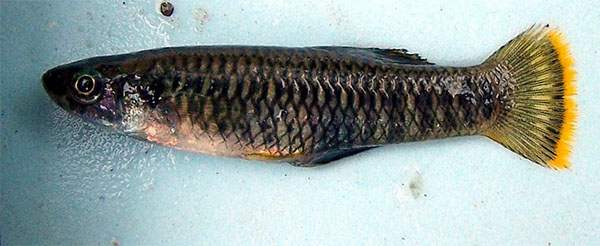 랍도포라 송사리(Rhabdophora olomina; Brachyrhaphis rhabdophora). 중앙아메리카 산. 관상어로 거래됨. Distribution/North and Central America Often kept in home aquaria. Max length/6.0 cm SL Author/Josh Rasmussen. ※The English name is temporary(영명은 필자가 지은 임시명임).
 모기고기(Mosquitofish; Gambusia affinis). 북미와 중앙아메리카 산. Distribution/North and Central America. Max length/5.1 cm TL. 새끼를 포유동물처럼 어미의 몸 속에서 잉태시키는 태생어이다. 수컷의 뒷지느러미가 성기로 변형되어 암컷과 짝짓기를 할 수 있다. 모기고기라는 이름은 이 물고기가 모기의 애벌레(장구벌레)를 잘 잡아먹어서 모기 퇴치에 많이 이용되고 있기 때문에 붙여졌다. The species is viviparous. Internal fertilization is possible because the anal fin of the male is modified into a copulatory organ. The name "mosquitofish" was given because the fish eats mosquito larvae, and has been used more than any other fishes for the biological control of mosquitoes. Author/Left; Samuel Frederick Hildebrand(1883–1949). Right; Materialscientist
 모기고기(Mosquitofish; Gambusia affinis). 중앙아메리카 산. Distribution/North and Central America. Japanese name/Kadayashi. Max length : 5.1 cm TL. Author/NOZO
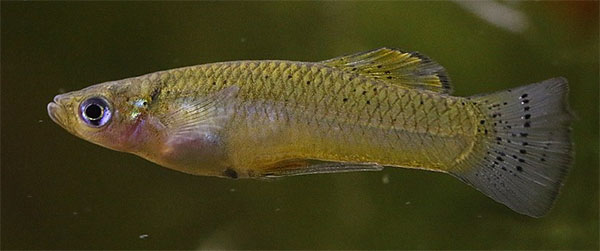
 눈물방울 모기고기(Teardrop mosquito; Gambusia sexradiata). A female photo. Max length/2.6 cm SL male, 3.5 cm SL(female). Distribution/North America: Mexico. Author/Volker Wirth


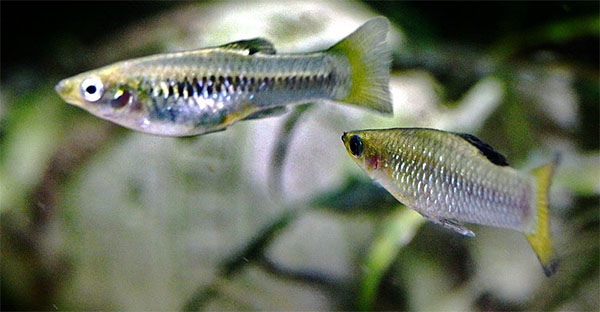 페루지아스 리미아(Perugia's limia; Limia perugiae). 중앙아메리카 도미니카 공화국 산. 관상어로 거래됨. 태생어로 임신 24일 후에 10-100 마리 새끼를 낳는다. Distribution/Central America: Dominican Republic, found in the aquarium trade. Max length/10.0 cm TL male). After 24 days gestation, female gives birth to 10-100 young. Author/Usien
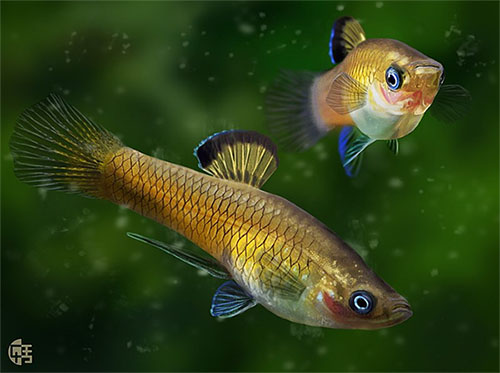 티코 올로미나(Tico olomina; Phallichthys tico). 중앙아메리카 코스타리카 산후안강 산. 관상어로 거래됨. Distribution/Central America: Upper San Juan River in Costa Rica, found in the aquarium trade. Max length/2.5 cm SL(male), 3.5 cm SL(female). Author/José Fabricio Vargas Murillo. ※The English name is temporary(영명은 필자가 지은 임시명임).
 미드 나이트 몰리의 수컷(Male Midnight molly; Poecilia latipinna). 미드 나이트 몰리는 Poecilia latipinna(Sailfin molly)와 Poecilia sphenops(Molly)의 잡종이다. 학명은 Poecilia latipinna로 표기되지만 Poecilia sphenops로 표기되기도 해서 혼선이 일어나 있다. 필자도 어떤 학명이 맞는 것인지 알지 못한다. 미국 노스캐롤라이나주에서부터 멕시코의 베라쿠르즈까지 분포. 관상어로 거래됨. Midnight Molly is a hybrid between Poecilia latipinna(Sailfin molly) and Poecilia sphenops(Molly). The scientific name is written as Poecilia latipinna generally, but it is also written as Poecilia sphenops, so there is confusion. I don't even know which scientific name is correct. Distribution/North America: Cape Fear drainage in North Carolina, USA to Veracruz, Mexico, found in the aquarium trade. Max length/Max length/15.0 cm TL(male), 10.0 cm TL(female). Author/Darkmax.
 text on preparation
 text on preparation
 text on preparation
 text on preparation
 text on preparation
 text on preparation
 text on preparation
 text on preparation
 text on preparation
 text on preparation
 text on preparation
 text on preparation
 text on preparation




 검색
