사이트 로그인
사이트 로그인
경골상강/Superclass Osteichthyes(bony fishes)→조기강/Class Actinopterygii(ray-finned fishes)→철갑상어목 Order Acipenseriformes→Family Polyodontidae Primary freshwater |
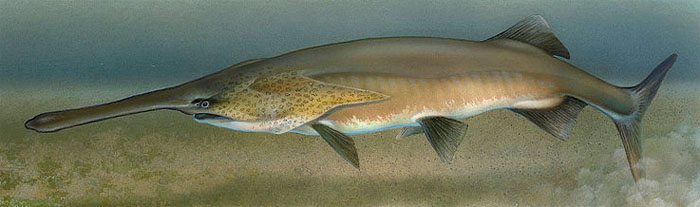 미시시피 패들피시(Polyodon spathula/아메리카 패들피시) 그림. Image of American paddlefish (Polyodon spathula). Source/US Fish and Wildlife Service. Author/Timothy Knepp |
 미시시피 패들피시(아메리카 패들피시)의 복면. Under view of Mississippi paddlefish(American paddlefish/Polyodon spatula). Date/1884. Author/Goode, George Brown. |
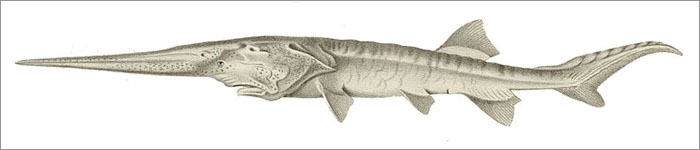 중국 패들피시 이미지. Image of Chinese paddlefish(Psephurus_gladius). Source Wikimedia(File:Psephurus_gladius_(flipped).jpg) |
|
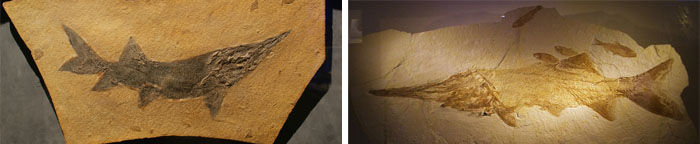
주걱철갑상어(Paddlefish)는 철갑상어와 함께 철갑상어목에 묶이는 물고기이다. 주걱철갑상어는 한국에 분포하지 않는 물고기여서 공식적인 한국 물고기 명단의 이름은 아닌 것 같고 두산백과 인터넷 사전이나 인터넷 영한 사전에 나오는 이름이다. 주걱철갑상어라는 이름은 이 물고기가 상어가 아니어서 혼동을 일으키며 철갑상어(역시 상어가 아님)처럼 몸이 골판 조각들로 보호되어있지도 않아 왜 “철갑”이란 말이 이름에 쓰였는지도 혼동을 일으킨다. 영명으로는 작은 보트를 젓는 노(주걱) 같이 생긴 주둥이 위턱 모양을 따서 패들피시(Paddlefish)라고 한다. 주걱철갑상어(패들피시)는 조기어류(條鰭魚類)의 원조격인 물고기로 뼈대 성분이 연골어류와 경골어류의 중간쯤 되는 연질어류이며 분류는 경골어류에 들어간다. 이 물고기의 조상 화석은 7천만년~7천5백만년 전 백악기 후기에서부터 발견되어 있는데 지금까지 외형이 크게 변하지 않아 “원시 물고기”라는 별칭을 갖고 있다. 주걱철갑상어류(패들피시)는 북아메리카와 중국에만 분포한다. 현생 종은 2종이 있고 멸종된 화석 종은 4종이 있는데 화석 종 3종은 모두 북아메리카 서부에서, 나머지 1종은 중국에서 발굴된 것이다. 현생 2종은 미시시피 패들피시(Mississippi paddlefish /Polyodon spathula)와 차이니스 패들피시(Chinese paddlefish/Psephurus glades; 중국주거철갑상어)이다. 미시시피 패들피시는 미국 미시시피강 수계에 사는 종으로 아메리카 패들피시(American paddlefish)라고도 한다. 차이니스 패들피시(중국주걱철갑상어)는 중국 양자강 수계가 본향이다. 차이니스 패들피시는 “중국 검고기(Chinese swordfish)” 또는 “코끼리고기(elephant fish)”라고도 부른다. 주걱철갑상어류(패들피시)는 긴 세월을 살아오는 동안 남획과 오염과 인간들의 개발사업으로 인한 서식지 잠식과 본능적으로 찾아가는 산란지행 길목을 막아버리는 댐 건설 등에 의해 그 개체 수가 대폭 감소해 왔다. 강을 개보수해서 자연적인 물길에 변화를 주는 것도 산란지의 특성과 유어들에게 적합한 환경에 악영향을 끼친다. 중국 패들피시는 2007 이후로 발견되지 않아 멸종된 것으로 보이며 미국에서도 이런 환경 악화는 진행되어 있다. 외형적 특징 미시시피 패들피시는 플랑크톤 여과섭식자인 반면 중국 패들피시는 주로 물고기를 잡아먹는 육식성 포식자이다. 중국 패들피시는 부리가 더 앞으로 길면서 좁고 뾰족한데 이는 헤엄치면서 입에 들어오는 작은 물고기를 잡아먹으며 가끔 새우나 바닥의 게도 잡아먹는다는 사실을 나타낸다. 미시시피 패들피시의 부리는 전적으로 여과섭식에 적응된 구조이다. 주로 동물플랑크톤을 먹고 곁들여 작은 곤충, 곤충 애벌레, 작은 물고기도 삼킨다. 중국 패들피시는 최대어 기록이 7.0 m이며 최대 수백 킬로그램이 나간다. 보통 크기가 3.0m에 무게가 500 kg이다. 미시시피 패들피시도 북아메리카에서는 큰 민물고기에 들어가지만 보통 길이1.5m에 무게 27kg으로 중국 패들피시에 비해서는 아주 작다. 미시시피 패들피시 최대어 기록은 1916년에 작살로 잡힌 2.16 m 짜리이다. 과학자들은 패들피시의 부리가 바닥의 흙은 파내는 용도일 것으로 생각했었으나 전자현미경으로 연구해 본 결과 부리에 전류감지기관이 들어있었다. 이는 로렌지니의 팽대부(Ampullae of Lorenzini)와 유사한 감각기관이다. Ampullae of Lorenzini는 상어의 주둥이와 머리에 있는 전류감지기관을 말한다. 패들피시의 전류감지기관은 물에 있는 먹이감에서 나오는 미미한 전류만 감지하는 것이 아니라 동물플랑크톤들이 헤엄치면서 부속지들을 움직이는 파장까지 감지한다. 수명과 번식 양식 기술 |
|
Primary freshwater |
|
Paddlefish(family Polyodontidae) are basal Chondrostean ray-finned fish. They have been referred to as "primitive fish" because they have evolved with few morphological changes since the earliest fossil records of the Late Cretaceous, seventy to seventy-five million years ago. Polyodontids are exclusively North American and Chinese. There are six known species: four extinct species known only from fossil remains(three from western North America, one from China), and two extant species, including the American paddlefish(Polyodon spathula) which is native to the Mississippi River basin in the U.S. and the critically endangered Chinese paddlefish(Psephurus glades) which is endemic to the Yangtze River Basin in China. Chinese paddlefish are also commonly referred to as "Chinese swordfish", or "elephant fish".
Paddlefish populations have declined dramatically throughout their historic range as a result of overfishing, pollution, and the encroachment of human development, including the construction of dams that have blocked their seasonal upward migration to ancestral spawning grounds. Other detrimental effects include alterations of rivers which have changed natural flows resulting in the losss of pawning habitat and nursery areas. Chinese paddlefish have not been seen since 2007, and may now be extinct for many of the same
|
 미시시피 패들피시로 만든 캐비어. 패들피시의 캐비어는 전통적인 오리지널 캐비어는 아니지만 캐비어로 취급해 준다. Tin of freshly processed Mississippi paddlefish caviar. Paddlefish caviar is not traditional caviar, but included in regular caviar category defined by the United Nations' Food and Agriculture Organization. Author/Earthwave Society. |
reasons that have plagued of the American species.
Morphology Unlike the filter-feeding American paddlefish, Chinese paddlefish are piscivores, and highly predaceous. Their jaws are more forward pointing which suggest they forage primarily on small fishes in the water column, and occasionally on shrimp, benthic fishes, and crabs. The jaws of the American paddlefish are distinctly adapted for filter feeding only. They are ram suspension filter feeders with a diet that consists primarily of zooplankton, and occasionally small insects, insect larvae, and small fish. The largest Chinese paddlefish on record measured 7.0 m in length, and was estimated to weigh a few thousand pounds. They commonly reach 3.0m and 500 kg). Although the American paddlefish is one of the largest freshwater fishes in North America, their recorded lengths and weights fall short in comparison to the larger Chinese paddlefish. American paddlefish commonly reach 1.5 m or more in length and can weigh more than 27 kg. The largest American paddlefish on record was caught in 1916 in Okoboji Lake, Iowa. The fish was taken with a spear, and measured 2.16 m long and 1.16 m in the girth. Scientists once believed paddlefish used their rostrums to excavate bottom substrate, but have since determined with the aid of electron microscopy that paddlefish have electroreceptors on their rostrum's ampulla(hair cells) which are similar in structure to other Lorenzini. The electroreceptors can detect weak electrical fields which not only signal the presence of prey items in the water column, such as zooplankton which is the primary diet of the American paddlefish, but they can also detect the individual feeding and swimming movements of zooplankton's appendages. Life cycle Propagation and culture They were introduced into several rivers in Europe and Asia, and provided the first broodstock that were successfully reproduced in 1984–1986 in Russia. Paddlefish are now being raised in Germany, Austria, the Czech Republic, and the Plovdiv and Vidin regions in Bulgaria. Reproduction was successful in 1988 and 1989, and resulted in the exportation of juvenile paddlefish to Romania and Hungary. In May 2006, specimens of different sizes and weights were caught by professional fisherman near Prahovo in the Serbian part of the Danube River. In 1988, fertilized paddlefish eggs and larvae from Missouri hatcheries were first introduced into China. Since that time, China imports approximately 4.5 million fertilized eggs and larvae every year from hatcheries in Russia, and the United States. Some of the paddlefish are polycultured in carp ponds, and sold to restaurants while others are cultured for brood stock and caviar production. China has also exported paddlefish to Cuba, where they are farmed for caviar production. Paddlefish have become of increasing interest to the aquaculture community in recent years, particularly as a potential new source of seafood and caviar. Native to North America, paddlefish show great promise both domestically and internationally as a commercially viable farmed species. |


|
| Copyright ⓒ FISHILLUST.COM All rights reserved. All contents can not be used without permission of the copyright holder. |


 검색