
사이트 로그인
사이트 로그인
경골상강/Superclass Osteichthyes(bony fishes)→조기강/Class Actinopterygii(ray-finned fishes)→이악어목 Lampriformes→ 산갈치과는 2속 3종 밖에 없는 식구가 작은 과이다. 한국 분포 종은 산갈치(Regalecus russelii) 1종이다. 산갈치과 물고기는 길이가 매우 길고 큰 원양성 어류이다. 드물게 발견되지만 온대 열대에 걸쳐 널리 분포한다. 산갈치류 중 자이언트 오어피시(Giant oarfish; 왕산갈치/임시명, 학명/Regalecus glesne)는 공인 최대 기록이 8m, 또는 11 m로 불확실하게 알려져 있으며 기네스 북에 경골어 중 가장 큰 물고기로 등재되어 있다. 그러나 이것이 물고기 중 가장 큰 물고기는 아니다. 더 큰 물고기는 연골어류에 있다. 고래상어나 돌묵상어가 더 크고 물론 체중도 비교가 안 된다. 영명 Oarfish(노고기)가 지어진 연유는 아마 이 물고기가 옆으로 매우 납작하고 길어서이거나 또는 근거 없는 이야기로 밝혀졌지만 이 물고기가 배지느러미를 노처럼 저어 물속을 다닌다는 설에서 나왔을 것 같다. 과의 학명 리갈리시디(Regalecidae)의 어원은 라틴어 regalis이며 영어로 "royal(왕)"이란 뜻이다. 산갈치류는 폭풍 때 해변에 좌초하는 일이 가끔 발생하고 병들거나 죽게 되었을 때 수면에 떠 어른거린다. 이런 현상 때문에 과거에 많은 바다 뱀 괴물 이야기가 만들어진 것으로 보인다. 대형 산갈치는 스포츠 낚시 대상어가 되는 경우가 있고 매우 드물게 어업적으로 잡기는 하지만 산갈치가 산채로 잡히는 일은 매우 희소하다. 산갈치는 점액이 많이 흘러서 식용으로 인기가 없다. 산갈치과 어류는 등지느러미가 눈 위에서 시작되어 몸 전체 길이에 놓여있다. 약 400개 기조로 이루어져 있고 맨 앞의 10~13개 기조는 머리의 볏처럼 보이며 매우 길다. 이 볏 기조들은 붉은 점들이 찍혀 있고 끝에 피편들이 장식처럼 붙어 있다. 배지느러미도 이와 비슷하게 매우 길고 장식되어 있으며 기조 수는 한개 뿐이다. 가슴지느러미는 매우 작게 축소되었고 몸 아래 쪽에 붙어있다. 뒷지느러미는 없으며 꼬리지느러미는 위축되었거나 없으며 꼬리부분은 뒤로 가면서 아주 가늘게 끝난다. 지느러미들에는 가시가 없다. 뉴질랜드에서 어류학자가 산갈치를 만졌더니 전기 쇼크가 일어났다는 딱 한번의 사례가 있다. 이악어목의 다른 과 물고기들과 마찬가지로 산갈치류는 매우 멀리 앞으로 튀어나갈 수 있는 입을 가졌다. 입은 작은 편이며 턱에는 눈으로 식별되는 정도의 이빨은 없다. 몸에는 비늘이 없으며 피부는 구아닌 성분의 은분으로 덮여 있으며 잘 벗겨진다. 스트림어 피시(Streamer fish; 학명/Agrostichthys parkeri)는 피부가 단단한 돌기들로 덮여있다. 모든 종이 부레가 없다. 아가미 갈퀴 수는 종마다 다르다. 산갈치류는 색상이 여러 가지이다. 체측에는 대부분 불규칙한 청색 내지 검은 줄무늬, 검은 점, 구불구불한 선들이 있다. 이 무늬들은 죽으면 금방 없어진다. 산갈치류 중에서 가장 큰 종은 자이언트 오어피시(Giant oarfish/왕산갈치)이며 비공인 크기는 17m에 체중 270kg가 주장되기도 한다. 스트림어 피시는 길이가 3m이다. 산갈치(Regalecus russelii)는 최대어 기록이 5.4m라는 기록도 있고 8m라는 기록도 있다. 산갈치류는 주로 크릴새우류, 새우, 기타 갑각류 같은 동물플랑크톤을 먹으며 그 외에 작은 물고기, 해파리, 오징어 등을 먹는다. 산갈치류는 대형 포식자들에게 잡아먹힌다.
3 Species in Family Regalecidae 2 Genera, 3 Species worldwide, 1genus with 1species in Korea. Oarfish are large, greatly elongated, pelagic lampriform fish belonging to the small family Regalecidae. Found in all temperate to tropical oceans yet rarely seen. One of these, the giant oarfish(Regalecus glesne), is the longest bony fish alive, growing up to 11 m(36 ft) in length. That is not enough to qualify as the longest fish, however, as some of the cartilaginous fish such as the basking shark and whale shark are even longer. The common name oarfish is thought to be in reference either to their highly compressed and elongated bodies, or to the now discredited belief that the fish "row" themselves through the water with their pelvic fins. The family name Regalecidae is derived from the Latin regalis, meaning "royal". The occasional beachings of oarfish after storms, and their habit of lingering at the surface when sick or dying, make oarfish a probable source of many sea serpent tales. Although the larger species are considered game fish and are fished commercially to a minor extent, oarfish are rarely caught alive; their flesh is not well regarded for eating due to its gelatinous consistency. The dorsal fin originates from above the(relatively large) eyes and runs the entire length of the fish. Of the approximately 400 dorsal fin rays, the first 10 to 13 are elongated to varying degrees, forming a trailing crest embellished with reddish spots and flaps of skin at the ray tips. The pelvic fins are similarly elongated and adorned, reduced to one to five rays each. The pectoral fins are greatly reduced and situated low on the body. The anal fin is completely absent and the caudal fin may be reduced or absent, as well, with the body tapering to a fine point. All fins lack true spines. At least one account, from researchers in New Zealand, described the oarfish as giving off "electric shocks" when touched. Like other members of its order, the oarfish has a small yet highly protrusible oblique mouth with no visible teeth. The body is scaleless and the skin is covered with easily abraded, silvery guanine. In the streamer fish(Agrostichthys parkeri), the skin is clad with hard tubercles. All species lack gas bladders and the number of gill rakers is variable. Oarfish coloration is also variable; the flanks are commonly covered with irregular bluish to blackish streaks, black dots, and squiggles. These markings quickly fade following death. The giant oarfish is by far the largest member of the family with unconfirmed reports of 17 m specimens—and 270 kg in weight. The streamer fish is known to reach 3 m in length, while the largest recorded specimen of Regalecus russelii measured 5.4 m(but 8m in Fishbase. Org). Oarfish feed primarily on zooplankton, selectively straining tiny euphausiids, shrimp, and other crustaceans from the water. Small fish, jellyfish, and squid are also taken. Large open-ocean carnivores are all likely predators of oarfish. |
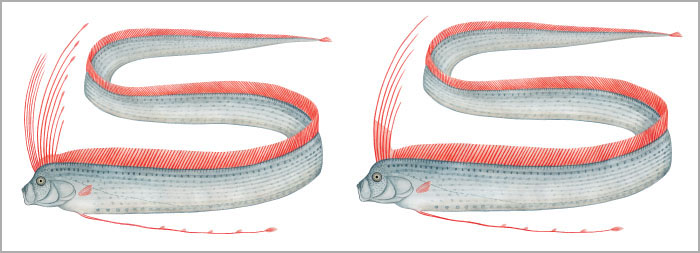 Left/왕산갈치(Giant oarfish; Regalecus glesne). Author/Kim In Young. Right/산갈치(Oarfifsh; Regalecus russelii). Author/Kim In Young. |
 왕산갈치(Giant oarfish; Regalecus glesne). 장소/아르헨티나. Country: Argentina. Author/Gosztonyi, Atila Esteban |
 산갈치(Oarfish). 해변에 좌초된 산갈치(Oarfifsh, 학명; Regalecus russelii)와 주민들의 기념 촬영 사진. 년도는 1907년. 장소는 미국 캘리포니아 오렌지 카운티 해변. Oarfish, Regalecus russelli, on the beach at Newport, Orange Co., Cal. Authors/Jordan, David Starr(1851-1931). 소장/Contributing/Smithsonian Libraries. |
 서구사회의 괴물 바다 뱀 전설은 그 근원의 일부 또는 전부가 왕산갈치에서 유래한 것으로 알려져있다. Tales of sea serpents were either partially or perhaps wholly inspired by the oarfish, otherwise known as the king of herrings. Unlike the mythical sea serpent, however, the oarfish is teethless and quite harmless. Left/출처; Source/History of the Northern Peoples, Rome, 1555. Right/출처; Source/The "Great Sea Serpent" according to Hans Egede(1734 illustration) |


|
| Copyright ⓒ FISHILLUST.COM All rights reserved. All contents can not be used without permission of the copyright holder. |


 검색
