
사이트 로그인
사이트 로그인
경골상강/Superclass Osteichthyes(bony fishes)→조기강/Class Actinopterygii(ray-finned fishes)→골표상목/Superorder Ostariophysi→카라신목/Order Characiformes(Characins)→세라살무스과 Family Serrasalmidae(Serrasalmus). 세라살무스과 Family Serrasalmidae(Serrasalmus) Family 119-1 세라살무스과는 카라신과(Characidae)의 아과로 있다가 최근에 과로 승격했지만 다른 속들과의 관계가 애매한 점이 많이 남아있다. 피라냐로 분류되는 무리들과 바로 그 옆 인척 무리들과의 관계도 분류계통학적으로 불안정적이다. 세라살무스과는 약 98종을 가지고 있으며 일반명으로는 피라냐(piranha), 파쿠(pacu), 실버 달러(silver dollar), 3가지 이름으로 종류가 나뉜다. 이 이름들은 이빨 특징과 섭식 방식의 특징 등 몇 가지 특징들 중에서 어떤 특징을 지칭한 것인가에 따라 다르게 지어진 이름이다. “피라냐”가 너무 유명해서 과 전체 일반명이 피라냐로 불려질 수도 있으나 그게 맞는 것은 아니다. 세라살무스과 어류는 크기가 중형에서 대형까지 있으며 대형은 거의 1m 까지 크다. 일반적으로 체고가 높고 좌우로 납작하며 복부의 맨 아래 중심 선에 가시나 인갑이 열 지어 있다. 등지느러미는 한 개이며 길고 기조 수가 16개 이상이다. 세라살무스과 어류는 씨앗, 과일, 나뭇잎, 여러 가지 무척추동물과 척추동물을 먹으며 물고기, 물고기 비늘, 지느러미도 뜯어 먹는다. “파쿠(pacu)”로 불리는 무리들은 과일과 나뭇잎을 잘 먹고 “피라냐”라고 불리는 무리는 육식성이 강하다. 피라냐 무리가 아닌 것들은 주로 초식을 많이 한다. 그러나 나이에 따라, 먹이 감의 존재 환경에 따라 먹는 것이 변한다. 육식 위주의 피라냐 무리(속/genus)는 카토프리온 속(Catoprion), 프리스토브리콘 속(Pristobrycon), 피고센투루스 속(Pygocentrus), 피고프리스티스 속(Pygopristis), 세라살무스 속(Serrasalmus)이다. 그 외에 계통발생학적으로 보면 초식성으로 알려진(실제로는 잡식성) 메틴니스 속(Metynnis)도 육식성 계열이다. 나머지 속들은 초식성인데 유속이 느린 하천에서 주로 씨앗, 열매, 과일을 먹는 무리(Colossoma 속, Mylossoma속, Piaractus속)와 유속이 빠른 하천에서 수초를 주식하는 무리(Mylesinus 속, Myleus 속, Ossubtus 속, Tometes 속, Utiaritichthys 속, Podostemaceae속)로 2분 된다. 씨앗, 열매를 먹는 무리는 씨앗이 널리 퍼지는 데 중요한 역할을 하며 위 명단에 빠진 밀로플루스 속(Myloplus)은 씨앗, 열매와 초식을 다하는 종들이다. 세라살무스과에는 관상어 수요가 있는 물고기들이 있고 피락투스 속(Piaractus)과 클로소마 속(Colossoma)의 파쿠(pacus)라고 부르는 몇 종처럼 어업과 양식업에서 경제적 가치가 있는 것들 것 있다. 피라냐들은 영세 어민들이 식량으로 이용하고 시장에도 나와 있지만 가치는 별로 없는 물고기로 취급된다. 피라냐 몇 종은 아쿠아리움 시장에서 거래되며 말린 박제 표본들이 관광 상품으로 나와 팔리고 있다. 피라냐는 가끔 수영객이나 물에 들어간 사람을 무는 일이 있다. 그러나 심한 공격은 드문 일이며 사람에게 위험할 정도라는 소문은 과장된 것이다. 또한 그러나 그물을 망가뜨리거나 미끼만 훔쳐먹고 도망가거나 잘못 다루다가 물리기도 하기 때문에 어부나 스포츠 낚시인들이 골칫덩어리로 취급한다. |
 Left/레드 피라냐. Red piranha/학명; Pygocentrus nattereri. Author/Tino Strauss. Right/그린 타이거 피라냐. Green Tiger Piranha /학명; Serrasalmus manueli. Author/Jonas Hansel |
 Left/피라냐 해골의 이빨 Jaws of pirhana’s skeleton . Author/André-Philippe D. P. Center/피라냐 새끼의 턱. Jaw of juvenile piranha. Author/Andrewself. Right/인간의 이빨과 비슷하게 생긴 파쿠(Pacu/피라냐류의 일종)의 이빨. Pacu with humanoid teeth. Author/Nisamanee wanmoon |
Family Serrasalmidae(Serrasalmus) Serrasalmids are medium- to large-sized characiform fishes that reach about 1 m long, generally characterized by a deep, laterally compressed body with a series of midventral abdominal spines or scutes, and a long dorsal fin(over 16 rays). The diets of the various serrasalmid fishes include seeds, fruits, leaves, and various invertebrate and vertebrate prey, as well as fish flesh, scales, and fins. To emphasize the diversity of diets, authors commonly highlight the fruit- and leaf-eating pacus and the highly carnivorous piranhas. Most in the family other than piranhas are primarily herbivorous. In contrast, piranhas have been long believed to be strict carnivores. Many species change diets depending on age and resource availability. The primarily carnivorous piranha group comprises the genera Catoprion, Pristobrycon, Pygocentrus, Pygopristis and Serrasalmus, but based on phylogeny also the mainly herbivorous (although with omnivorous tendencies) Metynnis. The remaining primarily herbivorous species can be divided into two groups based on ecology and, to some extent, phylogeny: Colossoma, Mylossoma and Piaractus are mainly found in relatively slow-moving waters, and feed extensively on fruits, nuts and seeds, playing an important role as seed dispersers. Mylesinus, Myleus, Ossubtus, Tometes and Utiaritichthys are found in fast-flowing sections of rivers, and mainly feed on aquatic plants, especially Podostemaceae. Myloplus mostly feed on plant material and some of its species are phylogenetically related with the previous group, but this genus includes species of both slow and fast-flowing waters. The Serrasalmidae were recently classified as a subfamily of the Characidae. Their relationship to other characiforms has yet to be determined. The taxonomy and systematics of piranhas and their relatives are complicated and much remains unsettled. Consequently, both species identification and phylogenetic placement of many taxa are problematic. Many serrasalmids are in demand as aquarium ornamentals, and several pacus, such as Piaractus and Colossoma, are economically important to commercial fisheries and aquaculture. Piranhas are generally less valued, although they are commonly consumed by subsistence fishers and frequently sold for food in local markets. A few piranha species occasionally appear in the aquarium trade, and, in recent decades, dried specimens have been marketed as tourist souvenirs. Piranhas occasionally bite and sometimes injure bathers and swimmers, but serious attacks are rare and the threat to humans has been exaggerated. However, piranhas are a considerable nuisance to commercial and sport fishers because they steal bait, mutilate catch, damage nets and other gear, and may bite when handled. |
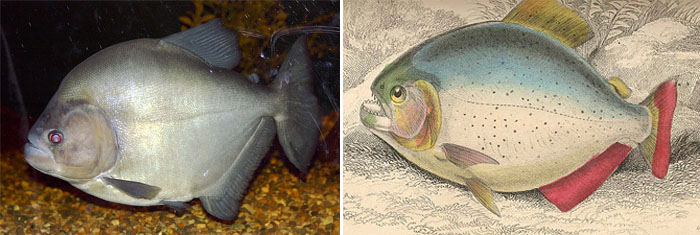 Left/레드아이 피라냐(블랙 피라냐). Redeye piranha(Black Pirahna)/학명; Serrasalmus rhombeus. Author/Ltshears. Right/로브투스 피라냐. Lobetoothed piranha/학명; Pygopristis denticulate. Date/1852. Author/Schomburgk, R. H. |
 Left/피라피틴가 파쿠 Pirapitinga pacu. 학명; Piaractus brachypomus. Author/Steven G. Johnson. Center/파쿠의 일종. A species of Pacus(Colossoma). Author/George Chernilevsky. Right/피라피틴가 파쿠 유어 모습. Juvenile Pirapitinga pacu. 학명; Piaractus brachypomus. Author/Wisky. |
 Left/레프트 훼이싱 실버 달라. Left facing silver dollar. 학명; Metynnis hypsauchen. Author/Sesamehoneytart. Center/오렌지 스폿티드 파쿠. Orange Spotted Pacu. 학명; Myleus asterias. Date/1845. Author/C. Haas. Right/블랙 밴드 밀레우스. Black band myleus. 학명; Myleus schomburgkii. Author/David J. Stang. |
 Left/카차마 파쿠. 브라질의 어시장. Cachama pacu. 학명; Colossoma macropomum. Location: A fish market in Brazil. Author/Thorke Østergaard. Right/카차마 파쿠. Cachama pacu. 학명; Colossoma macropomum. Author/Claudio Oliveira Lima |
 Left/피라냐 구이 요리. 아마존 정글(아마존 강이 아님)에서 잡은 피라냐로 만든 것. Grilled piranha. A piranha, caught in the Amazon jungle (though not in the Amazon river itself), lightly grilled and served as food. Author/Bobak Ha'Eri. Right/베이크드 파쿠 요리(구워서 스프에 넣은 것?). Pacu baked. Author/Cmasi |


|
| Copyright ⓒ FISHILLUST.COM All rights reserved. All contents can not be used without permission of the copyright holder. |


 검색
