
사이트 로그인
사이트 로그인
경골상강/Superclass Osteichthyes(bony fishes)→조기강/Class Actinopterygii(ray-finned fishes)→앨퉁이목/Order Stomiiformes(lightfishes and dragonfishes)→ 앨퉁이과 Family Sternoptychidae(Marine hatchetfishes). 과의 학명 Sternoptychidae의 어원은 그리스어 stérnon(breast) + ptýx(a fold/crease) 합성어이며 손도끼고기의 모양을 흉곽에 빗댄 것이다. 바다 손도끼고기(앨퉁이류)는 대서양, 태평양, 인도양의 열대, 아열대, 온대 바다 200–600m 깊은 수심에서 발견된다. 전반적으로 작은 물고기들이며 가장 작은 종(Polyipnus danae)은 2.8 cm 이며 가장 큰 종(Argyropelecus gigas/Giant Hatchetfish)도 12 cm 밖에 안 된다. 앨퉁이과는 2개의 아과(Sternoptychinae와 Maurolicinae)로 구성되어 있는데 그 체형이 서로 상당히 다르다. 스테르놉틱스 아과(Sternoptychinae)는 좌우로 아주 납작하게 측편되어 있고 체고가 아주 높아서 거의 원반 모양이다. 몸체는 손도끼의 철 부분 모양이고 꼬리는 손도끼의 손잡이 모양이다. 골반 부분이 수직으로 세워져 있는 모습이다. 반면에 마우로리쿠스 아과(Maurolicinae/ Araiophos속, Maurolicus속 등등) 종들은 체형이 일반 물고기 쪽에 가깝다. 앨퉁이과 물고기들의 몸은 은빛 비늘로 덮여있는데 아주 잘 떨어져나가는 약한 비늘이다. 어떤 종들은, 예를 들어, 하이라이트 헷치트피시(Highlight Hatchetfish/Sternoptyx pseudobscura)는 뒷지느러미 기부 쪽과 꼬리지느러미 기부 쪽 몸의 넓은 면적이 투명하다. 대부분 기름 지느러미가 1개씩 있다. 스테르놉틱스 아과는 아가미뚜껑 가시가 있고 등지느러미 앞에 담기골(擔奇骨/pterygophore/지느러미의 기부에 있는 뼈)이 있다. 눈은 크며 어떤 것은 튜브 모양이다. 이 눈들은 미미한 빛을 모아서 가까운 거리나 먼 거리의 물체에 초점을 잘 맞춘다. 대부분 종들의 눈은 그 방향이 위로 고정되어 있다. 이는 수면 쪽의 미미한 빛에 실루엣으로 나타나는 위쪽의 먹이감을 잘 구별하기 위한 것이다. 바다 손도끼고기(앨퉁이류)는 밤이 되면 수심 3,600m에서 수심 50–100m로 떼지어 상승한다. 밤새도록 먹이를 잡아먹고 새벽에 다시 하강한다. 이들이 주로 먹는 것은 요각류, 절지동물, 크릴 새우 같은 작은 갑각류와 자신 보다는 작은 물고기이다. 이들의 수명은 잘 알려져 있지 않으며 1년 이상 살지 못하는 것으로 보인다. 산란은 물 공간에 살포하는 식으로 하며 후세를 보호하는 생태는 아니다. 생체발광 앨퉁이과의 아과와 속의 명단 |
 Left/은손도끼고기(Silberbeil독일어). 아르지로펠레쿠스. 속학명; Argyropelecus olfersii. Date/1932. 눈이 튜브 모양으로 튀어나와 위를 보는 방향으로 고정되어 있다. 수면 쪽의 희미한 빛을 배경으로 나타나는 먹이감의 실루엣을 사냥해야 하기 때문에 이에 맞게 눈이 적응된 것이다. Eyes are tube-shaped and fixed gazing permanently upwards enabling them to discern the silhouettes of prey moving overhead. Right/아르지로펠레쿠스 속의 화석. Argyropelecus-fossil. Author/Ghedoghedo |
Family Sternoptychidae(Marine hatchetfishes). Found most often at depths of 200–600 meters in tropical, subtropical and temperate waters of the Atlantic, Pacific and Indian Oceans, marine hatchetfishes range in size from Polyipnus danae at 2.8 cm to the c.12 cm long Giant Hatchetfish(Argyropelecus gigas). The subfamily Sternoptychinae has narrow, laterally compressed, deeply keeled and roughly disc-shaped bodies, somewhat resembling a hatchet(with the thorax being the "blade" and the caudal peduncle being the "handle"); the pelvis is rotated to a vertical position. The members of the disputed subfamily Maurolicinae have a more conventional fish shape. Their bodies are covered in delicate silvery scales which abrade easily. In some species, such as the Highlight Hatchetfish(Sternoptyx pseudobscura), large sections of the body at the base of the anal fin and/or caudal fin are transparent. An adipose fin is usually present. The Sternoptychinae have preopercular spines and blade-like pterygiophores in front of the dorsal fin. Their large, sometimes tube-shaped eyes can collect the faintest of light and focus well on objects both close and far. In many genera, the eyes are fixed gazing permanently upwards, enabling them to discern the silhouettes of prey moving overhead against the slightly brighter upper waters. |
 Left/아르지로펠레쿠스 속(genus Argyropelecus). 영명/러블리 햇치트피시(Lovely hatchetfish). 종명/ Argyropelecus aculeatus. Author/Allan Riverstone McCulloch. Date/1923 Right/아르지로펠레쿠스 속(genus Argyropelecus). 영명/하프네이크드 햇치트피시(Half-naked hatchetfish). 종명/Argyropelecus hemigymnus. Author/Charles Henry Gilbert. Date/1905 |
 Left/아르지리프누스 속(genus Argyripnus). 영명/브릴리언트 펄사이드(Brilliant pearlside). 종명/Argyripnus iridescens. Author/Alan Riverstone McCulloch. Date/1918 Right/마우로리쿠스 속(genus Maurolicus). 영명/대서양 펄사이드(Atlantic pearlside). 종명/Maurolicus weitzmani. Author/NOAA |
 Left/마우로리쿠스 속(genus Maurolicus). 영명/페난트 펄사이드(Pennant pearlside). 종명/Maurolicus australis. Author/Allan Riverstone McCulloch. Date/1923 Right/마우로리쿠스 속(genus Maurolicus). 영명/실버리 라이트피시(Silvery lightfish). 종명/Maurolicus muelleri. Author/GrahamBould. |
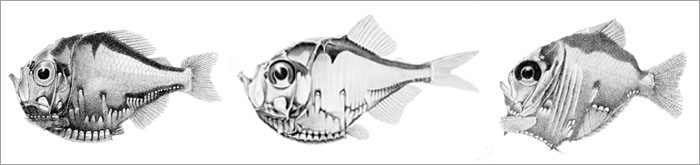 Left/폴리이프누스 속(genus Polyipnus). 영명/스피니 햇치트피시(Spiny hatchetfish). 종명/Polyipnus spinosus. Author/R. Mintern. Date/1887 Center/폴리이프누스 속(genus Polyipnus). 영명/쓰리스파인 햇치트피시(Three-spined hatchetfish). 종명/Polyipnus tridentifer. Author/A. R. Mc Culloch. Date/1911 Right/ 스테르높틱스 속(genus Sternoptyx). 영명/디아파노스 햇치트피시(Diaphanous hatchet fish). 종명/Sternoptyx diaphana. Author/R. Mintern. Date/1887 |


|
| Copyright ⓒ FISHILLUST.COM All rights reserved. All contents can not be used without permission of the copyright holder. |


 검색
