
사이트 로그인
사이트 로그인
※본 홈페이지 상단 메뉴 "바다 이야기" 안에 있는 " 해마(海馬) 백과 사전. 해마의 모든 것 " 칼럼에 모든 정보가 소개되어 있습니다. If you can read Korean language, go to the article " All about the Sea Horse(Hippocampus) "; prepared in upper menu “Sea Story" in this home page. 경골상강/Superclass Osteichthyes(bony fishes)→조기강/Class Actinopterygii(ray-finned fishes)→실고기목/Order Syngnathiformes(pipefishes and seahorses)→실고기과/Family Syngnathidae(pipefishes and seahorses). 실고기과 Family Syngnathidae(pipefishes and seahorses) 등지느러미는 1개이며 연조 15-60개이다. 뒷지느러미는 매우 작으며 연조 2-6 개이다. 가슴지느러미 기조 수는 10-23개이다. 배지느러미가 없다. 일부 종의 성어는 등지느러미, 뒷지느러미, 가슴지느러미가 없다. 꼬리지느러미가 없는 종도 있다. 꼬리자루(미병부)는 물체를 쥘 수 있다. 아가미 구멍이 매우 작다. 새파수는 1-3 개이다. 기저설상골(基底楔狀骨/basisphenoid)과 상쇄골(supracleithrum)이 없다. 신장은 외짝이며 신장 사구체(絲球體/glomerulus)가 없다. 실고기과 어류는 주둥이가 길고 몸이 골질 갑옷으로 감싸여 있다. 이 갑옷은 몸을 경직되게 만듦으로 지느러미를 매우 빠른 속도로 부채질하여 헤엄칠 수 밖에 없어서 속도가 느리다. 그러나 한자리에 계속 떠서 장시간 정지해 있는 호버링 같은 정교하게 움직이는 기술은 뛰어나다. 실고기과 어류는 암컷이 낳은 알을 수컷이 몸에 휴대하여 수정을 시키고 알이 부화할 때까지 지니고 다니는데 그 방법에는 차이가 있다. 해마를 예로 들면 수컷의 배에 주머니(육아낭)가 있어서 알을 여기에 담으며 수컷 해룡은(sea dragons)은 알을 꼬리에 부착시켜 가지고 다닌다. 수컷 파이프피시는 종에 따라 두 가지 방법 중 하나를 선택하고 있다. 실고기과 종들의 기본적인 차이는 수컷의 인큐베이터(육아낭)가 배에 있는가 꼬리 또는 몸 하부 어디에 위치하느냐에 있다. 실고기과 어류의 인큐베이터 시스템은 더 세분하면 여러 변형을 말할 수 있다. 단순히 몸에 알을 붙이는 접착부 형식에서부터 알을 완전히 감싸는 파우치까지 사이에 여러 가지가 있다. 좀 더 진보된 종은 수컷이 주머니에 든 알과 새끼에게 영양분을 공급할 뿐만 아니라 균에 대한 면역력도 지원한다. 더 발달된 종은 수컷이 인수받은 알이 열등한 암컷의 알인 경우 수컷이 알을 부화시키지 않고 유산시키는 것으로 알려져 있다. 실고기과 한국 분포 17종 명단 (1). 부채꼬리실고기(Honshu pipefish). Doryrhamphus japonicus(Araga & Yoshino, 1975) Family Syngnathidae(pipefishes and seahorses) 8 genera,17 species in Korea, 57 genera, 298 species worldwide. Mostly marine. Some in brackish and fresh water. Distribution: Atlantic, Indian, and Pacific Oceans (mostly in warm temperate to tropical). Most species inhabit shallow, coastal waters, but a few are known from the open ocean, especially in association with sargassum mats. About 60 cm maximum length. The Syngnathidae is a family of fish which includes the seahorses, the pipefishes, the pipehorses, and the leafy, ruby, and weedy seadragons. The name is derived from Greek, syn, meaning "fused" or "together", and gnathus, meaning "jaws". This fused jaw trait is something the entire family has in common. Dorsal fin single; soft rays usually 15-60. Very small anal fin. Anal rays usually 2-6. Pectoral fin rays usually 10-23. Adults of some species may lack dorsal, anal, and pectoral fins. Pelvic fins lacking. Some without caudal fin. Caudal peduncle may be prehensile. Very small gill openings. Branchiostegal rays 1-3. Basisphenoid and supracleithrum lacking. Kidney unpaired(right side) and lacking glomerulus. They are characterised by their elongated snouts, and by thick plates of bony armour covering their bodies. The armour gives them a rigid body, so they swim by rapidly fanning their fins. As a result, they are relatively slow compared with other fishes, but are able to control their movements with great precision, including hovering in place for extended periods. Uniquely, after syngnathid females lay their eggs, the male then fertilizes and carries the eggs during incubation, using one of several methods. Male seahorses have a specialized ventral pouch to carry the eggs, male sea dragons attach the eggs to their tails, and male pipefish may do either, depending on their species. The most fundamental difference between the different lineages of the Syngnathidae family is the location of male brood pouch. The two locations are on the tail(Urophori) and on the abdomen(Gastrophori). There is also variation in Syngnathid pouch complexity with brood pouches ranging from simple ventral gluing areas to fully enclosed pouches. In species with more developed, enclosed pouches it has been demonstrated that males directly provide their brood with not only nutrients but also immunity to pathogens. Syngnathids with more developed brood pouches are also known to be able to partially or completely abort a brood from a female with low fitness.
|
 |
[4면체의 몸] 해마류의 체형을 입체적으로 잘 보여준 사진, 몸통(머리 이하)과 꼬리 전체가 4면체이며 여러 개의 벽돌 모양 골질판이 연결된 구조이다. 각 이음새는 융기된 경계선을 가지고 있다. 각각의 골질판을 체륜(體輪)이라 부른다. 사진의 개체는 반 건조된 샘플이다. 살아있는 상태에서는 살이나 돌기물이 붙어있고 배가 부른 경우가 많아서 몸의 각진 모서리가 불분명하게 보일 수 있다. 특히 거의 모든 사진들이 정 측면을 향해 찍혀 있어서 몸통이나 꼬리가 둥근 것처럼 인식되기 쉽다. 사진의 해마 이름은 큰배해마(Big-belly seahorse/Hippocampus abdominalis)이지만 종에 관계없이 해마류의 4면체 체형 특징은 모든 해마류에 적용된다. [Tetrahedral body] A photo that clearly shows the body shape of seahorse in three dimensions. The trunk(below the head) and tail are tetrahedral, and are structured with multiple brick-shaped bony plates connected. Each seam has raised ridge border. Each bony plate is called “body ring”. The specimen in the photo is half dried. When alive, they often have flesh or protrusions and bellies are often swollen, so the angled edges of body can be seen unclearly. In particular, almost all photos are images of straight body side, so it is easy to perceive the body or tail as being round. The name of the seahorse in the photo is Big-belly seahorse(Hippocampus abdominalis), but the tetrahedral body characteristics applies to all seahorses regardless of species. Author of the photo/heymilly. Location/Rodney, Auckland, New Zealand. Source/inaturalist. |
| 실고기과 종의 예. Species examples in Syngnathidae(pipefishes and seahorses) ※실고기과는 형태 특징으로는 크게 4가지로 나눌 수 있다. 영명으로 파이프피시(pipefish), 파이프호스(pipehorse), 씨드래곤(해룡; seadragon). 씨호스(해마; seahorse)이다. 가장 유명한 부류는 해마=씨호스(seahorse)이다. |
 [파이프피시류; pipefishes]. Left/브록크스 파이프피시(Brock's pipefish; Halicampus brocki). Author/Graham Edgar Right/옐로우밴디드 파이프피시(Yellowbanded pipefish; Dunckerocampus pessuliferus). Author/Bernd divemecressi |
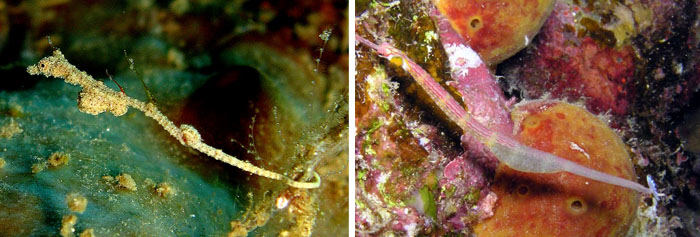 [파이프피시류; pipefishes]. Left/스레드 파이프피시(Thread pipefish; Kyonemichthys rumengani). 렘베 씨드래곤(Lembeh SeaDragon)이라고 부르기도 하는데 공식 명은 아님. 렘베 해협에서 촬영됨. Taken in Lembeh Straits. Inforamal other common name is Lembeh SeaDragon. Author/Steve Childs. Right/블랙브레스트 파이프피시(Blackbreasted Pipefish; Corythoichthys nigripectus). 수컷이며 꼬리쪽 배가 불룩한 것은 알은 지니고 있기 때문이다. Bulged abdomen with carrying eggs. Author/Silke Baron |
 [파이프피시류; pipefishes]. Left/퍼그헤드 파이프피시(Pugheaded pipefish; Bulbonaricus brauni). 불보나리쿠스 속(Bulbonaricus)은 예외적으로 주둥이가 길게 나오지 않았다. Bulbonaricus lack tubiform snout. Taken in Ogasawara Japan. Author/orangkucing. ※Pug; 몸이 작고, 납작한 얼굴에 주름이 많은 개. Right/검은목논병아리(Podiceps nigricollis)가 큰 파이프피시(Syngnathus leptorhynchus) 한 마리를 잡았다. Podiceps nigricollis captures and swallows a a large cold-water pipefish Syngnathus leptorhynchus, in Morro Bay, CA. Author/Mike Baird. |
 [파이프호스류; pipehorse]. Left/숏파우치 피그미 파이프호스(Short-pouch pygmy pipehorse; Acentronura breviperula). Taken in East Timor. Author/ Nick Hobgood. Right/숏파우치 피그미 파이프호스(Short-pouch pygmy pipehorse; Acentronura breviperula). Author/Steve Childs. |
 [파이프호스류; pipehorse]. Left/시드니 피그미 파이프호스(Sydney's pygmy pipehorse; Idiotropiscis lumnitzeri). Author/Taso Viglas Right/일러스트레이션. 사우선 리틀 파이프호스(Southern little pipehorse(Idiotropiscis austral). An illustration of Southern little pipehorse(Idiotropiscis austral). Author/E.R. Waite & H.M. Hale, 1921 |
 [해룡류; seadragons]. Left/잎사귀 해룡(Leafy seadragon; Phycodurus eques). Author/Joseph C Boone. Right/해룡(Common seadragon; Phyllopteryx taeniolatus). Author/Richard Ling |
 [해마류; seahorses]. Left/가시해마(Spiny seahorse;Hippocampus histrix). Author/Nick Hobgood. Center/숏스노우트 씨호스(Short snouted seahorse; Hippocampus hippocampus). Short-snouted seahorse on knotted wrack. Belgian part of the North Sea. Photographer/Hans Hillewaert. Right/데나이스의 피그미 해마(Denise's pygmy seahorse; Hippocampus denise). Author/Reijnen BT, van der Meij SET, van Ofwegen LP |
 [해마류; seahorses]. Left/바버스 해마(Barbour's seahorse; Hippocampus barbouri). Author/H. Zell. Center/롱스노트 해마(Long-snouted seahorse; Hippocampus guttulatus). Monterey Bay Aquarium. Author/FASTILY. Right/그뤠이트 해마(Great seahorse; Hippocampus kelloggi). Author/Izuzuki |
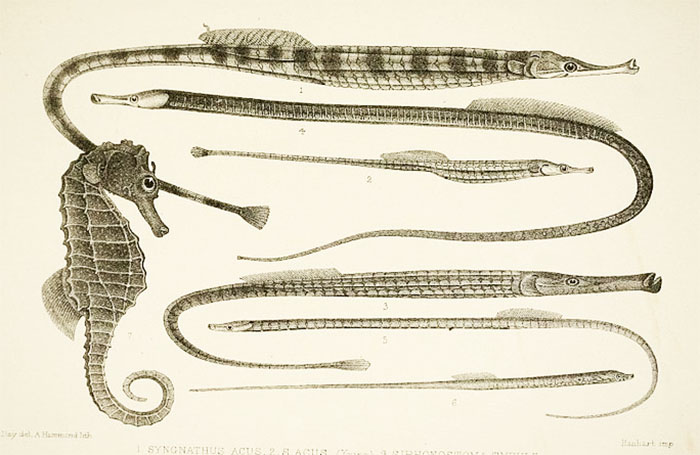 실고기과 어류 7가지의 도해(고문헌 자료). Illustrations of 7 species in family Syngnathidae. Date/between 1880 and 1884 Author/Achilles, C.; Day, Francis; Mintern Bros. |
 큰배해마(Big-belly seahorse)의 교배. 암컷(오른 쪽)이 수컷(왼쪽)의 육아낭에 알을 넣어주고 있는 장면. Hybridization of Big-belly seahorses. A scene where a female(right) is putting eggs into the brood pouch of a male(left). Location/Monterey Bay Aquarium, California. Author/Elizabeth Haslam. (CC
BY NC) |


|
| Copyright ⓒ FISHILLUST.COM All rights reserved. All contents can not be used without permission of the copyright holder. |


 검색

