Order Syngnathiformes Family Fistulariidae(cornetfishes).
Bluespotted cornetfish
Fistularia commersonii(Rüppell, 1838). Max length/160 cm TL, common length/100.0 cm TL
Korean name/cheong-dae-chi(청대치)
Japanese name/アオヤガラ(Ao-yagara)
Chinese name/无鳞烟管鱼, 棘馬鞭魚
D/soft rays 14-16. A/soft rays 14–15. P1/13~15. P2/6. Vertebrae/83-86. Branchiostegal rays(새조골)/5.
Distribution; Indo-Pacific/Red Sea, East Africa, Southeast Asia, China, southern Korea, southern Japan, Central Pacific, Australia, New Zealand, Polynesia, Rapa Island and Easter Island. East-Central Pacific/Mesico, Panama, Mediterranean/Discovered in several countries in 2010. This species is considered as part of the Lessepsian migration. Often misidentified as Fistularia petimba, a reddish or brownish-orange deep-water species with bony plates along dorsal midline(source/Fishbase.org).
General; Currently, in Korean literature, the scientific names for Cheong Daechi(equivalent; Bluespotted cornetfish) and for Hong Daechi(equivalent; Red cornetfish) are Fistularia petimba and Fistularia commersonii, respectively, but after reviewing various overseas materials, the scientific names were interpreted as reversed, so I changed the Korean name according to the author's opinion. To summarize, the scientific name of Cheong Daechi is Fistularia commersonii, and the scientific name of Hong Daechi is Fistularia petimba. In its English name, Fistularia commersonii is Bluespotted cornetfish and Fistularia petimba is Red cornetfish. Fishbase.org explains that these two scientific names are often interchangeably identical, and a search on Wikipedia or other Internet information shows that the Korean name is an error (date of this article; March 31, 2022)
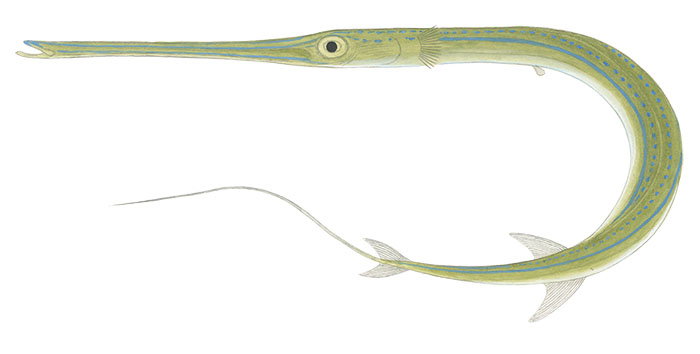
The bluespotted cornetfish(Fistularia commersonii), also known as smooth cornetfish or smooth flutemouth. Cornet and flute are both names of wind instruments. Body unusually long and slender. Head is very long, more than 1/3 of SL. The cross section of snout is hexagonal. Eyes large. The space between the eyes is almost flat. Body is becoming depressed(vertically flattened) after head. No scales on the body. The skin is rough as like shark's skin. Snout tubular and long. There are two ridges at the top of the snout that run the entire length of the snout. These lines are parallel to each other, but they widen in the middle and then narrow again, and merge at the end. Posterior part of ridge lines serrated. Small slightly oblique mouth at end of snout. The lateral line is complete and starts from the upper edge of the gill cover, curves upward for a moment, then descends to the center of the body and continues to the tail.
The upper jaw is shorter than the lower jaw, and the lower jaw has one row of small teeth. First four vertebrae fused. Caudal fin forked, Some soft rays extending from the bottom of the upper lobe and from the top of the lower lobe of the caudal fin are combined to create a single long, thread-like soft ray in the center of the caudal fin. This thread has sensory pores which may help detecting prey. The pectoral fins are very small, placed in the middle of the body height, this position is below the lateral line. The dorsal and anal fins are positioned symmetrically on the posterior body.
Overall colour is greyish, blue-grey, greenish yellow, greenish-grey to brown with a silvery-white belly, but sometimes dark vertical bars are present, especially at night. With two thin blue stripes or lines of dots along each side of the back; the upper one is in the form of dots and the lower one is in the form of stripes. Though this feature seems absent in Mediterranean specimens. The dorsal, anal and caudal fins are transparent. Caudal filament(thread) white.
Adults inhabit reef habitats to a depth of at least 128 m, except in heavy surge areas. Also found in sandy bottoms adjacent to reef areas. Benthopelagic. The bluespotted cornetfish is usually a solitary predator, or in schools. Often seen held perfectly straight when swimming slowly and undulating with a snake like motion when swimming quickly. Stalking and feeding on small fishes, crustaceans, and squid. Sometimes, they feed in small groups along the bottom on small, bottom-dwelling fish which their long snouts are very efficient at sucking up. It does not migrate far, and moves to a rather deep place in winter and to a rather shallow place in spring. Reproduction is oviparous. The spawning season is from March to August. The large eggs hatch and develop outside of the body. Larvae hatch at 6–7 millimetres (0.24–0.28 in). The fish is of minor importance commercially, mostly being sold as fish meal but also fresh and preserved. It is also sold as an aquarium fish.
※ Cornetfishes, such as Bluespotted and Red cornetfish, are easily mistaken for the needlefish. Donggalchi is a fish of Family Belonidae in Order Beloniformes. The Cornetfishes have a small mouth and jaws with long face, but the needlefish has a long mouth and long jaws with a small face.
[Differences between Bluespotted cornetfish and Red cornetfish] The Red cornetfish(F. petimba) has bony plates arranged in a row along the central axis of the dorsum before the dorsal fin, making it rough, but the Bluespotted cornetfish(F. commersonii) is smooth without these bony plates. The two ridges along the length of the snout at the top of the snout are parallel in the case of Red cornetfish, but in the case of Bluespotted cornetfish, the gap of the 2 ridges widens in the middle and then narrows again, so they are not completely parallel. Bluespotted cornetfish has blue stripes on its body, but Red cornetfish has no line patterns. The body color of both species varies in several colors, but Bluespotted cornetfish is mainly greenish gray, while Red cornetfishes are mainly red or orange. Bluespotted cornetfish and Red cornetfish are also called as Smooth cornetfish and Rough cornetfish respectively, this appears to be a name based on the presence or absence of rough bone plate structure on the back.
|


 청대치 분포도. Distribution map of Bluespotted cornetfish(Fistularia commersonii). Derived work. Author/fishillust. com
 청대치 기본 모습 묘사도. Illustration of Bluespotted cornetfish(Fistularia commersonii). Author/fao. (CC BY-NC)
 청대치와 암초 풍경. Bluespotted cornetfish(Fistularia commersonii) and reef scenery. Location/ Red Sea; Marsa Alam, Egypt. Author/Luis P. B.. (CC BY-NC)
 청대치 수중사진. At depth, Country/Greece. Bluespotted cornetfish(Fistularia commersonii). Author/Roberto Pillon. (CC BY-NC)
 청대치 수중사진. At depth, at Halifax Point, Port Stephens, New South Wales. Bluespotted cornetfish(Fistularia commersonii). Author/Richard Ling. (CC BY-NC)
 청대치 수중사진. At depth, in the Red Sea. Bluespotted cornetfish(Fistularia commersonii). Author/Derek Keats. (CC BY-NC)
 청대치 몸의 청색 줄 무늬를 나타내기 위해 위 사진(Derek Keats)에서 한 부분을 확대한 사진. An enlarged photo of a portion of the photo above(Derek Keats) to show the blue stripes on Bluespotted cornetfish(Fistularia commersonii)'s body. (CC BY-NC).
 청대치 몸의 청색 줄과 청색 점 줄무늬가 위치와 함께 잘 표현된 사진. This photo shows clearly the blue stripe and blue dotted line on Bluespotted cornetfish’s body and also allows you to clearly see their position. Location/Santa Cruz, Guanacaste, Costa Rica. Author/Pablo Fraire. (CC BY-NC).
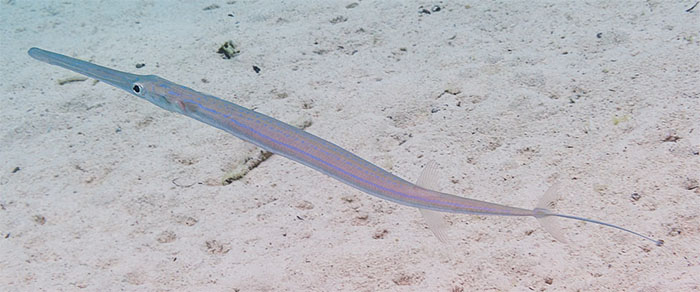 청대치. 하얀 모래 바닥 위를 헤어쳐가고 있음. Bluespotted cornetfish(Fistularia commersonii). A scene of swimming above white sand bottom. Location/Îles Sous-le-Vent, French Polynesia. Author/Francois Libert. (CC BY-NC).
 청대치 몸의 청색 줄 무늬를 나타내기 위해 위 사진(Francois Libert)에서 한 부분을 확대한 사진. An enlarged photo of a portion of the photo above(Francois Libert) to show the blue stripe and dotted line on Bluespotted cornetfish(Fistularia commersonii)'s body. (CC BY-NC).
 청대치. Bluespotted cornetfish(Fistularia commersonii). Location/Îles du Vent, French Polynesia. Author/Spike Pike. (CC BY-NC).
 청대치 몸의 청색 줄 무늬를 나타내기 위해 위 사진에서 한 부분을 확대한 사진. An enlarged photo of a portion of the photo above to show the blue stripes on Bluespotted
 청대치는 야간에는 몸에 여러 개의 폭이 넓은 수직 띠 무늬가 생긴다는 주장이 있다. 그러나 이사진들은 야간에 촬영하였다는 설명이 첨부되어 있지는 않다.
 몸색을 완벽한 띠 무늬로 바꾼 청대치. 야간 촬영이지 낮 촬영인지 설명되어 있지 않다.
 청대치는 야간에 밴드무늬를 가진다고 알려져 있지만 이 사진에서는 매우 밝은 낮 시간인데도 청대치가 밴드 무늬를 띠고 있다. Bluespotted cornetfish is known to have band patterns at night, but in this photo, it shows band patterns even during very bright daylight. Location/Montijo, Veraguas, Panama. Author/keesgroenendijk. (CC BY-NC)
 청대치. 황녹색 국면. Bluespotted cornetfish(Fistularia commersonii). Yellow-green phase. Location/Mosman, New South Wales, Australia. Author/Mike Jones. (CC BY-NC).
 청대치. 황녹색 국면. Bluespotted cornetfish(Fistularia commersonii). Yellow-green phase. Location/Santiago Ixcuintla, Nayarit, Mexico. Author/Cristian M. Galván Villa. (CC BY-NC).


 어린 청대치를 잡은 낚시인. Angler caught a young Bluespotted cornetfish. location/Sri Lanka, coastal waters off Unawatuna. Author/Theo Modder. (CC BY-NC)
 이스라엘 아콘(Akkon)시장에 진열된 청대치. Bluespotted cornetfish on a market in Acre, Israel. Author/Mosmas. (CC BY-NC)
 물수리가 청대치를 잡아 먹고 있다. An osprey is catching and eating a Bluespotted Cornetfish. Location/Puerto Lopez, Manabi, Ecuador. Author/Andy Pearce. (CC BY-NC)




 검색
