
사이트 로그인
사이트 로그인
|
분류계통/경골상강→조기강→큰가시고기목→큰가시고기과→큰가시고기 Copyright by Kim In Young. 김인영 그림
|
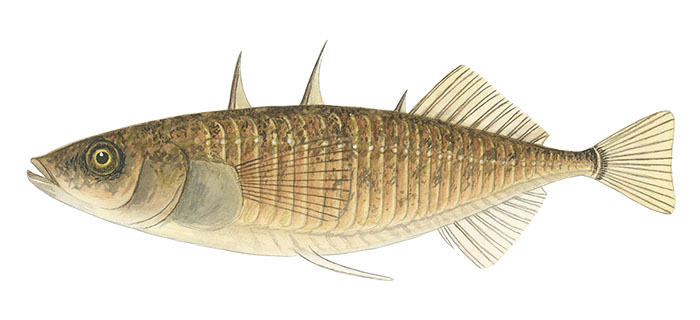 |
| 큰가시고기 기본 모습. Lateral view of Three-spined stickleback(Gasterosteus aculeatus) |
[담수, 해수; 소하성/ freshwater, marine; anadromous] 분포; 북반구의 온대 해역/35~70°N 범위의 유럽 전역, 북아프리카, 그린란드, 동아시는 일본 북부와 한반도에서부터 북으로 베링해까지, 30-32°N 범위의 북아메리카에 분포. 한국은 서남해, 남해, 동해로 흐르는 대부분의 하천에 분포한다. 몸은 길고 옆으로 매우 납작하며 꼬리자루는 가늘다. 아래턱이 위턱보다 약간 길다. 등지느러미 앞쪽 등에 3개의 가시가 있어서 영명으로 3가시 가시고기(Three-spined stickleback)라고 부르지만 가시가 2개인 것도 있고 4개인 것도 있다. 가시는 각기 분리되어 있고 뒤 쪽에 있는 등지느러미와도 분리되어 있다. 각각의 가시 뒷부분에 몸과 연결된 위축된 지느러미 막이 붙어 있다. 맨 뒤 세 번째 가시는 앞의 2가시보다 훨씬 작다. 뒷지느러미 맨 앞에 있는 1개의 가시도 뒤의 연조 부분과 분리되어 있다. 배지느러미는 1개의 날카로운 가시와 1개의 작은 지느러미 살로 되어있다. 모든 가시들은 포식자가 삼키기 어렵도록 세워진 채로 잠글 수 있다. 몸에는 비늘이 없고 대신 골판(인판)으로 덮여 있다. 인판은 등, 몸 측면, 배까지 덮여있다. 복부 인판은 1개이다. 그러나 체측면 인판의 수는 분포지와 서식 환경에 따라 크게 다르다. 소하형(遡河性)은 체측의 인판이 거의 몸 전체 면적을 덮고 있으며 그 수도 최대치인 37개로 구성되어 있다. 꼬리자루에 있는 인판들은 크기가 갑자기 작아져 있으며 용골처럼 잘 융기되어 있다. 해수 개체군이 체고가 더 높다. 일부 담수 개체군은 인판이 없는 것도 있다.가슴지느러미 뒤 가장자리는 거의 수직 절단형이다. 꼬리지느러미 뒤 가장자리는 아주 약간 안쪽으로 패인 형이다. 측선은 뚜렷하고 아주 작은 구멍이 나 있다. 몸색은 등쪽이 칙칙한 오렌지 색이거나 녹갈색인 것, 갈색 얼룩 무늬가 있는 것, 복부가 은색인 것 등등 다양하다. 담수 형 개체군은 대개 황갈색이거나 녹색을 띠며 소하형 개체군은 은녹색 내지 검푸른 색을 띤다. 육봉형 중 일부 지역 개체들은 몸 색이 흑색인 것도 있다. 지느러미들은 거의 투명하며 가슴지느러미에는 어두운 점 무늬가 있을 때가 많다. 산란기의 수컷(원래 색이 검은 개체군은 제외하고)은 밝은 청색 또는 녹색을 띠며 눈도 함께 청색이나 녹색을 띤다. 몸의 앞쪽 특히 가슴 부분은 밝은 적색이나 오렌지 색이 된다. 혼인색이 완전히 검거나 백색인 개체군도 있다. 산란기 암컷은 목구멍 부위와 복부가 연한 핑크색을 띤다. 산란과 번식. 벌레류, 갑각류, 수생 곤충, 물에 떨어지는 육상 곤충, 작은 물고기를 잡아먹는다. 동족의 알과 새끼도 먹는다는 보고가 있다. 담수 종은 최대 8 cm, 해수 종은 최대 11 cm로 자란다. 스칸디나비아 반도에서는 가끔 상업적으로 어획하며 어분이나 생선 기름으로 가공한다. 생물학적 연구에 다양한 용도로 사용되는 물고기이다. |
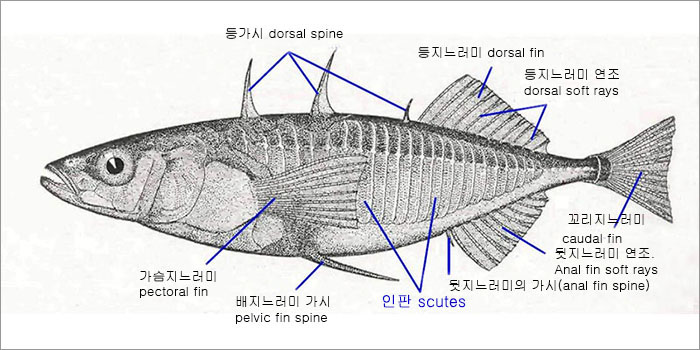 큰가시고기의 외부 형태. Illustration of external structure and appendages of Three-spined stickleback. Derived from Author/Barton Warren Evermann(1853–1932), |
[freshwater, marine; anadromous] Distribution; Temperate regions of northern hemisphere/throughout Europe between 35 and 70°N, North Africa, Greenland. in Eastern Asia/from Japan and the Korean peninsula to the Bering Straits. North America north of 30-32°N. ※ Korea; found in streams flow to east, south and southwest coasts. General; Adults occur in fresh waters, estuaries and coastal seas. Anadromous, with numerous non-anadromous populations in brackish or pure freshwater, rarely in marine waters. In the sea, confined to coastal waters. In freshwater, adults prefer to live in small stream but may occur in a variety of habitats including lakes and large rivers. Inhabit shallow vegetated areas, usually over mud or sand. Form schools. Young associated with drifting seaweed. Juveniles move to the sea (anadromous populations) or to deeper, larger water bodies(freshwater populations) in July-August, forming large feeding schools. The body is laterally compressed. Lower jaw slightly longer than upper jaw. The base of the tail is slender. Identified by the 3 spines before the dorsal fin(though some individuals may have only two or four). these dorsal spines separated from each other and from the soft-rayed fins. The third spine(the one closest to the dorsal fin) is much shorter than the other two. The back of each spine is joined to the body by a thin membrane. All spines can be locked in an erect position, making the fish extremely hard to swallow by a predator. Each spine having a reduced membrane attached to its posterior side and it jouned to the body; The anal fin is preceded by a short spine that is free from rest of the fin; The pelvic fins consist of just a spine and one ray, posterior margin of pectorals nearly truncate; caudal truncate to slightly indented. The body bears no scales, but is protected by bony plates on the back, flanks, and belly. Only one ventral plate is present, but the number of flank plates varies greatly across the distribution range and across habitat types The anadromous form is fully plated, with up to 37 plates on the sides. The plates on peduncle abruptly small in size and a rather pronounced keel on each side of the caudal peduncle. It is normally higher in marine populations (some freshwater populations may in fact lack lateral plates altogether). Lateral line complete and with very small pores. Dorsal coloration varies, but tends towards a drab olive or a silvery green, sometimes with brown mottling. The flanks and belly are silvery. Freshwater forms usually mottled brown or greenish; anadromous forms silvery green to bluish black. A few isolated populations are black. Fins pale; pectoral rays often have dark dots. Breeding males(except for black forms) become brilliant bluish or green with blue or green eyes, and the forward part of the body, especially the breast region, turns bright red or orange. The throat and belly of breeding females can turn slightly pink. A few populations, however, have breeding males which are all black or all white. Life cycle and mating behavior Feed on worms, crustaceans, larvae and adult aquatic insects, drowned aerial insects, and small fishes; has also been reported to feed on their own fry and eggs. Maximum length in freshwater is 8 cm while in saltwater is 11 cm. Occasionally taken commercially in Scandinavia and processed into fishmeal and oil. Commonly used as a laboratory animal. |
 다른 큰 풀 줄기에 의지해 바닥에서 위로 뜬 둥지를 만드는 가시고기류가 있지만 큰 가시고시는 바닥에 둥지를 만든다. Three-spined sticklebacks build nest on the bottom, not above floor.. Derived work from the image uploaded within the collaboration between the Master on Scientific Illustration of the UPV/EHU(University of the Basque Country) and the Basque Wikimedians User Group. Author/Agomem04 |
 수족관의 큰가시고기. Three-spined sticklebacks at Berlin Aquarium. Author/JSutton93 |
 큰가시고기 그림. Illustration of Three-spined stickleback(Gasterosteus aculeatus). Author/Kókay Szabolcs |
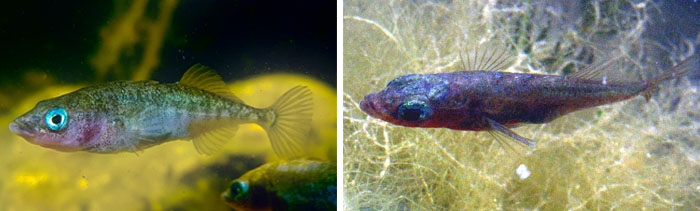 큰가시고기 모습 두 가지. 서식지 차이에 따라 원래 색이 검은 것이 있고 또는 혼인색이 검어지는 것이 있다(우측). Colors in Three-spined sticklebacks, rarely black specimens(right) found in some isolated population. Left; Author/Evan Baldonado. Right/Author/S. Rae from Scotland, UK |
 Left/모가지 부분이 붉고 눈에 파란 색을 띤 수컷 큰가시고기의 혼인색. Male stickleback with red throat and shiny blue eye. Right/수컷 큰가시고기의 혼인색. Male in breeding color of the three spined stickleback(Gasterosteus aculeatus). Author/Piet Spaans(Viridiflavus) |


|
| Copyright ⓒ FISHILLUST.COM All rights reserved. All contents can not be used without permission of the copyright holder. |


 검색
