Oder Beryciformes Family Trachichthyidae(Slimeheads).
Darwin's slimehead
Gephyroberyx darwinii(Johnson, 1866). Max length/60.0 cm TL. common length/45.0 cm TL
Synonym/Gephyroberyx japonicus
Korean name/nab-jak-geum-nun-dom(납작금눈돔)
Japanese name/ハシキンメ(Hashikinme)
Chinese name/達氏橋棘鯛.
D/spine 7-8 soft ray13~14. A/spine 3 soft ray 11~12. P1/14. Ventral scutes/12-14. Lateral line scale/29-31
Distribution; Indo-Pacific/off Natal(South Africa), Bay of Bengal, southern Australia, Chatham Plateau around New Zealand, and the Philippines, Japan, Jeju island of Korea. Also in northern South America. Eastern Atlantic/Madeira and the Canary Islands to Senegal, Gulf of Guinea and South Africa. Western Atlantic/southern Scotian Shelf, Canada to Greater Antilles, western Caribbean, Panama and northern Gulf of Mexico.
General; ※ Note/There is confusion between the scientific name Gephyroberyx darwinii and Gephyroberyx japonicus. These two species were known to be different species, but were later discovered to be the same species, and Gephyroberyx japonicus was synonymized with Gephyroberyx darwinii. Therefore, Gephyroberyx darwinii is the official name. Many descriptions made when the two species were known to be different species still remain on authoritative sites, so it can be confusing if you don't know this fact. Whether G. japonicus or G. darwinii, the Japanese name for both is commonly “ハシキンメ(Hashikinme)”.(data/as of 2023). Information Source/①Illustrated Fishes in Color Revised Edition, published by HOKURYUKAN CO., LTD. Japan. 2005. ②臺灣魚類資料庫(fish data base of Taiwan (http//fishdb.sinica.edu.tw)
The body is oval, with deep depth and compressed laterally. Body depth about 2.1 times in SL. The head is large and tall, with a concave profile at tip of snout. Snout blunt and short. Head has a large mucous cavity covered by tough skin. Mouth large and oblique. There are small teeth on both jaws, vomer, and palatal bone. The posterior end of the upper jaw reaches the posterior margin of eye. Numerous bony ridges below and behind the eyes. There is a large strong sharp spine extending backwards at the bottom of preopercle. Opercle with a large strong spine. Small ctenoid scales on the body. The lateral line slopes downward roughly straightly toward the tail. 9 to 16 very robust scutes on the midline of the abdomen between the pelvic and anal fins origin. Anus just before anal fin. Dorsal fin single, spine part and soft ray part of dorsal fin are connected without notch. Dorsal fin spine is 8, and the 4th spine is the longest. The length of the last spine of the dorsal fin is longer than the length of the second last spine. The pectoral fin located at lower side of the body, with the posterior end reaching the end of the base of dorsal fin spine part. .The caudal fin is deep in height and forked, both lobes rounded but the rear ends are relatively narrow. Caudal fin with 4-8 short, spiny rays at top and bottom of its base. Lateral line scales larger than surrounding scales and each with a small, flat, triangular spine.
When they are alive in the water, their entire body, including their fins, may be pale pink or reddish pink or red color. The fins are not patterned with spots or blotches. Tongue and gill cavity blackish; palate white to red. Lives close to or on the bottom of the upper continental slope. Depth range 9~1210 m, usually 200~500 m. Subtropical; 43°N - 35°S. Prefers rocky substrates. Feed on small shrimps and fish. A deep sea species, nonetheless, the young are often found near the coast. Utilized as fishmeal and source of oil in eastern central Atlantic.
|


 납작금눈돔 분포도. Distribution map of Darwin's slimehead(Gephyroberyx darwinii). Edited by fishillust.com
 납작금눈돔의 두 가지 체형도. 나이가 먹을수록 몸이 옆으로 길어지는 것으로 짐작된다. 납작금눈돔 평균 크기는 45.0 cm TL이다. 왼쪽 그림은 모델의 크기가 설명되어 있지 않으나 평균 크기 범주에 드는 것으로 보이며 오른쪽 그림은 모델의 크기가 11.5 cm라고 명기되어 있다. Two body types of Darwin's slimehead. It is assumed that as it get older, body becomes longer laterally. The average size of Darwin's slimehead is 45.0 cm TL. The left illustration does not describe the size of the model, but it appears to fall into the average size category, and the illustration on the right clearly states that the size of the model is 11.5 cm. Author/left; G. Brown Goode and Tarleton H. Bean, published 1896. Right; South African Institute for Aquatic Biodiversity.
 납작금눈돔 묘사도. Illustration of Darwin's slimehead(Gephyroberyx darwinii). Date/1921. Author/Edgar Ravenswood Waite(1866–1928).
 납작금눈돔. 대심도 ROV 카메라의 수중사진. Underwater photo of Darwin's slimehead(Gephyroberyx darwinii). Photographed by Remotely Operated Vehicle(ROV). Location: Gulf of Mexico, North. Author/NOAA
 납작금눈돔. 대심도 ROV 카메라의 수중사진. Underwater photo of Darwin's slimehead(Gephyroberyx darwinii). Photographed by Remotely Operated Vehicle(ROV). Location: Gulf of Mexico, North. Author/NOAA
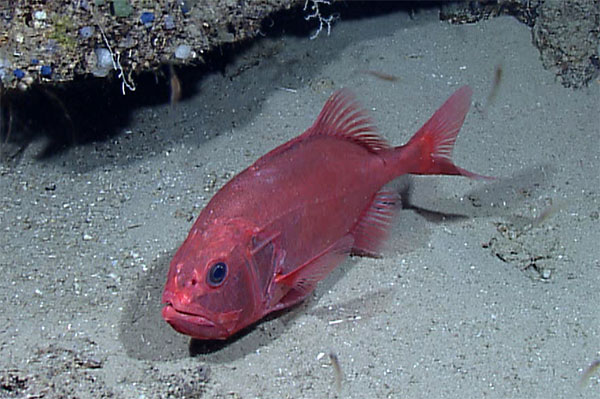

 text on preparation대심도에 사는 산호 사이에 은신해 있는 납작금눈돔. 수심 300. A Darwin's slimehead hiding among the corals that live in the great depths. Photographed by Remotely Operated Vehicle(ROV). Location: Gulf of Mexico, North. 300 meters depth. Author/U.S. Geological Survey.
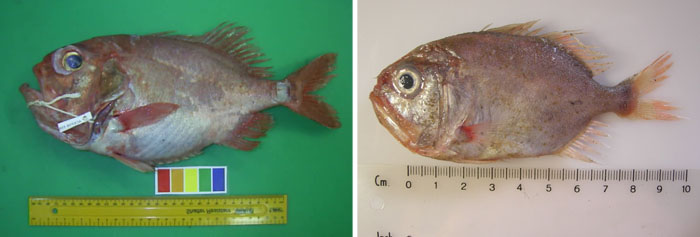 Left/납작금눈돔. 보존표본. 전장 약 35cm. Preserved specimen of Darwin's slimehead(Gephyroberyx darwinii). Length/about 35cm TL. Collected in Seychelles. Author/SAIAB(South African Institute for Aquatic Biodiversity). (cc by nc)
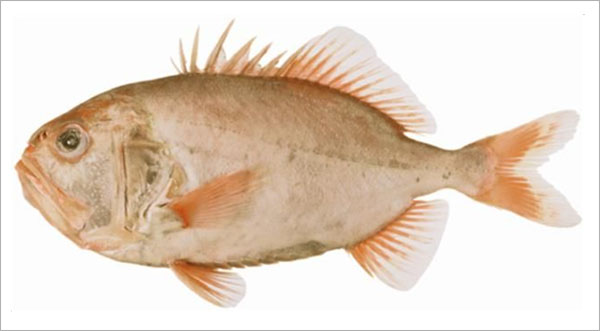 납작금눈돔. 보존 개체. Dead specimen of Darwin's slimehead(Gephyroberyx darwinii). collected in South Africa. Author/Australian National Fish Collection, CSIRO
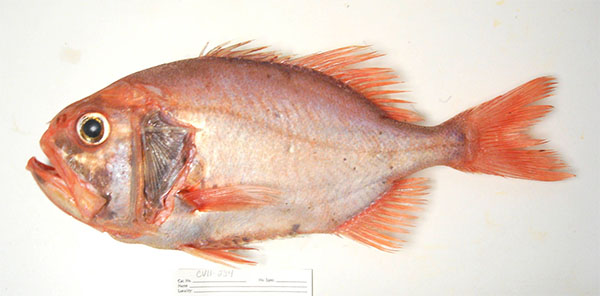 납작금눈돔. 보존 개체. Dead specimen of Darwin's slimehead(Gephyroberyx darwinii). Photographed during Cape Verde Expedition 2011. Author/Wieber, Kimberly
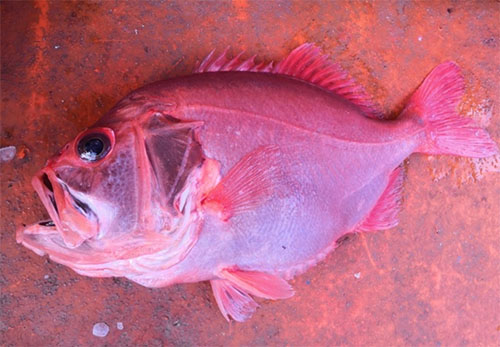 납작금눈돔. 죽은 개체. 30cm. Dead specimen of Darwin's slimehead(Gephyroberyx darwinii). Locality/Lucornia Shoal, Malaysia. Author/Tan See Kin
 납작금눈돔의 미병부 엑스레이 사진. 꼬리지느러미의 상하 기점에 있는 5개의 잔가시를 보여 주기 위한 사진인 것 같다. X-ray of the peduncle part of a Darwin's slimehead, likely to show the five spines at the upper and lower bases of the caudal fin. Collected in Senegal. Publisher MNHN(Museum national d'Histoire naturelle). Author/Ho Hans




 검색
