Oder Anguilliformes Family Muraenidae(Moray eels).
Australian mottled moray
Gymnothorax prionodon(Ogilby, 1895) 150 cm TL. common length : 80.0 cm TL
Japanese name/Yuri-utsubo
Chinese name/白斑裸胸鱔
Vertebrae: 135 – 138
Distribution; Western Pacific/southern Korea, southern Japan to the South China Sea, Australia and New Zealand.
General; The Australian mottled moray(in Australia), also called as Mottled moray(in New Zealand), or Saw-tooth. The Australian mottled moray is a very elongate scaleless fish, has a low dorsal fin, deep grooves in the opercular region and a swollen appearance behind the eyes. With a large mouth. Both jaws have a single row of large sharp teeth. Teeth facing backward, hinged so that they can fold back but lock when prey tries to struggle free. Despite one of the common names is Saw-tooth Moray does not have serrated teeth. Its coloration can vary from greenish brown to dark brown. It has white spots and blotches over its entire length. The spots are small and close together on the head, and increase in size and more widely spaced towards the tail.
The Australian mottled moray lives in rocky reef areas, found from shallow water to 80 m depth. Spend most of its time with its head emerging from its cave or crevice, mouth agape. The open-mouthed stance is not aggression - morays need to continuously draw water through their small gills. They are active mostly at night but will move about occasionally during the day if food is detected. Their diet is made up of crabs, sea urchins, and small fish such as blennies and scorpionfish. If provoked this species will make a lightning fast bite before retreating. When hooked, morays fight energetically even tying themselves in knots and it is often impossible to remove the hook.
|


 백설곰치. 적황갈색의 큰 백설곰치, 크고 작은 둥근 점무늬가 머리, 몸 꼬리 전체에 들어차 있다. Australian mottled moray(Gymnothorax prionodon). A large brown to reddish-brown moray with a variable pattern of small to moderate-sized spots(sometimes ocellated) on the head, body and tail. Halifax Point, Nelson Ba,y New South Wales, Australia. Author/Richard Ling
 백설곰치. 머리 뒤 아래 아가미가 있는 부분에 몇 개의 패인 고랑(주름)이 있다. Australian mottled moray(Gymnothorax prionodon). Has deep grooves in the opercular region. Author/Richard Ling
 백설곰치. Australian mottled moray(Gymnothorax prionodon). Author/Izuzuki
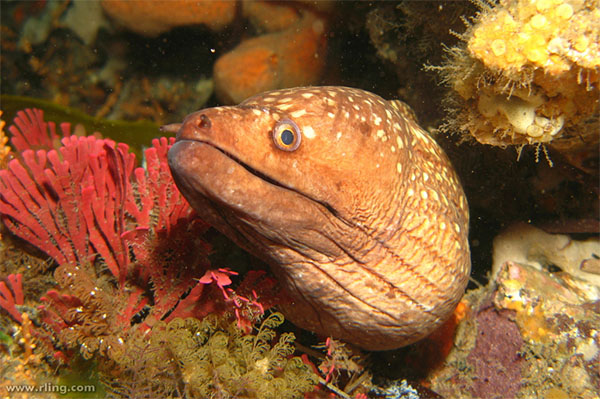 백설곰치. Australian mottled moray(Gymnothorax prionodon). Author/Ian Skipworth




 검색
