
사이트 로그인
사이트 로그인
|
분류계보/경골상강→조기강→잉어목→잉어과→모래무지아과→어름치(Korean spotted barbell; Hemibarbus mylodon) Copyright by Kim In Young. 김인영 그림
|
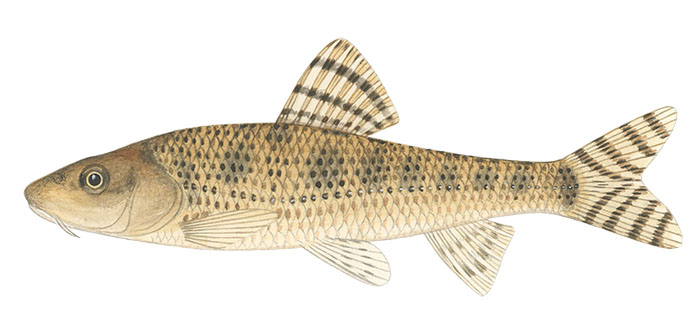 |
| 어름치 기본 모습. Lateral view of Korean spotted barbell(Hemibarbus mylodon) |
[담수어] 비늘은 비교적 크고 측선(옆줄)은 완전하며 앞쪽에서 배쪽으로 약간 휘어졌다가 직선으로 이어진다. 등지느러미는 삼각형이며 가장자리는 거의 직선이며 그 기점은 배지느러미 보다 약간 앞에 있다. 배지느러미 뒤 끝은 둥글다. 뒷지느러미는 등지느러미보다 훨씬 뒤에 있고 바깥 가장자리는 거의 직선이거나 약간 안으로 굽는다. 가슴지느러미는 아가미구멍 바로 뒤에 있고 배쪽에 가깝게 붙으며 비교적 길다. 꼬리지느러미는 깊이 갈라지고 위아래 조각(상엽과 하엽)의 크기나 모양이 거의 같다. 몸 빛깔은 연한 갈색이며 배쪽은 희다. 옆구리에는 7∼8줄의 검은 점이 수평으로 줄지어 있고 각각의 검은 점은 동공보다 작다. 등지느러미 꼬리지느러미 뒷지느러미에 검은 색 띠가 2~4줄 있다. 물이 맑고 바닥에 자갈이 깔려 있는 큰 강의 중·상류에 산다. 육식성으로 주로 수생곤충을 먹고 갑각류나 그 밖의 동물도 잡아 먹는다. 산란기는 4∼5월이다. 암컷이 여울 가장자리에 얕은 웅덩이를 파고 알을 낳으면 수컷이 방정한다. 암컷은 곧바로 모래와 자갈로 알을 덮고 나서 재차 알을 낳으며, 수컷도 기다렸다가 방정한다. 이를 서너 차례 반복한 후 암컷이 완전하게 알을 덮는다. 알 낳기가 끝나면 높이 20~30cm, 너비 60cm 정도의 돌탑이 쌓인다. 이것을 어름치의 “산란탑(spawn tower)”이라 한다. 산란기에 수컷은 배 쪽이 검은색으로 변하고 추성이 나타난다. |
[Freshwater fish]] Distribution; Asia/endemic to south Korea. Found in upper reaches of Han river and Geum river. Scales large. Lateral line complete, slightly curved down in the beginning part, straight posteriorly. Dorsal fin triangular in shape and with almost straight margin. Origin of dorsal fin placed slightly ahead of pelvic fin origin. Pelvic fin with rounded margin. Anal fin located far behind of dorsal fin, its’ margin almost straight or slightly caved in. Pectoral fin relatively long, placed immediately behind of gill opening and close to abdomen. Caudal fin deeply caved in and both lobes symmetrical in shape and size. Over all body color pale brown, with deep dark brown back, and whitish ventral side. 7∼8 lateral stripes of dark spots on body side, the size of each spots smaller than eye diameter. 2~4 dark bands on dorsal, anal, and caudal fins. Inhabit mid and upper reaches of large rivers with clear water and gravel bottoms. Feed on aquatic insects, crustaceans, and other aquatic animals. Spawn in April to May. Female make pit on the bottom and lay eggs there, male fertilize the eggs, then female covers the pit with sand and gravels, and again lay eggs over it and male fertilizes eggs again, and female again covers the eggs with sand and gravels, this process repeats several times. When egg laying finished, a mound of gravel and sands is born, the size of mound about 20~30cm in height, 60cm in diameter, this mound is called as “spawn tower” of Hemibarbus mylodon. Male get blackened abdomen and pearl marks in nuptial days. |
 어름치. Korean spotted barbel(Hemibarbus mylodon). Author/National Institute of Ecology of Korea. |
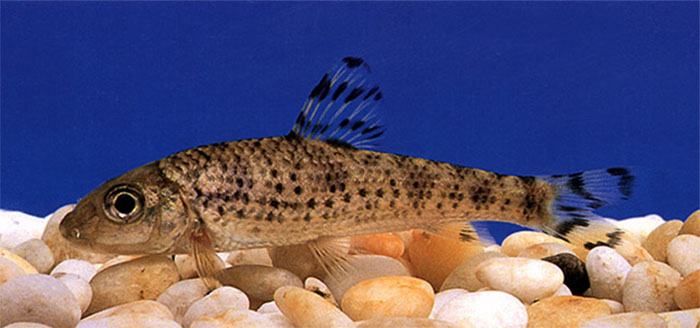 어름치. Korean spotted barbel(Hemibarbus mylodon). Author/Cultural Heritage Administration of Korea. |
| Copyright ⓒ FISHILLUST.COM All rights reserved. All contents can not be used without permission of the copyright holder. |


|


 검색
