
사이트 로그인
사이트 로그인
|
분류계통/ Copyright by Kim In Young. 김인영 그림
|
| image on preparing |
| text on preparation |
| text on preparation |
| text on preparation |


|
| Copyright ⓒ FISHILLUST.COM All rights reserved. All contents can not be used without permission of the copyright holder. |
|
분류계통/경골상강→조기강→실고기목(Syngnathiformes)→실고기과(Syngnathidae)→왕관해마 Copyright by Kim In Young. 김인영 그림
|
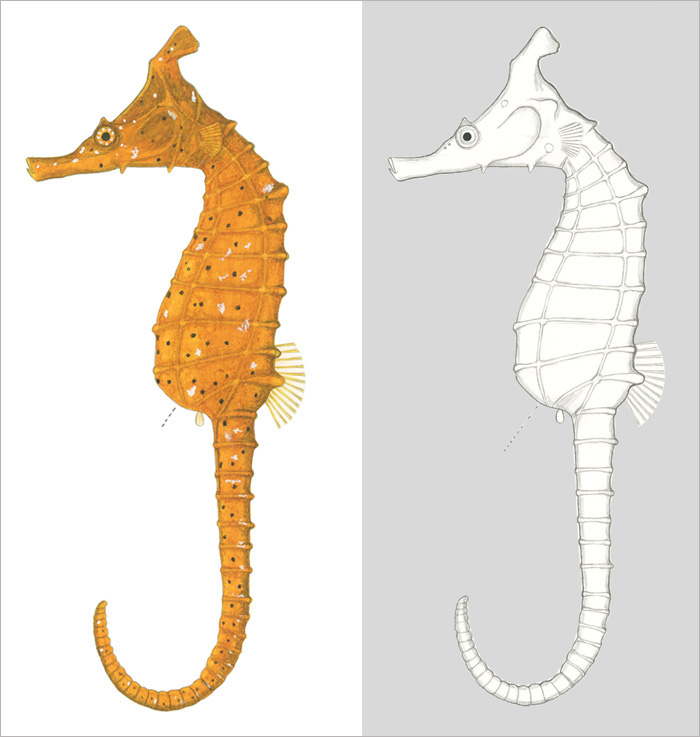
| [painting 1], left/ 왕관해마 기본 모습. Lateral view of Crowned seahorse(Hippocampus coronatus [painting 2], right/왕관해마 몸체의 기본 틀. Basic body frame of Crowned seahorse(Hippocampus coronatus). |
 |
[4면체의 몸] 해마류의 체형을 입체적으로 잘 보여준 사진, 몸통(머리 이하)과 꼬리 전체가 4면체이며 여러 개의 벽돌 모양 골질판이 연결된 구조이다. 각 이음새는 융기된 경계선을 가지고 있다. 각각의 골질판을 체륜(體輪)이라 부른다. 사진의 개체는 반 건조된 샘플이다. 살아있는 상태에서는 살이나 돌기물이 붙어있고 배가 부른 경우가 많아서 몸의 각진 모서리가 불분명하게 보일 수 있다. 특히 거의 모든 사진들이 정 측면을 향해 찍혀 있어서 몸통이나 꼬리가 둥근 것처럼 인식되기 쉽다. 사진의 해마 이름은 큰배해마(Big-belly seahorse/Hippocampus abdominalis)이지만 종에 관계없이 해마류의 4면체 체형 특징은 모든 해마류에 적용된다. [Tetrahedral body] A photo that clearly shows the body shape of seahorse in three dimensions. The trunk(below the head) and tail are tetrahedral, and are structured with multiple brick-shaped bony plates connected. Each seam has raised ridge border. Each bony plate is called “body ring”. The specimen in the photo is half dried. When alive, they often have flesh or protrusions and bellies are often swollen, so the angled edges of body can be seen unclearly. In particular, almost all photos are images of straight body side, so it is easy to perceive the body or tail as being round. The name of the seahorse in the photo is Big-belly seahorse(Hippocampus abdominalis), but the tetrahedral body characteristics applies to all seahorses regardless of species. Author of the photo/heymilly. Location/Rodney, Auckland, New Zealand. Source/inaturalist. |
실고기목 실고기과 분포; 서북태평양/한국의 남해, 울산, 울릉도, 일본 본섬(혼슈)의 서해 쪽 북부와 중부, 및 태평양 쪽의 도쿄만과 사가미만, 와카야마만, 규슈 섬의 왼쪽과 대마도,오키나와. 몸색은 변화가 있으며 밝거나 어두운 적갈색 또는 노랑색 또는 노란색이 많은 황갈색이다 가끔 몸에 가늘고 하얀 줄 무늬가 나타나거나 작고 검은 점들이 산재한다. 눈의 홍채에서부터 눈 주변으로 방사상의 흰 반점들이 배열되는 경우도 있다. 등지느러미는 투명하고 약간 어두운 색의 반원 형태의 띠 무늬가 있을 수도 있다. 가슴지느러미와 뒷지느러미는 투명하다. 수컷의 육아낭에는 가끔 작은 흰점과 검은 점들이 나타난다. 수컷의 육아낭을 제외하면 암수의 외형은 거의 차이 없다. 난태생 물고기이며 수컷이 육아낭에 알을 보관하고 있다가 새끼를 분만한다. 육아낭은 꼬리의 배쪽에 있다. 번식기는 6~8월 사이이다. 암컷은 6.9cm 크기일 때 수컷은 7.3cm일 때 성적으로 성숙한다. 수컷의 한번 분만 수는 12–46 마리이다. 아열대성, 저서형이며 이주하지 않는다. 해조류 거머리말이 서식하는 얕은 연안 수심(0-20m)에서 발견된다. 옆새우 같은 단각류와 요각류 같은 작은 갑각류를 먹지만 크기에 따라 다를 수 있으며, 더 작은 개체는 요각류를 소비하고 더 큰 개체는 양각류와 보리새우(mysids)를 먹는다. 최대 13.3 cm(SL) 까지 자라지만 보통 크기는 6 cm이다. 국제보호대상 어류(CITES)이며 포획, 매매가 금지되어 있다. 제주도에서는 해마류 양식에 성공하여 가공품을 생산 판매 한다. ====================================================== “왕관해마의 복잡성(Hippocampus coronatus complex)”이란 무엇인가? "Hippocampus coronatus complex"는 한국에서 오래 전부터 알려져 온 대표적 종인 “해마”의 실제 학명이 Hippocampus coronatus 가 아닐지도 모른다는 의문에서 시작된 것으로 보인다. 학자들이 이 의문을 해결하기 위해 나선 것은 2010년대에 들어와서이다. 2017년 10월에 발표된 논문(저자/Sang-Yun Han, Jin-Koo Kim, Yoshiaki Kai, Hiroshi Senou)에 의하면 “해마”의 이름으로 채집된 개체들은 모두 3종으로 분리되었다. 이들 3종은 왕관해마(Hippocampus coronatus), 신도해마(Hippocampus sindonis) 그리고 아직 학명이 없는 한 신종이었다. 이 신종의 학명은 Hippocampus haema 로 명명되었다. 간단히 말해서 아주 오래 전부터 한국에 알려져 있던 해마는 학명을 가지지 못한 물고기이며 Hippocampus coronatus 라는 다른 종의 학명이 잘못 붙여져 있었던 것이다. Hippocampus coronatus는 본래의 글로벌한 자기 원명인 왕관해마(Crowned seahorse)를 되찾게 되었고 한국 전래의 이름인 “해마”는 생물학적 족보가 없다가 Hippocampus haema라는 학명을 갖게 된 것이다. 아쉬운 것은 한국 명 “해마”는 50종이 넘는 해마 속(genus Hippocampus)의 통칭인 해마(seahorses)와 혼동이 일어난다는 것이다. 글로벌 영명은 “Korean seahorse”인데 한국명도 “한국 해마”라고 했으면 혼동이 일어나지 않을 것이다. 2017년 이전에 나온 간행물과 이를 기본으로 한 인터넷 정보에는 해마의 학명이 Hippocampus coronatus로 표기되어 있는 경우가 더 많음으로 헷갈리지 말아야 한다. |
Order Syngnathiformes Family Syngnathidae(pipefishes and seahorses) Distribution; Northwest Pacific/South Sea, Ulsan, and Ulleungdo of South Korea; the northern and central parts of the western coasts of Japan's main island(Honshu); and Tokyo Bay, Sagami Bay, Wakayama Bay on the Pacific side, southwest coasts of Kyushu Island. Tsushima Island, Okinawa. Variable color, light to dark red-brown or yellow or yellowish brown, sometimes showing numerous thin whitish striations and/or dark small dots along body. Often whitish radial blotches from iris to surrounding eye. Dorsal fin transparent and occasionally semicircular band present. Male brood pouch sometimes speckled with fine white and dark spots. No particular sexual dimorphism, apart from male brood pouch. This species is ovoviviparous, with males brooding eggs in a brood pouch before giving birth to live young. Brood pouch is found under the tail. Breeding season occurs from June to August, with females and males reaching sexual maturity at 6.9 centimetres (2.7 in) and 7.3 centimetres (2.9 in) respectively. Male brood size ranges from 12–46. It is subtropical, demersal and does not migrate. Found in shallow coastal waters(0-20m) where Zostera seagrasses developed. Feed mainly on small crustaceans such as gammarid amphipods and copepods, although this can vary by size, with smaller individuals consuming copepods while larger individuals feed on amphipods and mysids. It can grow to lengths of 13.3 centimetres, but is more commonly 6 centimetres. It is an internationally protected fish(CITES) and catching and selling is prohibited. In Jeju Island of Korea, seahorses have been successfully farmed and processed products are produced and sold. Used in Chinese medicine =============================================== What is the “Hippocampus coronatus complex”? "Hippocampus coronatus complex" seems to have originated from the question that the actual scientific name of the “hae-ma”, a representative species that has been known for a long time in Korea, may not be Hippocampus coronatus. It was in the 2010s that scholars began conducting research to resolve this question. According to the paper published in October 2017(authors/Sang-Yun Han, Jin-Koo Kim, Yoshiaki Kai, Hiroshi Senou), all of the specimens collected under the name “hae-ma” were separated into three species. These are the Crowned seahorse(Hippocampus coronatus), the Shiho's seahorse(Hippocampus sindonis) and a new species that did not yet have a scientific name. The new species was given the scientific name Hippocampus haema. In short, the seahorse, which has been known in Korea for a very long time, is a fish that does not have a scientific name, and the scientific name of another species, Hippocampus coronatus, was incorrectly given. Hippocampus coronatus regained its original global name, the “Crowned seahorse”, and the one with Korean traditional name “hae-ma” which had no biological genealogy, is given the scientific name “Hippocampus haema”. What is regrettable is that the Korean name “Hae-ma(equivalent to seahorse” is often confused with other common names in the genus Hippocampus, which has over 50 species. The global English common name for Hae-ma is “Korean seahorse,” if the Korean name were also called “Korean seahorse,” confusion would not arise. In publications published before 2017 and internet information based on them, the scientific name of the hippocampus is more often written as Hippocampus coronatus, so do not be confused. |
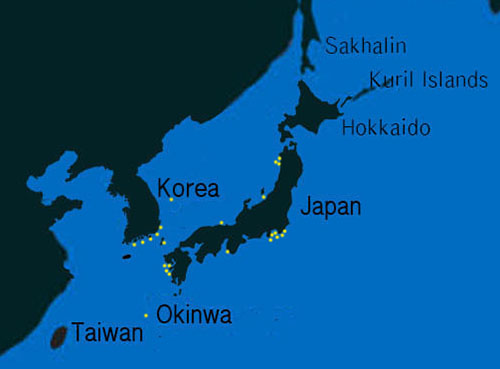 왕관해마 분포도. Distribution map of Crowned seahorse(Hippocampus coronatus). Author/Kim in-young(fishillust.com). Data/GBIF+Korean data, as of Feb.2004 |
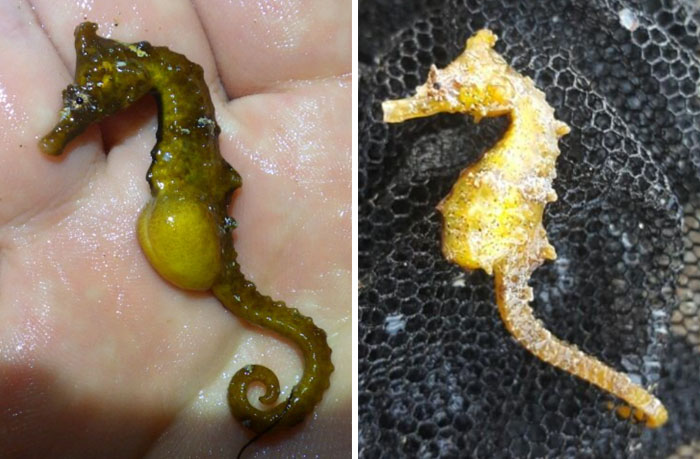 Left and right/왕관해마. 채집 장소는 한국으로 추측됨. Crowned seahorse(Hippocampus coronatus). The collection location is believed to be Korea. Author; left/Yun seong-yeol(윤성열), right/Kim Jae-hyun(김재현). Source/www.naturing.net/. (CC BY NC) |
<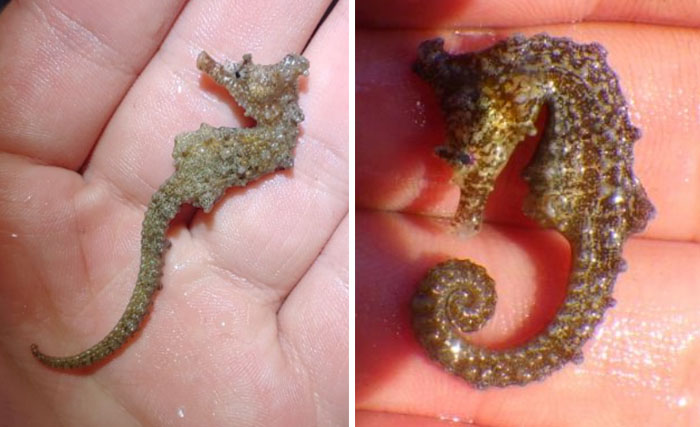 좌우 사진/왕관해마. 사진의 개체는 몸 전체에 돌기가 빽빽이 들어차 있어서 전문 정보들의 해설과 일치하지 않아 보인다. 사진은 신뢰할 수 있는 사이트로 인정할 수 있는 www.naturing.net에 게재된 것이다. 개체가 좀 건조진 결과일까 싶은데 필자는 해마 전문가가 아니어서 설명할 수가 없다. 채집 장소는 한국으로 추측됨. 저자/윤성열 Crowned seahorse(Hippocampus coronatus). The specimen in the photo is densely packed with protrusions all over its body, so it does not seem to match the commentary provided by expert information. However, the photo was posted on www.naturing.net, which is considered a trustworthy site. I wonder if it's the result of the specimens being a bit dry, but I'm not seahorse expert, so I can't explain. The collection location is believed to be Korea. Author of both photos/Yun seong-yeol, 윤성열. Source/www.naturing.net/. (CC BY NC) |
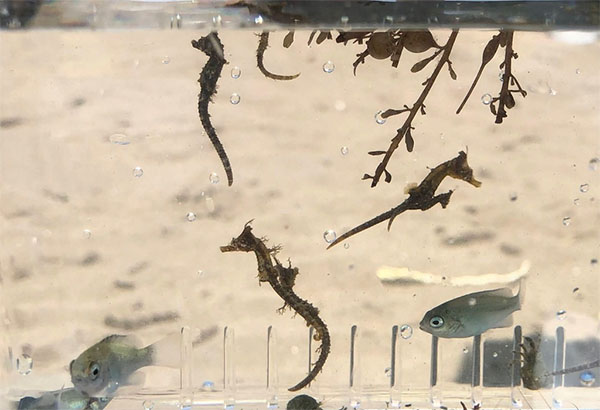 어항 속의 왕관해마 Crowned seahorse(Hippocampus coronatus) in fish tank. Location/Kashiwazaki, Niigata, Japan. Author/ts04 (cc by nc) |
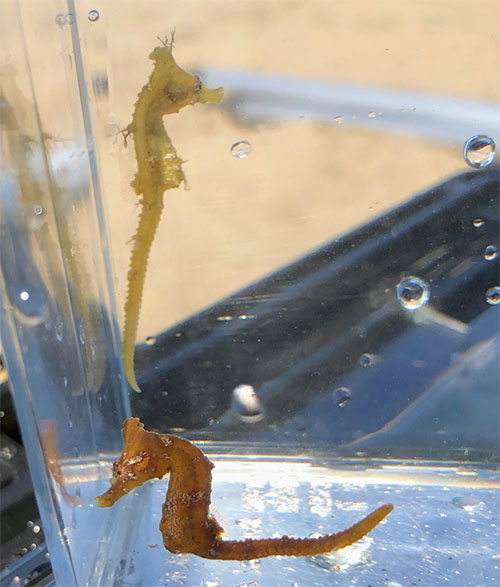 어항 속의 왕관해마 Crowned seahorse(Hippocampus coronatus) in fish tank. Location/Kashiwazaki, Niigata, Japan. Author/ts04. (cc by nc) |
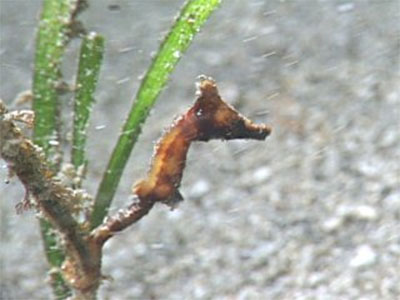 왕관해마 새끼. Juvenile of Crowned seahorse(Hippocampus coronatus). Location/Susaki, Izu, Shizuoka Pref. Japan. Author/Izuzuki diver. (cc by nc) |
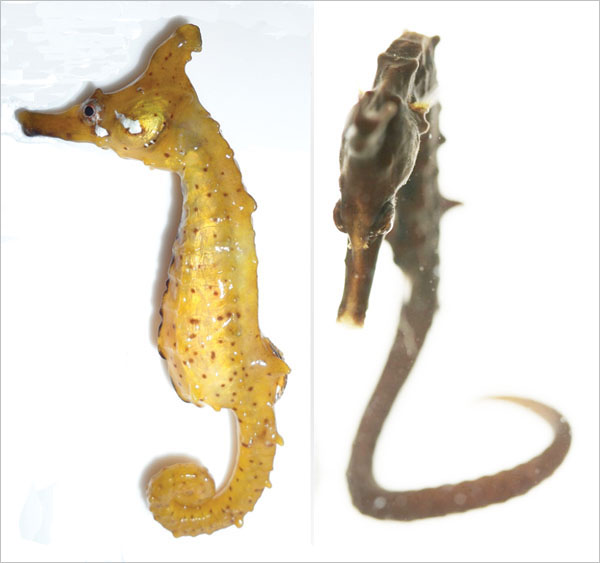 Left/왕관해마. 몸의 검은 점은 없는 경우가 더 많다. Crowned seahorse(Hippocampus coronatus). More often than not, there are no black spots on the body. Author/Han S et al. (cc by nc). Right/해마 정면 모습. Front view of Crowned seahorse(Hippocampus coronatus). Author/Leo D'lion. (cc by nc) |
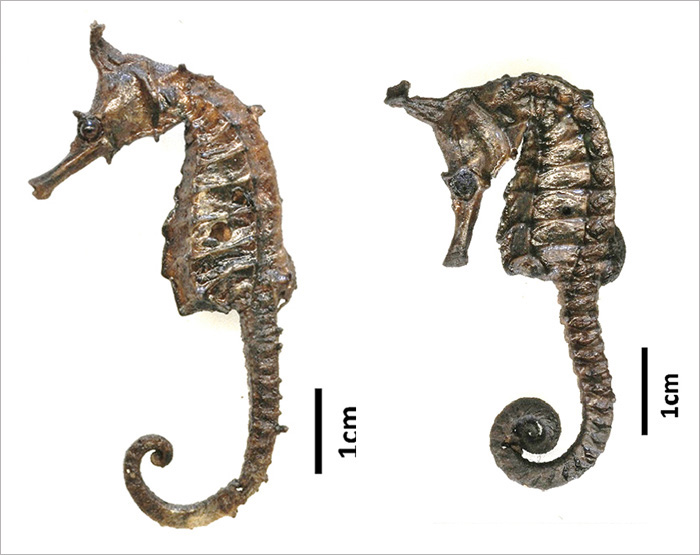 왕관해마 보존 개체. Preserved specimen of Crowned seahorse(Hippocampus coronatus). Author/Han S-Y, Kim J-K, Kai Y, Senou H (2017). (CC BY NC) |
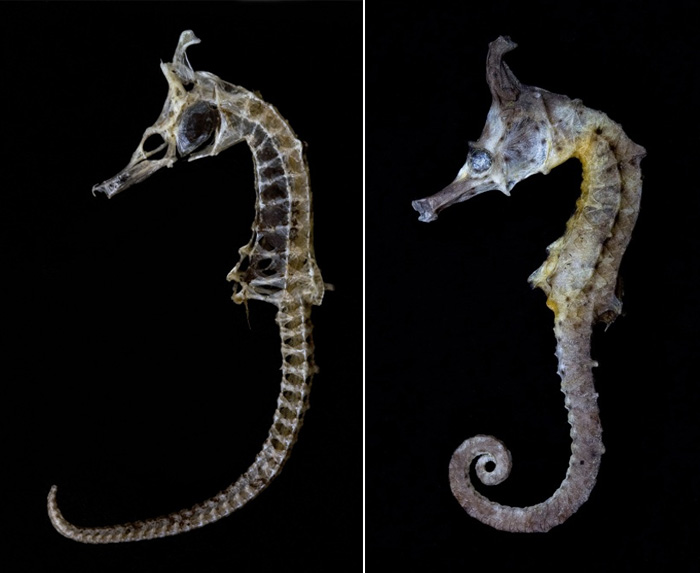 왕관해마의 해골(왼쪽)과 건조된 표본(오른쪽). Skeleton(left) and dried specimen of Crowned seahorse(Hippocampus coronatus). Author/Leo D'lion. (cc by nc) |
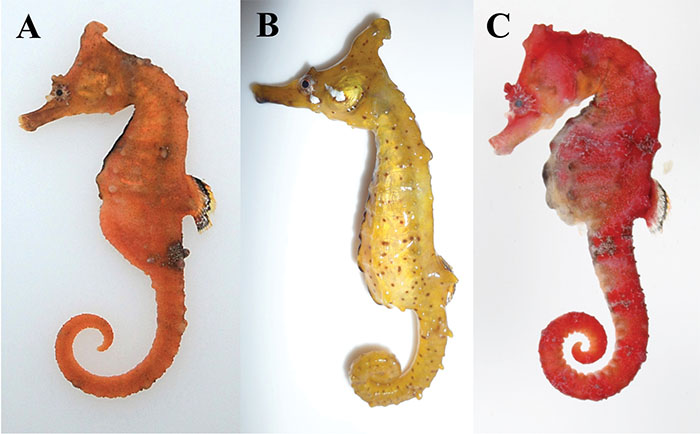 “히포캄푸스 콤플렉스(Hippocampus coronatuscomplex)”에 해당되는 3종. 비교적 신선한 상태에 있을 때의 색상이다. 3 species belonging to the “Hippocampus coronatuscomplex” group. The colors are in relatively fresh state. A/Hippocampus haema(해마). B/Hippocampus coronatus(왕관해마). C/Hippocampus sindonis(신도해마). Author/Han S-Y, Kim J-K, Kai Y, Senou H(2017). (CC BY NC) |
|
|
| Copyright ⓒ FISHILLUST.COM All rights reserved. All contents can not be used without permission of the copyright holder. |


 검색
