
사이트 로그인
사이트 로그인
분류계통/경골상강→조기강→실고기목(Syngnathiformes)→실고기과(Syngnathidae)→복해마 |
Copyright by Kim In Young. 김인영 그림
 [Painting 1] 복해마 수컷의 기본 모습. 색상은 암수 구별과 관계없음. Lateral view of male Spotted seahorse(Hippocampus kuda). Color is not gender-specific. |
Copyright by Kim In Young. 김인영 그림
 [Painting 2] 복해마 수컷 몸의 기본 틀. Lateral view of male Spotted seahorse(Hippocampus kuda). Basic body frame of male Hippocampus kuda. |
Copyright by Kim In Young. 김인영 그림
 [Painting 3] 복해마 암컷의 기본 모습. 색상은 암수 구별과 관계없음. Lateral view of female Spotted seahorse(Hippocampus kuda). Color is not gender-specific. |
Copyright by Kim In Young. 김인영 그림
 [Painting 4] 복해마 암컷 몸의 기본 틀. Lateral view female Spotted seahorse(Hippocampus kuda). Basic body frame of female Hippocampus kuda. |
 |
[4면체의 몸] 해마류의 체형을 입체적으로 잘 보여준 사진, 몸통(머리 이하)과 꼬리 전체가 4면체이며 여러 개의 벽돌 모양 골질판이 연결된 구조이다. 각 이음새는 융기된 경계선을 가지고 있다. 각각의 골질판을 체륜(體輪)이라 부른다. 사진의 개체는 반 건조된 샘플이다. 살아있는 상태에서는 살이나 돌기물이 붙어있고 배가 부른 경우가 많아서 몸의 각진 모서리가 불분명하게 보일 수 있다. 특히 거의 모든 사진들이 정 측면을 향해 찍혀 있어서 몸통이나 꼬리가 둥근 것처럼 인식되기 쉽다. 사진의 해마 이름은 큰배해마(Big-belly seahorse/Hippocampus abdominalis)이지만 종에 관계없이 해마류의 4면체 체형 특징은 모든 해마류에 적용된다. [Tetrahedral body] A photo that clearly shows the body shape of seahorse in three dimensions. The trunk(below the head) and tail are tetrahedral, and are structured with multiple brick-shaped bony plates connected. Each seam has raised ridge border. Each bony plate is called “body ring”. The specimen in the photo is half dried. When alive, they often have flesh or protrusions and bellies are often swollen, so the angled edges of body can be seen unclearly. In particular, almost all photos are images of straight body side, so it is easy to perceive the body or tail as being round. The name of the seahorse in the photo is Big-belly seahorse(Hippocampus abdominalis), but the tetrahedral body characteristics applies to all seahorses regardless of species. Author of the photo/heymilly. Location/Rodney, Auckland, New Zealand. Source/inaturalist. |
실고기목 실고기과 분포; 인도-태평양/남아프리카공화국, 탄자니아, 마다가스카르, 모리셔스, 페르시아만, 홍해 북부, 몰디브, 인도, 스리랑카, 안다만 제도, 태국, 말레이시아, 싱가포르, 인도네시아, 동티모르, 파푸아뉴기니, 호주, 하와이, 프랑스령 폴리네시아(소사이어티 제도),, 팔라우, 필리핀, 홍콩, 대만, 중국, 한국(부산, 마산, 진해), 일본. 대서양(분포 가능성)/브라질의 리우데자네이루, 카리브 해(온두라스, 도미니카, 푸에르토리코). ※복해마는 인도-태평양에 널리 분포하지만 주로 중국에서부터 오스트레일리아에 이르는 해역에 집중적으로 분포한다. 눈은 비교적 크며 주둥이가 가늘어지기 시작하는 부분의 등쪽에 있다. 안경 전방에 가시가 없고 안경 상단의 가시는 끝이 무디어 흔적적이다. 뺨에 1개의 가시가 있다. 주둥이 길이는 눈 뒤 가장자리에서부터 가슴지느러미 기점 사이의 길이보다 짧다. 가슴지느러미는 길이가 짧다. 배지느러미와 꼬리지느러미는 없다. 뒷지느러미는 등지느러미 기저 후단의 반대쪽에 위치하며, 길이는 매우 짧아 흔적적이다. 등지느러미는 몸 전체 길이의 가운데보다 약간 앞부분에 있다. 등지느러미 기저부는 2개 몸통체륜과 1개 꼬리자루체륜을 포함하고 있다. 수컷의 육아낭은 항문 후방의 체륜 7-8개에 걸쳐 형성되어 있다. 육아낭의 복부에 가시가 없다. 살아 있을 때 체색은 검정색, 황색, 연홍색, 연갈색 및 연흑색 등으로 다양하며 아주 작은 흑색 점들이 산재하거나 어두운 반문들이 흩어져 있다. 몸 전체에 짧은 필라멘트들을 털북숭이처럼 뒤집어써서 위장하는 경우도 있다. 성어들은 등지느러미 연조에 작은 흑색 반문들이 몸 길이 방향으로 가는 줄 무늬를 나타낸다. 가슴지느러미와 뒷지느러미는 투명하다. 복해마를 포함해 해마류들은 꼬리 후단을 돌돌 말아서 물체를 잡고 있을 수 있다. 꼬리는 배쪽 방향으로 만 휘어질 수 있는데 이는 골질판이 갖고 있는 저산소근육(hypoxia muscle)의 특성 때문이다. 해마가 골판을 통해 저산소근육에 힘을 가하면 꼬리가 휘어진다. 해마의 해부학적 구조를 더 깊이 이해하는 데는 이러한 근골격계의 기능을 이해하는 것이 도움이 된다. 복해마는 기수, 라군, 내항, 해변, 해안의 해조류 지대에 서식하며 얕은 수심에서부터 55m 수심까지 발견된다. 평상시에 꼬리를 아래로, 머리를 위로 하고 있다. 이 상태로 헤엄도 친다. 복해마의 짝짓기/복해마의 짝짓기 방식은 완전한 일부이처제이다. 짝짓기 전에 특이한 구애 행동을 한다. 수컷은 몸색을 바꾸면서 암컷을 돌면서 춤을 추는데 이 때 정관(coronet)으로 딸깍하는 소리를 낸다. 그 다음 단계는 암수가 서로 꼬리를 감아 몸을 안정시킨 뒤 암컷이 산란관을 통하여 수컷의 육아낭 속으로 알을 집어 넣는다. 한번 짝짓기에서 약 1천개까지의 알을 집어넣을 수 있다. 부화는 20일 내지 28일 정도 후에 된다. 그러나 출산은 몬슨 기후, 음력의 시기, 수온에 따라 크게 좌우된다. 수컷이 새끼를 분만할 때는 대개 만월 시기이다. 갓 나온 새끼의 크기는 평균 7mm이다. 인간에게의 유용성/복해마는 한약재 시장에서 값이 매우 비싸다. 신경계, 생식계, 내분비계 및 면역계를 조절하는 것으로 알려져 있다. 매년 2,500만 마리의 해마가 약용 목적으로 사용되며 가장 큰 수출국은 베트남, 인도, 필리핀 및 태국이다. 복해마 아쿠아리움/복해마는 관상어 시장에서 인기 있다. 해마류는 입이 매우 작아서 브라인쉬림프(Brine Shrimp) 같은 작은 플랑크톤 새우만 먹을 수 있으며 갓 태어난 구피 새끼도 먹는다. 하루에 4-5 번 먹이를 주어야 한다. 애완가들은 브라인쉬림프와 윤충류(rotifers)를 직접 사육하여 먹이로 준다. 먹이가 없을 때는 물벼룩(Daphnia)을 주기도 한다. 해마는 수영 능력이 부족하기 때문에 꼬리로 산호 가지나 해조류 가지에 매달려 대부분의 시간을 보낸다. 따라서 수족관에도 비슷한 고정 점이 필요하다. 해마는 크고 호전적인 물고기가 없고 물이 느리게 움직이는 조용한 탱크를 좋아한다. 복해마는 만다린피시(Synchiropus splendidus, the mandarinfish)나 다른 바닥에 사는 물고기를 탱크 동료를 받아들이는 것으로 관찰되었다. 멸종 위기 평가/복해마는 아직은 흔히 발견되지만(특히 인도네시아와 뉴기니에서) 세계자연보전연맹(IUCN)은 종 보존 위험 등급으로 분류하고 있다. 새우잡이 어업에서는 부수어로 잡히며 관상어와 한약제 시장에서는 의도적으로 남획되기 때문이다. 또한 해마는 재생산이 육아낭 보육 방식이어서 재생산 량이 적다. 이에 더하여 서식지 환경 파괴도 번식에 지장을 주고 있다. 복해마는 “멸종위기종 국제거래협약(CITES)”에 의해서 국제간 거래도 금지되어있다. 복해마의 개체 수는 지난 수십 년간 30%로 줄어들었다. |
Order Syngnathiformes Family Syngnathidae(pipefishes and seahorses) Distribution; Indo-Pacific/South Africa, Tanzania, Madagascar, Mauritius, Persian Gulf, Northern Red Sea, Maldives, India, Sri Lanka, Andaman Islands, Thailand, Malaysia, Singapore, Indonesia, Timor-Leste, Papua New Guinea, Australia, Hawaii, French Polynesia(Society Islands) ), Palau, Philippines, Hong Kong, Taiwan, China, Korea(Busan, Masan, Jinhae), Japan. Atlantic(possible distribution)/Rio de Janeiro, Brazil, Caribbean (Honduras, Dominica, Puerto Rico). ※The Spotted seahorse(Hippocampus kuda) is widely distributed in the Indo-Pacific, but is mainly concentrated in sea areas from China to Australia. Eyes are relatively large and located dorsally where the snout begins to taper. There is no spine in front of eye, and spine on top of eye is vestigial with blunt end. There is one spine on the cheek. Snout length is shorter than the length between posterior margin of eye and origin of pectoral fin. Pectoral fin is short. No pelvic and caudal fins. Anal fin is located opposite the rear end of dorsal fin base, and is very short and rudimentary. Dorsal fin is located slightly ahead of middle of entire body length. Base of dorsal fin contains two body rings and one caudal ring. The male's brood pouch is formed over 7-8 body rings behind the anus. No spines on the ventral side of brood pouch When alive, the body color varies from black, light black, yellow, light red, light brown and with tiny black specks or dark spots scattered throughout. In some cases, they camouflage themselves by covering their entire body with short filaments that look like fur. Some adult fish display small black spots on the soft rays of the dorsal fin, forming a narrow stripe running through the dorsal fin in the direction of its width. Seahorses, including Spotted seahorse, can hold objects by curling the rear end of their tail. The tail can only bend ventrally due to its possession of hypoxia muscle in body plates. The hypoxia muscle is responsible for bending the seahorse's tail. The plates send forces to the hypoxia muscles to ensure bending of the tail. These functions of the musculoskeletal system allow us to understand the anatomy of seahorses in further depth. Spotted seahorse inhabits brackish waters, lagoons, inner harbors, beaches, and coastal algae zones and is found from shallow to 55 m deep. It usually has its tail down and its head up. You can even swim in this state. Reproduction/The mating system of H. kuda is completely monogamous. The species engages in a unique courtship ritual before engaging in mating. The male will change its color patterns and dance around the female and while producing a clicking with the coronet. Eventually, the tails of the male and female intertwine and the female will place her eggs into the male's ventral brood pouch via an ovipositor. There may be up to one-thousand eggs in a singular pouch, where the developmental process can last from twenty to twenty-eight days. Birth, however, depends largely on the monsoon patterns, lunar cycles, and water temperature. Males typically go into labor during a full moon, and after birth, the baby seahorses average a length of seven millimeters. Importance to humans/H. kuda are extremely valuable to the traditional Chinese medicine trade. H. kuda has been said to regulate nervous, reproductive, endocrine, and immune systems. 25 million seahorses are used every year for medicinal purposes. The largest known exporters of H. kuda are Vietnam, India, the Philippines, and Thailand. In the aquarium/H. kuda is a popular species among aquarium keepers. Common seahorses have very small mouths, eating only small animals like brine shrimp and even newborn guppies. Seahorses need to eat approximately 4–5 times daily. Many aquarists who have kept H. kuda cultivate their own brine shrimp and rotifers. Daphnia is eaten when other foods are unavailable. Seahorses spend most of their time anchoring to coral reefs and branches with their tails because they are poor swimmers. They therefore need similar anchor points in the aquarium. Seahorses like a quiet tank, without large, belligerent fish, and a slow-moving current. Aquarists have found them to be generally accepting of tankmates like Synchiropus splendidus and other bottom-dwelling fishes. Conservation status/The species is still commonly encountered(especially in Indonesia and New Guinea) but is currently classified as vulnerable by the IUCN, as populations face some threat from bycatch in the shrimp trawl fishery, targeted catch for the aquarium and traditional medicine trade, and habitat destruction, coupled with low fecundity due to the involved method of parental brood care. Internationally, it is also listed in Appendix II of the Convention on International Trade in Endangered Species of Wild Fauna and Flora (CITES), which means that it is not necessarily threatened with extinction, but its trade must still be controlled in order to avoid utilization incompatible with their survival. Populations of H. kuda have declined by 30% in the last few decades due to pollution, habitat destruction, and illegal trading in Chinese medicine. |
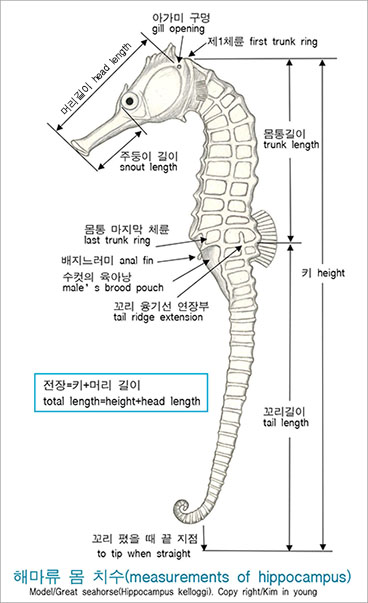
해마류 몸 각 부위 측정하기 Measuring each part of seahorse body |
 복해마 분포도. 복해마는 인도-태평양에 널리 분포하지만 주로 중국에서부터 오스트레일리아에 이르는 해역에 집중적으로 분포한다. 대서양의 표시들은 분포 가능성을 말함. Distribution map of Spotted seahorse(Hippocampus kuda). The Spotted seahorse(Hippocampus kuda) is widely distributed in the Indo-Pacific, but is mainly concentrated in sea areas from China to Australia. Dots in the Atlantic Ocean indicate distribution possibilities. Edited by fishillust.com(Kim in young). source/GBIF. as of March, 2024 |
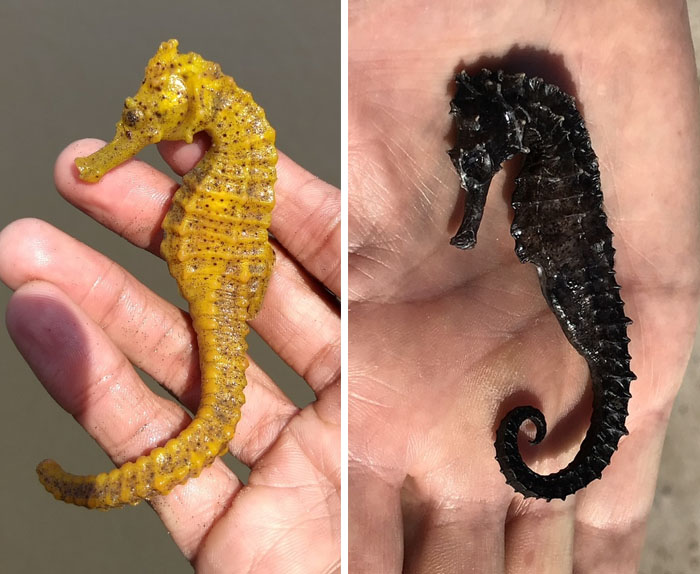 Left/복해마 황색 국면. Spotted seahorse(Hippocampus kuda). Yellow phase. Location/North Goa, India. Author/Abhishek Jamalabad. (CC BY-NC-SA). Right/복해마 흑색 국면. Spotted seahorse(Hippocampus kuda). Black phase. Location/Hawaii County, US. Author/lynnbeittel. (CC BY-NC). |
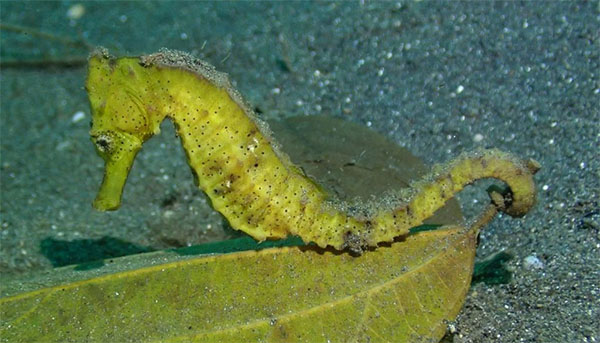 가랑잎의 자루를 꼬리로 잡고 있는 복해마. Spotted seahorse(Hippocampus kuda), holding a stalk of a fallen leaf with its tail. Location/Utara, Sulawesi, Indonesia. Author/Tsu Soo Tan. (CC BY-NC). |
 복해마. 땅 바닥 색과 동일한 색으로 몸색을 위장함. Spotted seahorse(Hippocampus kuda), camouflaging its body color with the same color as the ground. Location/East, Singapore. Author/budak. (CC BY-NC). |

| 복해마. 땅 바닥 색과 동일한 색으로 몸색을 위장함. Spotted seahorse(Hippocampus kuda), camouflaging its body color with the same color as the ground. Location/East, Singapore. Author/budak. (CC BY-NC). |
 복해마. 해조류 식물에 꼬리를 감고 있다. Spotted seahorse(Hippocampus kuda). It is wrapping its tail around algae plants. Location/?. Author/Shallow Reef. (CC BY-NC). |
 복해마. Spotted seahorse(Hippocampus kuda), Location/Bitung, Sulawesi Utara, Indonesia. Author/uwkwaj. (CC BY-NC). |
 복해마. 땅 바닥 색과 동일한 색으로 몸색을 위장함. Spotted seahorse(Hippocampus kuda), camouflaging its body color with the same color as the ground. Location/Manado, Sulawesi Utara, 인도네시아. Author/Franco Colnago. (CC BY-NC). |
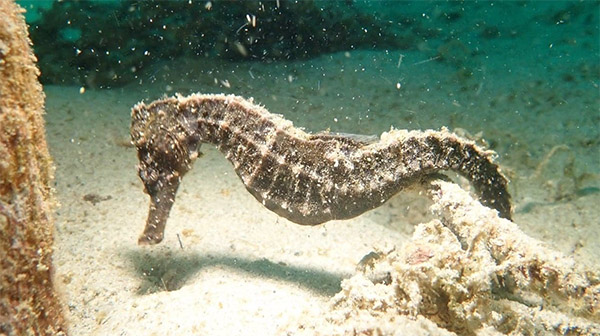 복해마. Spotted seahorse(Hippocampus kuda), Location/Klaeng, Rayong, Thailand. Author/ATMEC Team. (CC BY-NC). |
 복해마. Spotted seahorse(Hippocampus kuda). Location/Bitung, Sulawesi Utara, Indonesia. Author/Rafi Amar. (CC BY-NC). |
 복해마. Spotted seahorse(Hippocampus kuda). Left/Location; Honolulu County, Hawaii, United States. Author/kanzo. Right/Location; Vilanculos, Inhambane, Mozambique. Author/gilroytaryn. (CC BY-NC). |
 복해마. Spotted seahorse(Hippocampus kuda). Left/Location; Honolulu County, Hawaii, United States. Author/David R. (CC BY-NC). Location; Honolulu County, Hawaii, United States. Author/kanzo. Right/Location; Vilanculos, Inhambane, Mozambique. Author/monikaward. (CC BY-NC). |
 복해마. Spotted seahorse(Hippocampus kuda). Location/Bitung, Sulawesi Utara, Indonesia. Author/David R. (CC BY-NC). |
 복해마. Spotted seahorse(Hippocampus kuda). Location/Mozambique. Author/carel van der Colff. (CC BY-NC). |
 복해마. Spotted seahorse(Hippocampus kuda). Location/Lungalunga, Kwale, Kenya. Author/Ewout Knoester. (CC BY-NC). |
 복해마와 수중사진가. Spotted seahorse and underwater photographer. Location/Rayong, Thailand. Author/ATMEC Team. (CC BY-NC). |
 복해마와 날치(날치과). Spotted seahorse and a flyingfish. Location/Atsimo-Andrefana, Toliary, Madagascar. Author/ATMEC Team. (CC BY-NC). |
| text on preparation |


|
| Copyright ⓒ FISHILLUST.COM All rights reserved. All contents can not be used without permission of the copyright holder. |


 검색
