
사이트 로그인
사이트 로그인
|
분류계통/경골상강→조기강→실고기목(Syngnathiformes)→실고기과(Syngnathidae)→점해마 Copyright by Kim In Young. 김인영 그림
|
Copyright by Kim In Young. 김인영 그림  [painting 1]. 점해마 암컷의 기본 모습. 색상은 암수 구별과 관계 없음. Lateral view of female Longnose seahorse(Hippocampus trimaculatus). Color is not gender-specific. |
Copyright by Kim In Young. 김인영 그림
 [painting 2].점해마 암컷 몸의 기본 틀. Body frame of female Longnose seahorse(Hippocampus trimaculatus). |
Copyright by Kim In Young. 김인영 그림  [painting 3]. 점해마 수컷의 기본 모습. 색상은 암수 구별과 관계 없음. Lateral view of male Longnose seahorse(Hippocampus trimaculatus). Color is not gender-specific. |
Copyright by Kim In Young. 김인영 그림
 [painting 4]. 점해마 수컷 몸의 기본 틀. Body frame of male Longnose seahorse(Hippocampus trimaculatus). |
 [painting 5]. 점해마의 특징 중 하나는 암수 모두 등에 3개의 흑점이 있는 것이라고 말해지고 있다. 그러나 인터넷의 많은 사진 자료들을 보면 이 점 무늬가 없는 경우가 훨씬 더 많은 것으로 관찰된다. One of the characteristics of the Longnose seahorse(Hippocampus trimaculatus) is that both sexes have three black spots on their backs. However, looking at many photo materials on the Internet, it is observed that there are many more cases where this dot pattern is not present. The image above is of a male. |
 |
[4면체의 몸] 해마류의 체형을 입체적으로 잘 보여준 사진, 몸통(머리 이하)과 꼬리 전체가 4면체이며 여러 개의 벽돌 모양 골질판이 연결된 구조이다. 각 이음새는 융기된 경계선을 가지고 있다. 각각의 골질판을 체륜(體輪)이라 부른다. 사진의 개체는 반 건조된 샘플이다. 살아있는 상태에서는 살이나 돌기물이 붙어있고 배가 부른 경우가 많아서 몸의 각진 모서리가 불분명하게 보일 수 있다. 특히 거의 모든 사진들이 정 측면을 향해 찍혀 있어서 몸통이나 꼬리가 둥근 것처럼 인식되기 쉽다. 사진의 해마 이름은 큰배해마(Big-belly seahorse/Hippocampus abdominalis)이지만 종에 관계없이 해마류의 4면체 체형 특징은 모든 해마류에 적용된다. [Tetrahedral body] A photo that clearly shows the body shape of seahorse in three dimensions. The trunk(below the head) and tail are tetrahedral, and are structured with multiple brick-shaped bony plates connected. Each seam has raised ridge border. Each bony plate is called “body ring”. The specimen in the photo is half dried. When alive, they often have flesh or protrusions and bellies are often swollen, so the angled edges of body can be seen unclearly. In particular, almost all photos are images of straight body side, so it is easy to perceive the body or tail as being round. The name of the seahorse in the photo is Big-belly seahorse(Hippocampus abdominalis), but the tetrahedral body characteristics applies to all seahorses regardless of species. Author of the photo/heymilly. Location/Rodney, Auckland, New Zealand. Source/inaturalist. |
실고기목 실고기과 분포; 인도-서태평양, 남중부태평양/한국 남부의 여수와 제주도, 동해의 울릉도, 일본 홋카이도 이남의 태평양 연안, 유구열도, 중국, 대만, 필리핀, 베트남, 태국, 말레이시아, 미얀마, 인도네시아, 인도 남부와 서북부, 이란(페르시아 만), 오스트레일리아, 남중부 태평양의 프랑스령 타히티 섬. 머리와 몸통은 옆으로 약간 납작하고 등면은 지붕 기왓장을 1열로 이어놓은 것처럼 편평하다. 등지느러미 이후의 꼬리는 4각목이 구부러진 형이며 4각형 벽돌들이 연결되어 있는 모양새다. 꼬리 끝으로 물체를 감아 쥘 수 있는 기능을 가졌다. 코일처럼 말려 있는 꼬리 끝은 불가피한 경우가 아니면 펴지지 않는다. 주둥이는 관 모양으로 길다. 주둥이 길이는 눈 뒤 가장자리에서부터 가슴지느러미 기부 사이의 거리와 비슷하다. 주둥이 가시와 눈앞 가시가 없다. 눈 위 가시는 작지만 분명하게 있고 납작하다. 뺨에 갈고리 모양의 발달한 가시가 1개 있다. 체색은 서식환경에 따라 다양하다. 살아있을 때 몸색은 금빛 오렌지색, 황갈색, 모래 색, 연적색, 암갈색, 연녹색. 진한 흑색 등으로 다양하다. 1번, 4번, 7번 체륜의 등쪽에 큰 흑색 점을 가질 때가 있으며 암컷 보다는 수컷에서 이 점 무늬가 더 자주 나타나며 몸색이 검은 경우에는 이 점이 잘 보이지 않는다. 몸 전체가 갈색과 백색이 교차하는 제브라 무늬를 나타내는 경우도 있다. 수컷의 육아낭 부분은 몸색과 동일하지만 색이 연하다. 여러 설명들에서 등쪽의 검은 점 3개가 이 종의 특징인 것으로 말하고 있지만 이 특징을 안 가지고 있는 것들이 훨씬 더 많다. 등지느러미는 1개이다. 등지느러미 기부는 2개의 몸통 체륜과 1번 꼬리 채륜에 의하여 지지되고있다. 등지느러미 기부 체륜의 가시는 발달하여 있다. 가슴지느러미는 작다. 배지느러미와 꼬리지느러미가 없다. 나머지 등지느러미, 가슴지느러미, 뒷지느러미는 무색 투명하다. 뒷지느러미는 등지느러미 기저부 중심 건너편에 위치하며 매우 작아서 흔적적이다. [Habitat, Reproduction]. 연안 정착성 어류로 수심 10m 이내에서 잘 발견되며 최대 100m 수심에서도 발견된다. 해조가 자라고 있는, 자갈, 펄, 모래바닥에 서식한다. 깊은 수심에서는 펄 바닥에서 발견된다. 기수에서도 살 수 있다 홀로 또는 쌍으로 있을 때가 많다. 난태생이다. 수컷이 꼬리에 있는 육아낭에 알을 보관하면서 부화시킨다. 번식기는 연중이며 3월과 5월 그리고 10월이 피크 시즌이다. 알의 지름은 약 1 mm, 부화 기간은 평균 16일, 갓 태어난 새끼는 평균 6 mm 크기이다. 한번에 낳는 알 수는 최대 1,783개를 기록했다. 먹이는 플랑크톤과 작은 갑각류이며 주둥이를 빨대처럼 이용해서 순식간에 흡입해 먹는다. 해조류에 꼬리를 감아 매달려 있기를 좋아하는데 이는 에너지를 절약하면서 먹이 활동을 하기 위한 것이다. [Vulnerability]. 점해마는 국제자연보전연맹(IUCN) 지정 국제 멸종 취약종이다. 원인은 여러 가지가 있지만 그 중 가장 큰 원인은 국제적으로 연간 수백만 마리가 매매되고 있는 해마류 거래에 점해마도 포함되어 있다는 점이다. 해마류는 해마 잡이 외에 다른 어로 작업에서도 부수어로 많이 잡힌다. 해마류는 중국의 한약재로 사용된다. 대개 말려서 상품이 되며 장식용 선물로도 많이 팔린다. 또한 산 것은 관상어로 매매된다. CITES(멸종위기 야생동식물 무역 제한 협약)는 해마의 국제 거래 규제를 권고하고 있으며 10 cm 이내 크기는 규제를 강하게 하도록 유도하고 있다. 한국에서도 해양수산부 지정 해양보호생물이다. |
Order Syngnathiformes Family Syngnathidae(pipefishes and seahorses) Distribution; Indo-West Pacific, South Central Pacific/Korea's Yeosu(city), Jeju Island in south sea and Ulleungdo(Island) in East Sea, Japan's Pacific coasts south of Hokkaido, Yugu Islands, China, Taiwan, Philippines, Vietnam, Thailand, Malaysia, Myanmar, Indonesia, southernmost and northwestern India, Iran(Persian Gulf), Australia, French Tahiti Island The head and body are slightly flat on the sides, and the dorsal surface is flat like a row of roof tiles connected together. And the tail after the dorsal fin is shaped like a curved square bar that composed of series of square bricks. The tail is prehensile, and can be unlocked only in the most extreme conditions. The snout is long and tube-shaped. The length of the snout is similar to the distance between the rear edge of the eye and the base of the pectoral fin. No snout spine, no spine on anterior eye. The spine above the eye is clearly present and flat. One well developed hook-shape spine below the cheek. Body color varies depending on habitat. Color when alive, with golden orange, brown, dark brown, sandy coloured, reddish, greenish or totally black. May have large dark spots on the dorso-lateral surface of the first, fourth and seventh trunk rings(less visible in dark specimens, and more common in males than females); some specimens zebra-striped in brown and white. The color of male's brood pouch is the same as the body color, but lighter. Many descriptions say that the three black spots on the back is a “constant” feature of this species, but there are many, many more that do not have this feature. Has single dorsal fin. The base of the dorsal fin is supported by two trunk rings and one caudal ring. The trunk ring spines on the dorsal fin base are developed. The pectoral fin is small. There are no pelvic and caudal fins. The rest dorsal fin, pectoral fin, and anal fin are transparent. The anal fin is located across the middle of the dorsal fin base and is very small and vestigial. [Habitat, Reproduction]. It is a coastal benthic fish that is commonly found within 10m depth and up to 100m depth. It lives on gravel, mud, and sandy bottoms where seaweed grows. In deep water, it is found at the muddy bottoms. It can tolerate brackish waters. Occur singly or in pairs. Ovoviviparous. The male carries the eggs in a brood pouch which is found under the tail. Breeding season year round, peaking March to May and in October; egg diameter averages 1 mm; gestation duration averages 16 days; length at birth averages 6 mm. Its diet consists of plankton and small crustaceans that get sucked in through its snout. This species likes to anchor itself to sea grass while feeding in order to save energy, which is a typical seahorse behavior. [Vulnerability]. H. trimaculatus is listed as Vulnerable by IUCN13. Its vulnerability is due to a few factors. One large factor is that Longnose seahorse make up some of the millions of seahorses traded internationally each year, and they are frequently bycatch. Seahorses are frequently harvested and used in traditional Chinese medicine; they are commonly dried and sold as souvenirs in the United States; and they are sold as pets throughout the world. These practices have led the Convention on International Trade in Endangered Species of Wild Fauna and Flora (abbreviated CITES) to suggest restrictions on the seahorse trade. Though these restrictions are not binding, traders must abide by them to be certified as sustainable. The most relevant restriction is that no seahorse under 10cm can be harvested. In Korea, it is also a marine protected organism designated by the Ministry of Oceans and Fisheries. |
 점해마 분포도. Distribution map of Longnose seahorse(Hippocampus trimaculatus). Main Ref/GBIF.(included Korean data). Edited by Kim in-young. |
 Left/점해마 보관 개체. ※점해마의 특징이라고 알려진 등의 3개 흑점이 보인다. 그러나 인터넷 검색에서 수 많은 사진 중 이 특징이 나타나 있는 개체는 매우 희귀하다. ※ Preserved specimen of Longnose seahorse(Hippocampus trimaculatus). Author/ Lourie, S.A( Project Seahorse). (CC BY NC). ※Three black spots on the back, which are known to be characteristic of Longnose seahorse, are visible. However, among the numerous photos searched on the Internet, specimen showing this feature is very rare. Right/점해마. Longnose seahorse(Hippocampus trimaculatus). Location/Klaeng, Rayong, Thailand. Author/Phakawat Kittikhunodom). (CC BY NC)
|
 점해마. Longnose seahorse(Hippocampus trimaculatus). Location/Bitung, Sulawesi Utara, Indonesia. Author/craigjhowe. (CC BY NC) |
 점해마. Longnose seahorse(Hippocampus trimaculatus). Location/Bitung, Sulawesi Utara, Indonesia. Author/craigjhowe. (CC BY NC) |
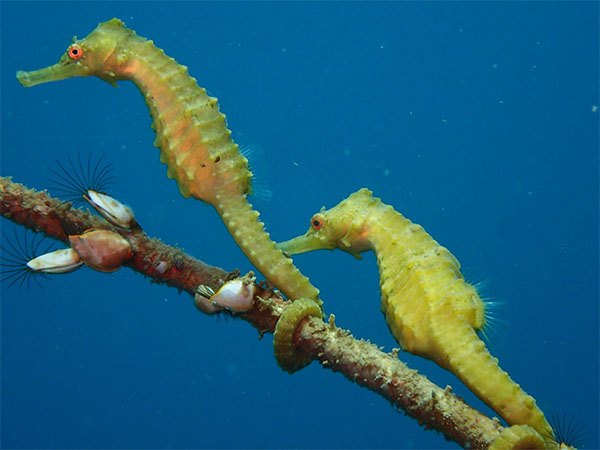 점해마. Longnose seahorse(Hippocampus trimaculatus). Location/Ko Phangan, Surat Thani, Thailand. Author/ATMEC(Aow Thai Marine Ecology Center). (CC BY NC) |
 제브라 무늬를 가진 점해마. Longnose seahorse(Hippocampus trimaculatus) with zebra patterns. Location/Mambajao, Camiguin, Philippines. Author/Franca Wermuth. (CC BY NC) |
 제브라 무늬를 가진 점해마. Longnose seahorse(Hippocampus trimaculatus) with zebra patterns. Location/Mambajao, Camiguin, Philippines. Author/Franca Wermuth. (CC BY NC) |
 ※ 참고 사진/제브라 해마(Zebra seahorse). 학명; Hippocampus zebra. 오스트레일리아 고유종. 제브라 무늬를 가진 점해마와 혼동하지 말 것. ※ Reference photo/Zebra seahorse(Hippocampus zebra), endemic to Australia. Not to be confused with the zebra-patterned Longnose seahorse(Hippocampus trimaculatus). Author/Mark Allen. Rights holder/Australian Museum. |
 왼쪽/손가락으로 쥔 점해마. 측면을 보여 줌. 오른쪽/복부 쪽을 보여줌. Left/Longnose seahorse(Hippocampus trimaculatus). Held by fingers, showing body side. Right/showing ventral side. Location/Klaeng, Rayong, Thailand. Author/Niran Anurakpongsathorn. (CC BY NC) |
 점해마. Longnose seahorse(Hippocampus trimaculatus). Left; Location/Buleleng, Bali, indonesia. Author/uwkwaj. Right; Location/Klaeng, Rayong, Thailand. Author/ATMEC Team. (CC BY NC) |
 점해마. Longnose seahorse(Hippocampus trimaculatus). Left; location/Bitung, Sulawesi Utara, Indonesia. Author/craigjhowe. (CC BY NC). Right; location/Bitung, Sulawesi Utara, Indonesia. Author/Dan Schofield. (CC BY NC) |
 점해마. Longnose seahorse(Hippocampus trimaculatus). Location/Sai Kung, Hong Kong. Author/dave2811. (CC BY NC) |
| text on preparation |


|
| Copyright ⓒ FISHILLUST.COM All rights reserved. All contents can not be used without permission of the copyright holder. |


 검색
