Order Beloniformes Family Exocoetidae(Flyingfishes)
Bony flyingfish
Hirundichthys oxycephalus(Bleeker, 1853). max length/25cm TL
Korean name/ga-neun-mae-nal-chi(가는매날치)
Japanese name/ホソアオトビ(Hoso-ao-tobi)
Chinese name/尖頭細身飛魚(첨두세신비어), 尖头燕鳐鱼(첨두연요어)
D/Soft ray 10. A/soft ray 11~12. P1/ⅰ,14~16. P2/6. Lateral line scales/51~56. Vert/45. Gill rakers/7~9 +21~23 = 29~32. Pred. S/33~34
Distribution; Indo-Pacific/South Sea of Korea, Chiba Prefecture of Honshu and Kagoshima Prefecture of Southern Japan, Taiwan, East and South China Seas, Philippines, Sri Lanka, Eastern Indonesia, Papua New Guinea, Solomon Islands, Northwest to East Australia, Arabian Sea, Distant waters southeast of Madagascar. Pacific waters off Mexico in the eastern Pacific.
General; The body is elongated, slightly compressed cylindrical shape and thinner than other congener flying fishes. The body length is 3.9-4.2 times the head length and 5.8-6.4 times the body height. The snout is blunt and short, shorter than eye diameter. Inter orbital space wider than eye diameter. The mouth opens toward the front at the tip of the snout. Upper and lower jaws approximately equal in length, both jaws with 1 row of small teeth on anterior part, palatine bone without teeth. Rear end of upper jaw reaches in front of eye. Two pairs of nostrils, large in shape, close to the eyes. Gill slit wide, gill membrane free in throat isthmus. The swim bladder is large and extends backward, the intestine is simple, without pylorus and caecum. Body covered with deciduous round, large, thin scales. The head is partially scaled. Lateral line very low, close to ventral margin, straight, unbranched at thorax. Number of scales between the origin of dorsal fin and lateral line is 5-6.
Dorsal fin without spines, located at posterior back of the body, no black spot on the fin membrane. The origin of the anal fin is located in almost the same position as the origin of the dorsal fin. The end of pectoral fin reaches the posterior end of the dorsal fin, the 1st fin ray is not branched, and the rest branched. The pectoral fins are uniformly dark without patterns, but the rear edge is transparent and colorless. Pelvic fin is long, the end reaches at middle basal part of anal fin base, and the front half is light colored, the rear part is dark. Caudal fin is well developed, deeply split, and the lower lobe is longer than upper lobe.
Migratory fish species live in the surface water layer of offshore or shallow seas. When frightened, it will use its specialized pectoral fins to jump out of the water for long-distance gliding. It mainly feeds on plankton such as copepods and amphipods. The egg masses produced have sticky filaments, which can be attached to drifts or benthic algae. Migrating within oceans typically between spawning and different feeding areas, as tunas do. Migrations should be cyclical and predictable and cover more than 100 km. Taking Taiwan as an example, the main fishing season is spring and summer when Kuroshio arrives on the southeast coast of Taiwan. It is caught with drift nets or fixed nets, and objects such as woven mats are used to collect flying fish eggs. Adult fish is suitable for stewing or soup and can be eaten dried, and fish roe can be used for salting and has a good flavor. The catch is relatively abundant and it is the main fish species producing flying fish roe.
|

 가는매날치 분포도. Distribution map of Bony flyingfish(Hirundichthys oxycephalus). Main Ref. GBIF. Author/fishillust.com
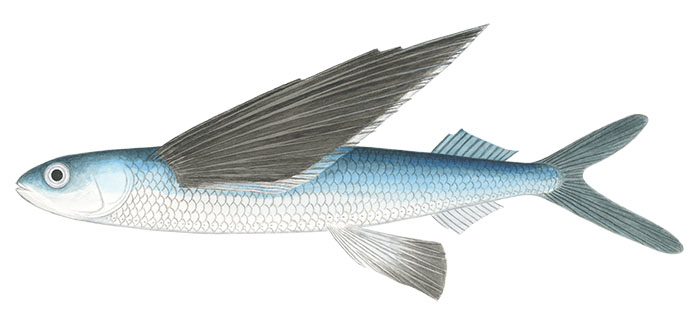
 가는매날치 묘사도. Illustration of Bony flyingfish(Hirundichthys oxycephalus). Author/fao
 가는매날치 죽은 개체 사진. Dead specimen of Bony flyingfish(Hirundichthys oxycephalus). Author/Australian National Fish Collection, CSIRO, by-nc-sa/4.0/
 가는매날치 죽은 개체 사진. Dead specimen of Bony flyingfish(Hirundichthys oxycephalus). Author/ Williams, Jeffrey T. Publisher/Smithsonian Institution, NMNH, Fishes. Philippines FDA market survey.
 가는매날치 죽은 개체 사진. Dead specimen of Bony flyingfish(Hirundichthys oxycephalus). Author/©臺灣魚類生態進化研究室

 가는매날치 보존 표본. Preserved specimen of Bony flyingfish(Hirundichthys oxycephalus). Author/ Raphael Al Muhana(Rights holder/Australian Museum). CC-BY 3.0(Au)




 검색
